

Hiking and working dog harness equipment is chest-worn kit with the aim of controlling a dog without concentrating lead pressure at the neck. A military dog harness adds webbing, attachment points and working-kit styling, but the term does not represent a recognised safety or performance standard in 2026.
- A military dog harness is a style, not a recognised safety or performance standard.
- Y-front harnesses suit active hiking dogs because they leave the shoulders comparatively free.
- MOLLE vest harnesses suit working dogs carrying light, balanced accessories.
- Military Mart is best for practical dog leads, identification gear and working-dog accessories alongside a properly fitted harness.
Why a military dog harness matters for hiking and working dogs
Hiking dogs need freedom through the shoulders, secure lead control and straps that do not rub during a long day. Working dogs need the same basic fit, but attachment points, a grab handle or removable pouches can also matter.
A military-style appearance tells you very little on its own. Camouflage fabric, hook-and-loop panels and MOLLE rows can look the part while hiding weak stitching, rough strap edges or poor adjustment. Fit and construction matter more than colour.
Your dog's task should therefore decide the harness. A lightly built hiking dog moving over open ground needs different kit from a working dog wearing a harness for repeated handling. The lead matters too, and this guide to army surplus dog leads and collars made from webbing explains the adjacent kit.
In 2026, the sensible buying order is straightforward: measure the dog, choose the harness shape, inspect the stitching, check every attachment and test it under normal movement. Do not start with a camo pattern and work backwards.
Measure your dog while it is standing
Use a soft tape and follow the sizing points specified by the harness manufacturer. Do not use breed, age or body weight as a substitute for actual measurements; dogs of the same breed can have different chest depth and proportions.
Measure over the coat the dog will normally wear under the harness. A thick winter coat, waterproof dog jacket or clipped summer coat can change the working fit. Record the measurements rather than relying on memory when comparing size charts.
- Measure the deepest part of the ribcage behind the front legs
- Measure the lower neck where the front straps will sit
- Check chest length if the maker requests it
- Compare every measurement with the maker's current chart
- Choose another model if the dog falls between incompatible dimensions
Match the harness shape to the dog's task
A harness should support the activity rather than simply look tactical. Y-front models are usually the cleanest starting point for hiking because the straps sit around, rather than straight across, the front of the shoulders. H-back models add structure and adjustment, while vest designs create space for handles, identification and modular attachments.
Pack harnesses are a separate category. They need stable, balanced bags and careful loading; empty MOLLE webbing does not automatically make an ordinary vest suitable for carrying weight.
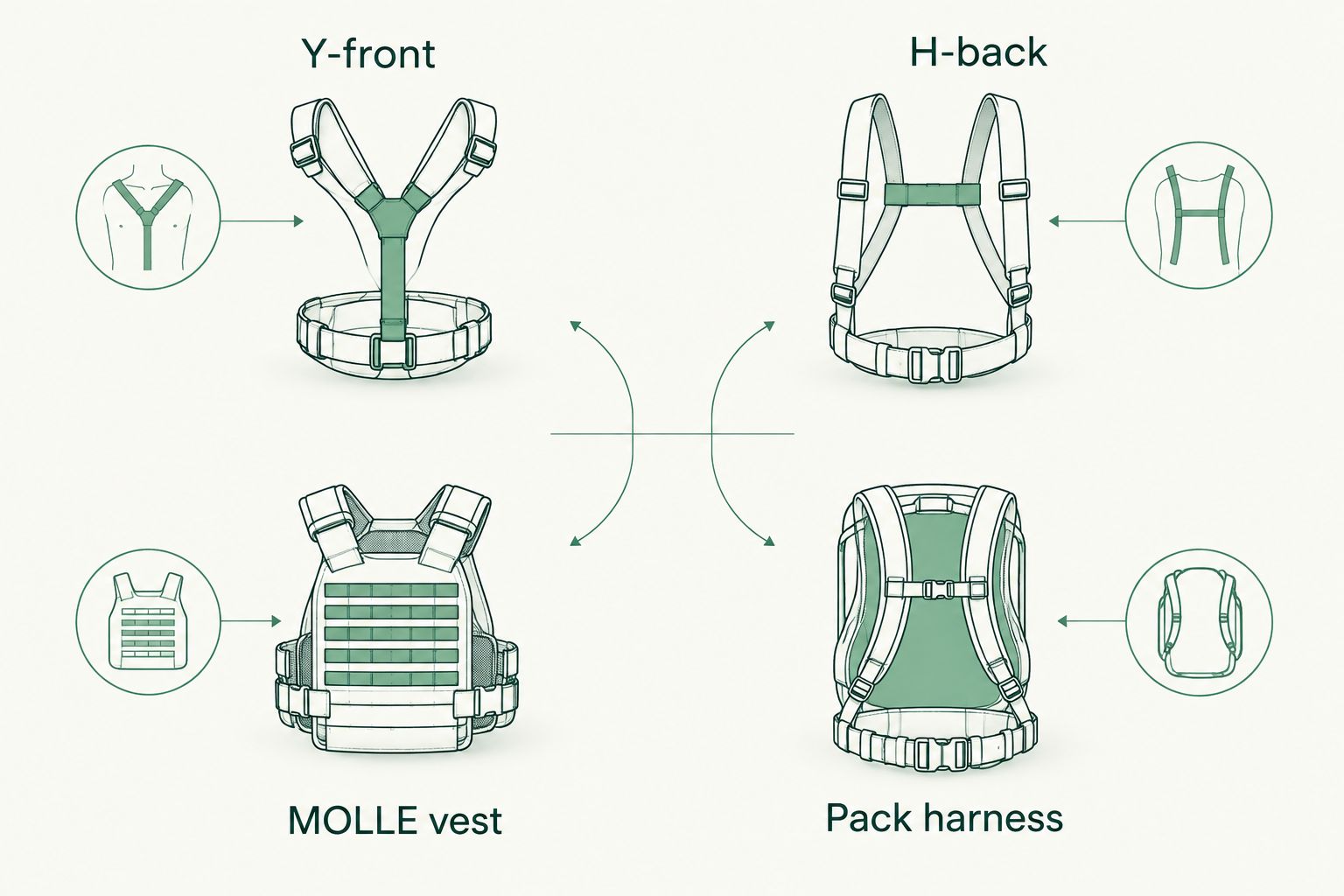
- Choose a Y-front for active hiking and unrestricted movement
- Choose an H-back when broad adjustment matters
- Choose a MOLLE vest for identification and light accessories
- Choose a pack harness only when it is designed to stabilise side loads
- Skip rigid or bulky panels that interfere with the dog's normal stride
Inspect the webbing, seams and edges
Turn the harness over before judging it. The underside is where folded webbing, exposed thread ends and rough binding can contact the dog's coat and skin. Padding helps only when it sits flat, dries properly and does not conceal the structural seams.
Look closely at every point where a buckle, lead ring or handle joins the body. Box stitching and repeated bar tacks spread stress across more thread than a single straight seam, but even good-looking stitching needs checking for skipped, cut or loose sections.
Military Mart deals in surplus and outdoor kit where condition and grading matter. Apply the same approach to a military dog harness in 2026: inspect the actual item, not just the category name.
- Check load points for box stitching or repeated bar tacks
- Reject webbing with cuts, melted edges or deep abrasion
- Feel the inner edges for hard seams and rough binding
- Check that padding lies flat without bunching
- Treat used harnesses as used safety kit and inspect every component
Check the buckles, rings and handle
Metal is not automatically better than plastic. A heavy metal fitting can add unnecessary weight, while an unmarked decorative fitting can still fail. The useful question is whether every buckle and ring is specified for the harness and secured by sound stitching.
A top handle can help you steady a dog at a stile, gate or vehicle. It should not be treated as permission to lift a dog by the harness unless the manufacturer explicitly says the harness supports lifting.
If you add identification or a handler patch, place it where it remains visible without covering adjustment points. Military Mart carries working-dog accessories, but accessories cannot correct a loose or badly shaped harness.
- Open and close every buckle before the first walk
- Pull each ring in the direction the lead will load it
- Check that the top handle is anchored into the main structure
- Keep identification clear of clips and adjustment sliders
- Follow the maker's instructions before using any lifting point
Test movement before taking a long route
Fit the harness indoors, then watch the dog walk, turn, sit and lie down. The front straps should remain clear of the throat, while the rear straps should stay away from the soft area directly behind the front legs.
Use the manufacturer's fitting allowance rather than applying one universal finger rule. Padding thickness, webbing width and coat depth all change how much space feels correct. A fit that is secure on one model can be loose on another.
Repeat the check during a short local walk before using the harness on a hill day or working session. In 2026, this remains the quickest way to find twisting, rubbing or buckle movement without discovering it miles from the vehicle.
- Watch both shoulders through a full walking stride
- Check whether the chest piece rotates when the lead tightens
- Make sure no strap moves onto the throat
- Inspect the coat and skin after the test walk
- Stop using the harness if the dog changes gait or shows discomfort
Add pouches without unbalancing the harness
MOLLE rows make attachment easy, but they do not remove the need to balance a load. One pouch placed on one side can rotate the vest, pull a strap towards the elbow and change how the lead ring sits.
Start with the harness empty. Add only kit needed for the specific walk or task, and keep paired items balanced across both sides. Water is better carried by the handler unless the harness is a purpose-built dog pack with guidance for loading it.
- Keep identification separate from load-carrying pouches
- Place matching items at the same height on both sides
- Keep hard objects away from the ribs and elbows
- Remove unused pouches rather than carrying empty bulk
- Recheck strap position whenever the load changes
Clean and inspect the harness after use
Mud and grit collect around sliders, stitching and folded webbing. Cleaning makes wear easier to see, but harsh heat can affect webbing, coatings, padding and plastic parts.
Follow the care label. Remove detachable pouches, brush away dry grit and allow the harness to dry fully before storing it. Do not hide damage with tape or glue at a load-bearing seam.
A 2026 inspection routine should cover the whole setup, including the harness, lead, identification and any pouch attachments. The Jack Pyke lead listed below uses 10 mm soft braided nylon, which also needs checking where the material enters the stitched joint.
- Follow the maker's washing and drying instructions
- Clear grit from buckles and adjustment sliders
- Inspect stitching while the harness is clean and dry
- Replace damaged load-bearing parts instead of patching them
- Refit the harness after coat or body-condition changes
Harness options compared
The best option depends on whether the dog is moving freely, pulling steadily, carrying accessories or transporting a purpose-designed load. No single military-style harness covers every role well.
| Option | Best for | Main advantage | Key limitation |
|---|---|---|---|
| Y-front harness | Hiking dogs and active trail walks | Leaves the front of the shoulders comparatively open | Usually has limited space for pouches or patches |
| H-back harness | Dogs needing several adjustment points | Can provide a stable, adaptable fit | More straps create more possible rub points |
| MOLLE vest harness | Working dogs needing visible ID or light accessories | Provides modular attachment space | Added bulk can trap mud and shift if loaded unevenly |
| Pack harness | Multi-day routes requiring dog-carried kit | Designed around balanced side storage | Needs careful loading and is excessive for ordinary walks |
| Basic step-in harness | Short walks and simple lead control | Quick to put on when correctly sized | Offers little working-kit attachment space |
For most hiking dogs, a clean Y-front design is the best starting point; for working dogs needing identification or light accessories, a properly fitted MOLLE vest is the better tool. Choose a pack harness only for genuine load carrying.
Relevant Military Mart dog kit
These items support a hiking or working-dog setup, but neither replaces a correctly measured harness. The slip lead provides a separate handling option, while the patch identifies a dog-handler role.


Military Mart is best for handlers who need a webbing lead, identification gear and working-dog accessories alongside a separately fitted military dog harness. The limitation is clear: a lead, patch or pouch cannot make an unsuitable harness fit correctly.
Common mistakes hiking and working dog owners make
Buying the appearance instead of the construction
Camouflage fabric and MOLLE rows are visual features. They do not prove the quality of the webbing, buckles or seams. Inspect the underside and every load point before trusting the harness outdoors.
Sizing from breed or weight alone
Breed labels are too broad for precise fitting. Measure the individual dog and compare those figures with the specific manufacturer's chart.
Blocking shoulder movement
A wide horizontal strap across the front of the shoulders can restrict the dog's natural stride. Watch the dog walking from the side and front rather than judging fit while it stands still.
Adding too much kit
A military dog harness can become a hanging platform for pouches, patches, lights and tags. Extra items add bulk, create noise and can shift the vest. Carry non-essential kit in your own rucksack.
Using the handle as a lifting sling
A grab handle helps with close control. It is not necessarily designed to support the dog's full body weight, so follow the manufacturer's stated use.
FAQ
What is the best military dog harness for hiking?
A well-fitted Y-front harness is the best starting point for most hiking dogs because it keeps the front of the shoulders comparatively open. Check the individual manufacturer's sizing and inspect for rubbing during a short test walk.
What is the best harness for a working dog?
A structured H-back or MOLLE vest harness is best when a working dog needs secure identification, a handle or light accessories. Choose fit and construction before attachment count or camouflage pattern.
Is a military dog harness better than a normal harness?
No, the military-style label does not make a harness safer or stronger. Webbing quality, stitching, hardware, shape and correct fitting decide whether it works for the dog.
Can a dog carry pouches on a MOLLE harness?
A dog can carry light, balanced accessories only when the harness is designed for attachments. Use a purpose-built pack harness for carried loads and follow the manufacturer's loading guidance.
How tight should a military dog harness be?
A military dog harness should be secure without restricting movement, but there is no universal adjustment rule for every design. Use the manufacturer's fitting allowance and check the dog while walking, sitting and turning.
How much does a military dog harness cost in 2026?
A military dog harness has no single fixed price because basic Y-front designs, MOLLE vests and load-carrying packs are different products. Compare current listings by fit, construction and intended use rather than treating price as proof of quality.
Can I lift my dog using the harness handle?
Only lift a dog when the manufacturer explicitly states that the harness and handle support lifting. Most top handles are intended for close control rather than suspending the dog's full weight.
How do I clean a military-style dog harness?
Follow the care label, remove detachable accessories and clear grit from buckles and sliders. Dry the harness fully and inspect all load-bearing seams before using it again.
One last thing
Run the 2026 fit check with every pouch removed. If the bare harness twists, rides onto the throat or rubs behind the front legs, adding more kit will make the problem worse. Sort the fit first, then build the working setup around it.

Leave a comment