

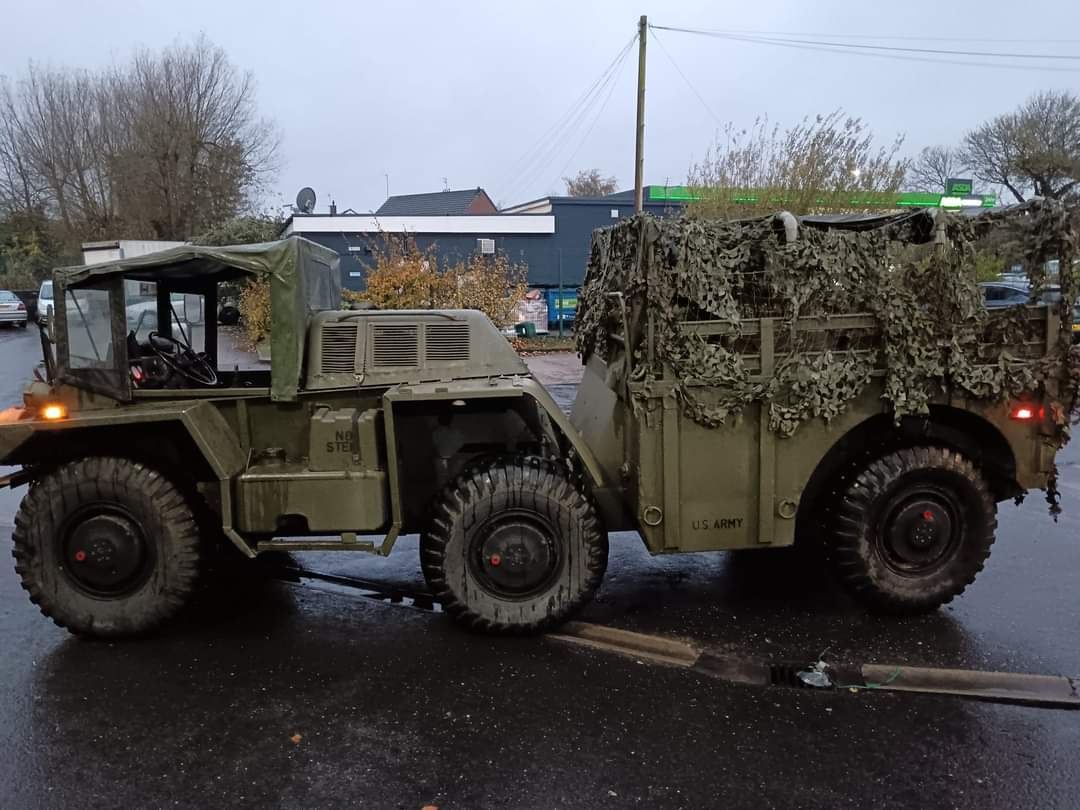
An ex-US Army M561 Gama Goat, showing its distinctive articulated chassis and rear cargo bed.
Few vehicles in US military history look as strange, or drive as strangely, as the Gama Goat. Officially the M561 (cargo/troop carrier) and M792 (ambulance variant), this six-wheeled, semi-amphibious, double-jointed truck was built to go anywhere — and largely did, at the cost of being one of the noisiest, most maintenance-hungry vehicles the US Army ever fielded. Here's its full story, the engine underneath it, and why so many ended up scrapped in Germany.
Where the name comes from
"Gama Goat" is a portmanteau of two things: Gama, from Roger Gamaunt, the engineer who designed the vehicle's articulated joint back in 1947, and Goat, for the vehicle's genuinely mountain-goat-like ability to scramble over terrain that would stop a conventional truck dead. The articulated design — essentially two separate body sections connected by a joint that could twist and flex independently — let all six wheels stay in contact with uneven ground simultaneously, which is exactly what gave it that reputation.
Development: from Corvair engine to Detroit Diesel
The programme's roots go back further than most people realise. Gamaunt's original articulated-joint concept dates to 1947, but serious Army development didn't begin until a contract was awarded to Chance Vought Aircraft in the early 1960s. The first XM561 prototype was built in December 1963, with a further batch of 14 prototypes completed by May 1965 for extensive Army testing.
The early prototypes used an air-cooled Chevrolet Corvair "pancake" six-cylinder engine — an unusual choice that turned out to overheat badly in service. The production vehicle switched to a liquid-cooled Detroit Diesel 3-53, a three-cylinder two-stroke diesel, which solved the overheating problem but introduced a whole new set of quirks we'll get to below.
Production was awarded to Consolidated Diesel Electric (CONDEC) in 1966, with the first production M561 leaving the factory in September 1969. By the time production ended in September 1973, 14,274 units had been built (down from an originally planned 15,274, after the Army cancelled 1,000 vehicles on budget grounds).
Where the Gama Goat was used
The M561 saw its most demanding service in Vietnam, where its off-road articulation genuinely earned its keep in terrain few other vehicles could cross. It remained in US and Mexican service through the 1970s, 80s and into the 1990s, primarily as a cargo/troop carrier, before being gradually phased out in favour of Commercial Utility Cargo Vehicles (CUCVs) and, eventually, the Humvee.
The M792 was the dedicated field ambulance variant of the same chassis, sharing the articulated running gear and Detroit Diesel 3-53 engine but fitted with a raised, enclosed rear body for carrying casualties — used anywhere the standard M561 was deployed where forward medical evacuation over rough ground was needed.
The Detroit Diesel 3-53: an aluminium-head two-stroke
The 3-53 is part of Detroit Diesel's Series 53 family, a two-stroke diesel line introduced in 1957 as a lighter, more compact alternative to the larger Series 71. "53" refers to the nominal swept displacement per cylinder in cubic inches — so the 3-53 is a three-cylinder engine displacing roughly 159 cubic inches (2.6 litres) in total, all three cylinders sharing a common bore and stroke of 3⁷⁄₈" x 4½" across the whole Series 53 range.
Two features define how this engine behaves in service. First, it's a true two-stroke diesel, using a Roots-type blower to force air through the cylinders for scavenging, since a two-stroke has no separate intake stroke to draw air in naturally — this is what gives Detroit Diesels their distinctive high-pitched mechanical whine, quite different to a four-stroke diesel's note. Second, certain Series 53 military variants — including versions used in the Gama Goat programme — were built with an aluminium cylinder head rather than cast iron, saving weight but demanding more careful attention to cooling system condition and the correct oil, since aluminium heads are considerably less forgiving of overheating or poor lubrication than a cast iron equivalent.
In the Gama Goat, the 3-53 was mounted directly behind the driver's head, and combined with the two-stroke's characteristic noise, this made hearing protection essential and on-the-move radio communication genuinely difficult — a well-documented complaint from soldiers who drove it.
Why the correct oil matters so much on a 3-53
Two-stroke diesels like the 3-53 are unusually sensitive to oil chemistry. Because the engine's scavenging process constantly exposes the cylinder liner, rings and aluminium head to combustion byproducts in a way a four-stroke doesn't, using the wrong oil accelerates ring-sticking, deposit build-up, and liner glazing — all of which are expensive and difficult to fix once they set in on an engine this old.
This is exactly why we stock and recommend Ring Free DD40 2-Stroke Diesel Engine Oil by Morris Lubricants for Detroit Diesel 3-53 (and other Series 53) engines. DD40 is formulated specifically for two-stroke diesel service: a low-ash formulation that limits the deposit build-up two-stroke diesels are prone to, combined with the detergency to keep rings free-moving (hence "Ring Free") rather than sticking in their grooves — the single most common cause of lost compression and smoking on old two-stroke Detroit Diesels. For an engine with an aluminium head that's already less tolerant of poor cooling and lubrication than a cast iron unit, running an oil actually engineered for this exact engine family, rather than a generic modern diesel oil built around four-stroke chemistry, is the difference between a Gama Goat that runs sweetly and one that eats itself from the inside.
Why so many were scrapped in Germany
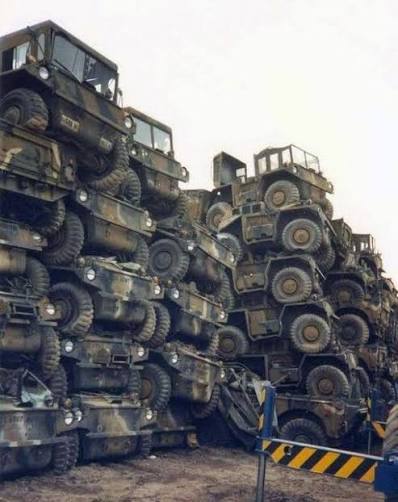
Decommissioned Gama Goats stacked awaiting disposal — a common sight at US Army vehicle disposal yards in Germany as the type was withdrawn from service.
Large numbers of US Army Gama Goats were based in West Germany throughout the Cold War as part of the forward-deployed forces watching the inner-German border. When the M561/M792 was retired from front-line service from the late 1980s into the 1990s — replaced by CUCVs and Humvees — vehicles stationed in Germany were pulled from units and taken to disposal yards rather than shipped back to the US, since it was far cheaper to scrap or auction them locally than to pay the cost of transporting thousands of obsolete trucks across the Atlantic.
The vehicle's well-known maintenance burden (the full lubrication order alone reportedly took around six hours) and the double-hulled, complex articulated drivetrain that made it expensive to repair meant most retired Gama Goats were assessed as uneconomical to keep running and went straight to scrap, rather than being refurbished or sold on for further military use — hence the piles of stacked, decommissioned Gama Goats photographed at German disposal yards that remain some of the most recognisable images of the type's retirement.
The Gama Goat today
Surviving Gama Goats are now firmly in collector and living-history territory, prized for their genuinely unusual engineering as much as their oddball looks. Anyone running one needs to respect exactly the quirks that made it infamous in service — the noisy, aluminium-headed Detroit Diesel 3-53 chief among them — and maintain the cooling system and oil properly to keep it running the way it's meant to.
We currently have a genuine M561 Ex US Army Gama Goat 6x6 in stock, and stock the correct Ring Free DD40 2-Stroke Diesel Engine Oil for anyone running or restoring a Series 53-engined vehicle. Browse our wider Military Vehicle Spares & Accessories range for other parts and consumables.
Frequently asked questions
What is the difference between the M561 and M792?
The M561 is the standard Gama Goat cargo/troop carrier, while the M792 is the dedicated field ambulance variant built on the same articulated chassis and Detroit Diesel 3-53 engine.
Why is the Gama Goat called that?
The name combines "Gama," after Roger Gamaunt, who designed its articulated joint, and "Goat," for its mountain-goat-like off-road ability.
What engine does a Gama Goat use?
Production M561/M792 vehicles use a Detroit Diesel 3-53, a three-cylinder, two-stroke liquid-cooled diesel producing around 103 horsepower, replacing the air-cooled Corvair engine used in early prototypes.
Why does a Detroit Diesel 3-53 need a specific oil?
As a two-stroke diesel with an aluminium cylinder head, the 3-53 is highly sensitive to ring-sticking and deposit build-up; a low-ash, two-stroke-specific oil like Ring Free DD40 is formulated to prevent this in a way generic four-stroke diesel oils are not.
Why were so many Gama Goats scrapped in Germany?
Large numbers were stationed in West Germany during the Cold War; when the type was retired in the late 1980s/1990s it was cheaper to scrap them locally than ship them back to the US, especially given their high maintenance cost and complex articulated drivetrain.

Leave a comment