

Best overall: the Swedish Army Ranger Trangia stove for a compact camp cooking kit. Best for quick, controlled cooking: a gas canister stove. Best for a short brew stop: a solid fuel stove. This 2026 guide ranks military camping stoves by fuel type, then shows you what to check before taking surplus kit into the field.
- For military camping stoves, the Swedish Army Ranger Trangia stove is the best overall pick for a compact camp kit.
- Choose gas canisters for flame control, solid fuel for short stops and liquid fuel for longer trips.
- Check the actual burner and its specified fuel before filling or lighting any surplus stove.
- Military Mart's Swedish Army Ranger Trangia stove is best for campers who want a named surplus option, not an assumed fuel specification.
Why this matters
A stove's fuel changes how you carry it, light it, cook on it and deal with a spill. The word military tells you little about those jobs. An issue-style stove, a modern gas burner and a wood-burning stove can all turn up in a camp kit, but they do not take the same fuel or behave the same way under a pan.
In 2026, start with the burner you actually have, not the stove's appearance. Surplus gear can be incomplete or altered, and a familiar-looking cooking set does not prove which burner sits inside it. Military Mart sells genuine ex-military kit and grades its condition; when buying a stove, read the individual listing for its components and condition rather than treating the name as a full specification. If you are new to surplus equipment, the guide to using a military surplus stove for camping covers the basic checks before your first cook.
What makes the best military camping stove?
A good stove fits the meal, the campsite and the fuel you can carry. These criteria drive the ranking rather than an unsupported claim about boil times or output.
- Fuel identification: You must know the burner type and its approved fuel before lighting it. Never identify fuel by the shape of the pan set alone.
- Cooking control: A stove for a pan meal needs a controllable flame. A stove used only to heat water has a simpler job.
- Complete kit: On surplus equipment, check for the burner, pot supports, wind protection and any parts named in the listing. Do not assume they are included.
- Packing: Count the stove, fuel container and cooking vessel. The smallest burner does not always make the smallest complete setup.
- Campsite rules: Check whether open flames, wood burning and stove use are permitted where you plan to stop.
- Condition: Examine seals, threads, supports and fuel containers for damage. Do not put a suspect stove into service.
The best military camping stove is the one whose fuel you can positively identify and whose complete kit suits the cooking you plan to do. That rule matters more than an army label.
Military camping stoves at a glance: 2026 fuel ranking
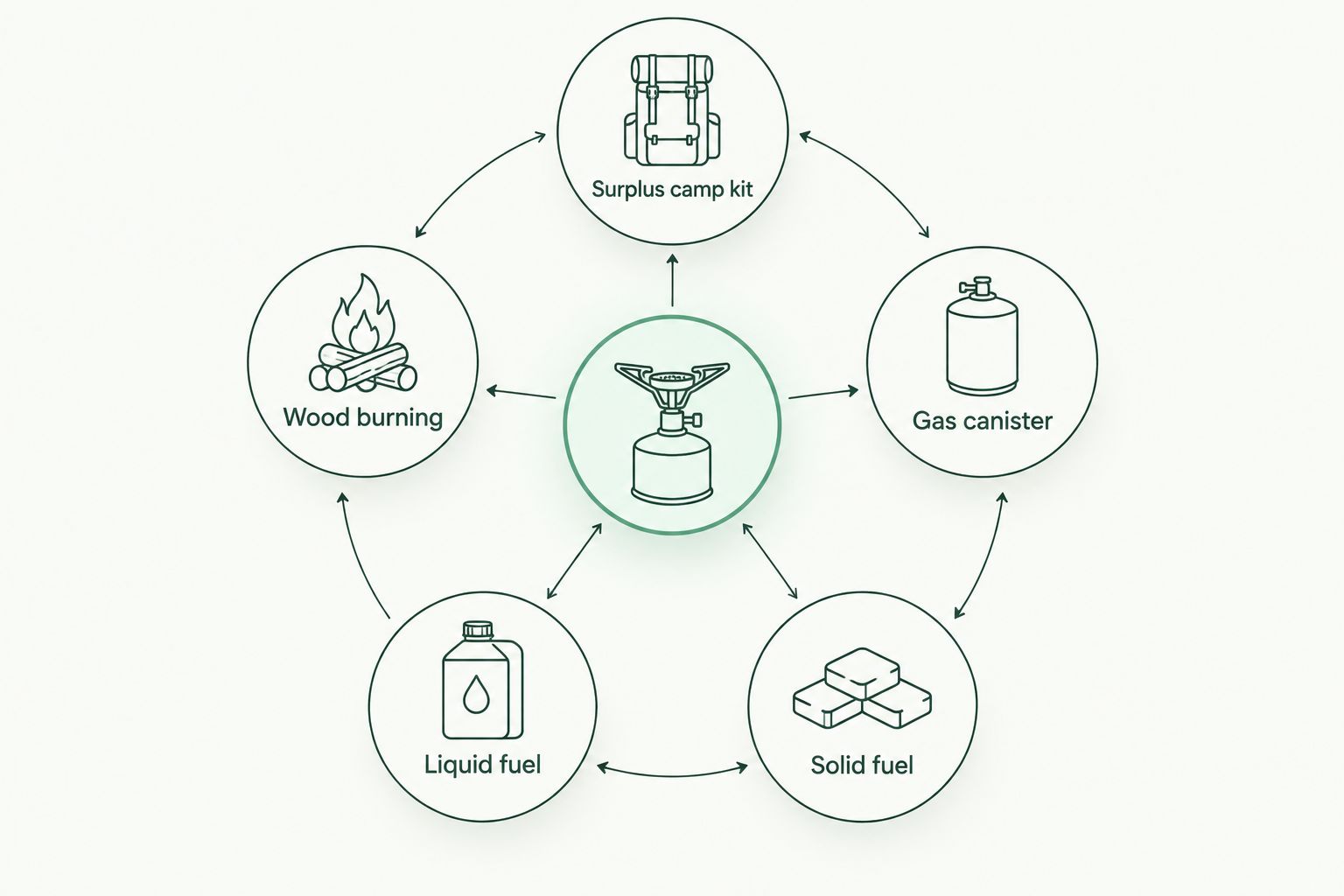
The fuel categories below describe types of stove, not specific products stocked by Military Mart. The Swedish Army Ranger Trangia is the named surplus option in this guide; check its listing and burner before choosing fuel.
| Rank and option | Best for | Standout feature | Key limitation |
|---|---|---|---|
| 1. Swedish Army Ranger Trangia stove | A compact surplus camp cooking kit | Named ex-military-style stove option | The name alone does not establish the supplied burner's fuel or included parts |
| 2. Gas canister stove | Controlled cooking at an ordinary campsite | Adjustable flame on suitable models | Requires a compatible canister and connector |
| 3. Solid fuel stove | A short stop to heat water | Simple burner format | Limited flame control and residue after burning |
| 4. Liquid fuel stove | Campers prepared to maintain their stove | Refillable fuel system on suitable models | More parts and handling steps to inspect |
| 5. Wood-burning stove | Permitted campsites with suitable dry fuel | Burns gathered biomass where allowed | Fuel condition, smoke and fire restrictions affect use |
A military camping stoves comparison is most useful when it separates fuel type from issue status. A gas stove does not become military issue because it sits beside a surplus mess tin. Equally, a genuine surplus cooking set still needs its burner checked before use.
1. Swedish Army Ranger Trangia stove: best for surplus camp cooking
Best for: A camper who wants a named surplus stove for a compact cooking kit and will verify its burner before use.
Military Mart lists a Swedish Army Ranger Trangia stove. That makes it the clearest named surplus pick here, but the supplied information does not specify its components, condition or fuel. Military Mart's Swedish Army Ranger Trangia stove is best for campers who want surplus camp kit and will confirm the supplied burner before choosing fuel.
A Trangia-style cooking set is often associated with spirit burners, but that association is not permission to pour alcohol into an unidentified burner. Look at the actual burner, read the listing and follow the instructions for that component. If it arrives with parts you cannot identify, keep it unlit until you can identify them.
Swedish Army Ranger Trangia stove pros:
- A specific stove listing gives you a starting point for checking what is included.
- The surplus format suits campers who prefer traditional camp cooking gear.
- A pot-and-burner setup is a practical choice when you want to cook rather than just carry a heat source.
Swedish Army Ranger Trangia stove cons:
- Its name does not confirm which burner or fuel is supplied.
- A surplus set needs a careful check for missing, worn or mismatched parts.
- It is not the default choice if you want the simple flame adjustment associated with a suitable gas stove.
Verdict: Buy if the listing confirms a complete set for your needs and you can identify and use its burner correctly. Otherwise, hold until those points are clear. For 2026, it is the best named surplus option in this comparison, not a claim that every example has the same configuration.
2. Gas canister stove: best for controlled campsite cooking
Best for: A camper who wants to adjust heat while cooking with a suitable stove and canister.
A gas canister stove draws fuel from a compatible pressurised canister. Many designs let you adjust the flame with a valve, which makes them easier to use for pan cooking than a burner with little control. Match the stove to the correct canister connection; similar-looking fittings are not proof of compatibility.
Gas is a fuel choice, not an authenticity claim. If genuine military surplus matters more to you than flame control, check whether a gas model is actually described as issue kit before treating it as such. If easy pan cooking matters most, judge the burner on compatibility, stability and how securely it supports your cookware.
Gas canister stove pros:
- A controllable flame suits meals that need more than a rolling boil.
- Fuel stays in its canister rather than being poured into a burner.
- You can turn a suitable stove off at its valve when cooking ends.
Gas canister stove cons:
- The stove is unusable without a compatible canister.
- A narrow burner can be unstable under a large pan; check the support and cooking surface.
- Canister type and local rules still affect what you can carry and use.
Verdict: Buy for general campsite cooking when flame adjustment is your main requirement. Skip it as a purported military-issue purchase unless the individual item is identified as genuine issue kit. In 2026, gas wins this use case on control, not on military provenance.
3. Solid fuel stove: best for a short brew stop
Best for: Heating water on a brief stop when a simple burner matters more than precise flame control.
A solid fuel stove burns fuel in tablet or block form on a support beneath your vessel. The format is straightforward, but the exact fuel matters: use only fuel approved for the stove. Keep tablets dry and follow their handling instructions. Do not treat an unmarked block found with old kit as identified cooking fuel.
This is the stove type to consider when the task is narrow: stop, heat water, let the equipment cool and pack it away. It is less convincing for a meal that needs a low, steady heat. Wind protection and a firm base also matter; neither should be improvised by using a stove inside a tent.
Solid fuel stove pros:
- The basic stove format has few moving parts.
- Fuel can be portioned for a planned stop.
- It suits a simple water-heating task.
Solid fuel stove cons:
- Flame control is limited compared with a suitable gas stove.
- Burning can leave residue on cookware and the stove.
- An unidentified tablet is not safe to use just because it came with surplus kit.
Verdict: Buy for straightforward brew stops if you have correctly identified fuel and a permitted outdoor cooking spot. Skip it for meals that need careful heat control. For 2026 camp planning, pack for the food you will actually prepare, not the smallest stove you can find.
4. Liquid fuel stove: best for experienced stove users
Best for: Campers comfortable checking a refillable stove's fuel system, seals and operating instructions.
Liquid fuel stoves use a refillable fuel supply, but the phrase liquid fuel does not identify a safe fuel for any particular model. Some designs require priming or pressure management; others use different arrangements. Follow the exact model's instructions. Never substitute a fuel because it is close at hand.
This category earns a place in a military camping stoves guide because refillable systems appeal to people who want to manage their own fuel supply. They also give you more components to check. For surplus kit, inspect the fuel vessel, cap, connections and supports before considering use; a seller's condition grade is not a substitute for those safety checks.
Liquid fuel stove pros:
- A refillable system lets you plan fuel around the stove's specified requirements.
- It suits users who are willing to inspect and maintain their cooking gear.
- Models with suitable controls support more than a brief heat-and-stop routine.
Liquid fuel stove cons:
- Fuel spills and damaged seals demand careful handling.
- Priming and operation vary by model, so a generic lighting method is not enough.
- An incomplete surplus stove can be difficult to assess without its instructions.
Verdict: Hold unless you can identify the exact stove, its approved fuel and its operating method. Buy only once those checks are complete. In 2026, experience with one liquid fuel stove does not replace the instructions for another.
5. Wood-burning stove: best where fires are permitted
Best for: A campsite where the rules permit this type of fire and you have suitable fuel.
A wood-burning camp stove contains a small fire beneath your cookware. Its fuel does not come in a canister, but that does not make the setup unrestricted. You still need dry material, a stable position and permission to burn it. Check site rules and local restrictions before leaving a packaged fuel option behind.
Wood is the least dependable choice in this ranking for a planned meal when fuel and permission are uncertain. Damp material makes cooking harder and smoke more likely. Do not cut living material or damage a site to feed a stove; bring a different cooking method when appropriate fuel is not available.
Wood-burning stove pros:
- No gas canister connection or liquid fuel vessel to match.
- Suitable dry biomass can serve as fuel where collection and burning are permitted.
- The burner keeps a small cooking fire contained within the stove.
Wood-burning stove cons:
- Fire rules can rule out its use altogether.
- Damp fuel and smoke make cooking less predictable.
- Ash and hot embers require proper disposal after the stove has cooled.
Verdict: Skip as your only stove when you have not checked the campsite rules. Buy for permitted sites if you accept the extra fuel, smoke and fire-management work. A wood burner is a deliberate choice, not a fuel-free answer to camp cooking.
How were these fuel types ranked?
The ranking puts an identifiable surplus stove first because this is a guide to military camping stoves, not a general list of backpacking burners. It then separates the other options by the job each does best: controlled cooking, a short stop, refillable-fuel use and permitted wood burning. No boil-time, weight or output figures are used because none are supplied for the listed stove or the generic alternatives.
Treat the ranking as a decision tree. Start with provenance if genuine surplus is the point of the purchase. Start with flame control if the meal is the point. In either case, confirm the precise fuel, complete kit and condition before you light anything. Military Mart's trading history goes back to 1999, but an individual stove still needs an individual condition and component check.
Which military camping stove should you choose?
Choose the Swedish Army Ranger Trangia stove if you want the named surplus option and can verify its burner and included parts. Choose a gas canister stove if adjustable heat for campsite meals matters more than issue status. Choose solid fuel for a short stop, consider liquid fuel when you know the exact model, and take a wood burner only where its use is allowed.
Do not buy fuel first and work backwards to a surplus stove. That reverses the safety check. A stove without an identified burner, correct fuel and sound components is kit to inspect, not kit to light.
FAQ
What is the best military camping stove in 2026?
The Swedish Army Ranger Trangia stove is the best named surplus option in this guide for a compact camp cooking kit. Confirm its actual burner, fuel and included parts before use.
Is a gas stove better than a military surplus stove?
A suitable gas stove is better when adjustable flame control is your priority. A named surplus stove is the better match when genuine kit matters, provided you verify its components and condition.
What fuel does the Swedish Army Ranger Trangia stove use?
The supplied product information does not specify the fuel for the listed Swedish Army Ranger Trangia stove. Identify the burner supplied with the individual stove and follow its instructions before choosing fuel.
Are solid fuel camping stoves good for cooking meals?
Solid fuel stoves suit simple heating tasks better than meals needing careful flame control. Use only fuel identified as suitable for the stove and cook outdoors where permitted.
Can you use a camping stove inside a tent?
No: keep a fuel-burning stove out of an enclosed tent. Fire and carbon monoxide are serious hazards; follow the stove instructions and campsite rules.
What should I check on a used military stove?
Check the burner identity, included parts, supports, fuel container and visible condition. Do not light a stove with damaged components or an unidentified fuel system.
Is a wood-burning camping stove allowed everywhere?
No. Campsites and land managers set fire and stove rules, so check permission before relying on wood as your cooking fuel.
One last thing
The pot is not the burner. Two cooking sets can look alike when packed yet need different fuel or contain different parts. Before a 2026 wild camp, unpack the whole kit, identify each component and check the cooking setup outdoors at home under its instructions. If any part remains unidentified, leave that stove unlit.


Leave a comment