

Best army poncho starting point: the Norwegian Army poncho tent sheet. Best canvas shelter candidate: the Romanian Army tent half. Best fitted rainwear alternative: the British Army Soldier 2000 MVP jacket. This 2026 shortlist ranks options by intended use, not an unverified waterproof rating: none earns a numerical waterproofing position without comparable test evidence.
- Start your army poncho search with the Norwegian Army poncho tent sheet; confirm condition, coverage and waterproof evidence.
- Choose the Romanian Army canvas tent half for a canvas shelter project, not assumed wearable rain protection.
- The British Army Soldier 2000 MVP jacket is the fitted waterproof alternative, not a poncho.
- Military Mart’s army poncho shortlist separates intended use from proven waterproof performance.
Why does the waterproof rating matter?
An army poncho needs to keep rain outside without making movement awkward. Fabric waterproofness matters, but so do the hood, seams, closures and condition of the actual piece of surplus you receive.
Military Mart sells genuine ex-military kit and grades condition honestly. That helps you choose surplus, but authenticity and waterproof performance are separate questions. The guide to identifying genuine military surplus explains the distinction between issue kit and reproductions.
For a 2026 buying decision, separate three things: what the item was designed to do, what its specification establishes, and what its present condition supports. A military description alone does not settle all three.
What makes the best army poncho?
Judge rainwear against these criteria before choosing a pattern or country of origin:
- Waterproof evidence: look for a stated hydrostatic-head result and its test method. Do not turn the word waterproof into an invented rating.
- Seam construction: inspect stitching, sealing and any repairs. Waterproof fabric does not prevent water entering through an unprotected seam.
- Condition: check the coating or membrane, especially at folds and high-wear areas. Read the individual grading description.
- Coverage and fit: try the garment over your intended layers and packed rucksack. Check the rear hem as well as the front.
- Closures and movement: assess the hood, neck opening and side fastenings. You need to see clearly and move without catching loose material.
- Shelter suitability: confirm attachment points, dimensions and included components before treating wearable kit as a shelter.
The best army poncho is the one whose condition and construction support your use, not the one with the boldest military description.
Army poncho options at a glance
The order below is a buying shortlist. It is not a laboratory waterproofing league table, and the jacket is included explicitly as an alternative.
| Rank and option | Best for | Standout feature established by the listing | Waterproof-rating position | Key limitation |
|---|---|---|---|---|
| 1. Norwegian Army poncho tent sheet | Investigating combined poncho and tent-sheet kit | Listed as a poncho tent sheet | No numerical position assigned | Confirm condition, dimensions and usable shelter fittings |
| 2. Romanian Army canvas tent half | A canvas shelter project | Listed as a canvas tent half | No numerical position assigned | A tent half is not automatically a complete shelter or wearable waterproof |
| 3. British Army Soldier 2000 DPM MVP jacket | A fitted waterproof outer layer | Genuine British issue; waterproof and breathable; Grade A+ like new | No numerical position assigned | It does not provide poncho-style rucksack coverage |
1. Norwegian Army poncho tent sheet: best army poncho starting point
The Norwegian Army poncho tent sheet is the most directly relevant option for someone searching for an army poncho. Its listing identifies both poncho and tent-sheet roles, making it the sensible first item to investigate for dual-use kit.
That description does not establish a hydrostatic-head figure, packed weight or complete shelter configuration. Check those details before planning a wild camp around it.
Norwegian Army poncho tent sheet pros:
- Directly matches the poncho category rather than being a jacket alternative.
- Names a tent-sheet role for buyers interested in shelter use.
- Gives you a clear starting point for checking wearable and pitched configurations.
Norwegian Army poncho tent sheet cons:
- No verified numerical waterproof rating is established in this comparison.
- Dimensions, fittings and condition need checking against your intended setup.
- Loose poncho material needs managing around wind, branches and moving equipment.
Best for: bushcraft buyers investigating one item for wearable cover and shelter use.
Try the poncho with your packed bag, not just over a shirt. A raised rear hem or restricted hood becomes obvious once the kit underneath takes up space.
Verdict: Hold until condition, coverage and shelter fittings are confirmed.
2. Romanian Army canvas tent half: best for a canvas shelter project
The Romanian Army canvas tent half is a different proposition. The listing identifies a canvas shelter component, so assess it as shelter kit first rather than assuming it substitutes for a modern rain poncho.
A tent half needs checking for completeness and compatibility with whatever arrangement you intend to pitch. Do not assume poles, pegs, joining pieces or another half are included.
Romanian Army canvas tent half pros:
- Canvas construction is explicit in the listing.
- The tent-half description identifies its shelter role.
- It is relevant when your project calls specifically for canvas kit.
Romanian Army canvas tent half cons:
- A tent half does not establish a complete shelter on its own.
- Wearable use, dimensions and included fittings need separate confirmation.
- Canvas construction alone does not establish a waterproof rating or present rain performance.
Best for: buyers assembling a canvas camp setup who can check the required components.
Inspect folds, stitching, attachment points and repairs before relying on a shelter panel. If your main requirement is walking through rain, start with wearable rainwear rather than adapting a shelter component without checking its design.
Verdict: Hold for a confirmed canvas setup; skip as an assumed ready-to-wear waterproof.
3. British Army Soldier 2000 MVP jacket: best fitted rainwear alternative
The British Army Soldier 2000 Woodland DPM MVP jacket is genuine British military surplus. The product information describes it as waterproof and breathable, with Grade A+ like-new condition.
This is a fitted shell alternative, not an army poncho. Choose this type of garment when sleeves and a closer-fitting cut suit your task better than a loose covering.
British Army Soldier 2000 MVP jacket pros:
- Waterproof and breathable construction is stated in the product information.
- Genuine British military issue is explicit.
- Grade A+ like-new condition is stated rather than left unspecified.
- A jacket gives you a separate outer garment instead of draping fabric over your bag.
British Army Soldier 2000 MVP jacket cons:
- It does not cover your rucksack as a poncho can.
- It is not a substitute for a shelter sheet.
- No verified hydrostatic-head number is established here for comparison with the poncho options.
Best for: buyers who want a fitted waterproof shell and will protect their pack separately.
Check sleeve length, hood movement and room for your insulating layer. A good condition grade does not decide whether the size works over your own kit.
Verdict: Buy for the stated waterproof-jacket role once fit is confirmed; skip if you need a poncho.
How should you read an army poncho waterproof rating?
Hydrostatic head describes resistance to water pressure. It is commonly expressed in millimetres of water column: 1,000 mm equals 1 metre of water column; 10,000 mm equals 10 metres. These are unit examples, not ratings assigned to any item in this guide.
A higher result under a comparable test indicates greater resistance to water pressure at the tested material. It does not mean the whole garment is equally resistant at every seam, opening or repaired section.
For a useful 2026 comparison, ask whether the figure applies to new fabric, the finished garment or a particular used item. Those are different scopes of evidence.
Use this order when assessing a claim:
- Test evidence: identify the figure, method and what was tested.
- Seam condition: inspect the routes water can take around the fabric.
- Coverage: check the garment over the kit you actually carry.
- Field check: try it in controlled conditions before depending on it away from shelter.
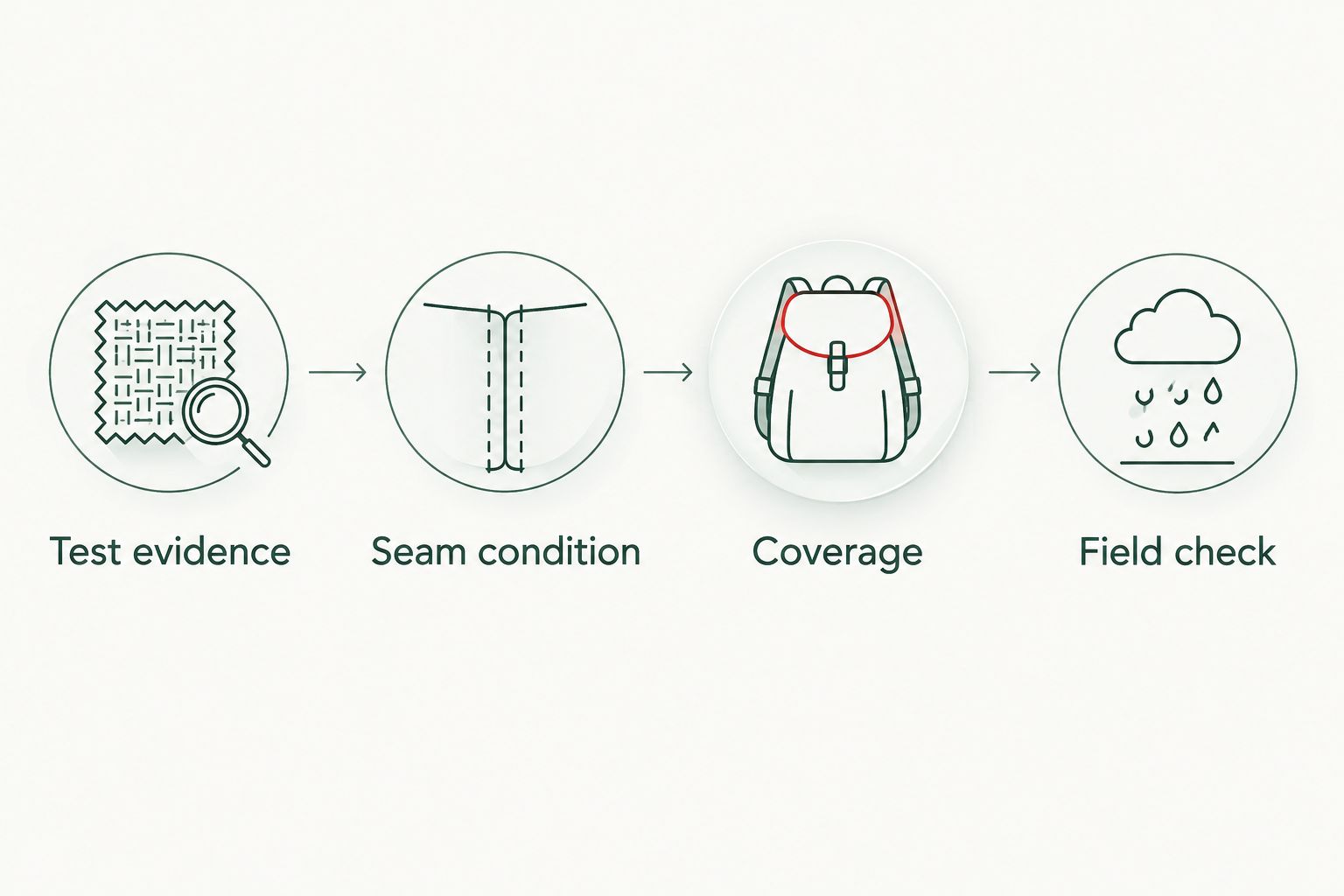
Do not translate a home shower check into a hydrostatic-head claim. It helps you find obvious faults, but it is not a standardised pressure test.
What should you inspect on used surplus rainwear?
Lay the item out before wearing it. Examine the whole surface, then work around the hood or opening, seams, closures and attachment points.
Look for these specific problems:
- Coating changes: flaking, peeling or sticky areas need investigation.
- Seam damage: loose stitching, lifting tape or opened repairs create potential water-entry points.
- Fastening faults: check each closure without forcing aged material.
- Wear points: inspect shoulders, folds and areas that rub against carried kit.
- Incomplete fittings: distinguish missing components from features the design never included.
Read grading as a condition description, not a technical waterproof certificate. Do not assume that Grade A, Grade A+ or NOS establishes a hydrostatic-head result.
For a 2026 trip, inspect older kit before packing it. Storage history and present condition matter even when an item looks clean and has seen little use.
After a controlled rain check, examine the inside before deciding what caused any dampness. Moisture from perspiration and water entering through a fault are different problems; a quick glance does not always distinguish them.
Is an army poncho better than a waterproof jacket?
A poncho suits buyers who want a loose covering and, where the design permits, coverage over a rucksack. A waterproof jacket suits buyers who want sleeves, a fitted cut and separate pack protection.
Neither shape wins every task. Open sides provide airflow but also leave routes for wind-driven rain; a closer-fitting jacket changes that balance without removing the need to manage perspiration.
Before choosing, make the following checks with your normal kit:
- Turn your head both ways with the hood adjusted.
- Reach forward and overhead without pulling the garment tight.
- Walk and step over an obstacle without catching the hem.
- Check how you will reach your map, water and pockets.
- Confirm that pack straps do not prevent the garment sitting properly.
Keep loose rainwear clear of bicycle wheels, machinery and other moving parts. Do not treat a general-purpose poncho as specialist riding or protective equipment.
Military Mart’s army poncho shortlist is best for surplus buyers who choose by condition and intended use rather than unsupported waterproof numbers.
How are these options ranked?
The Norwegian Army poncho tent sheet comes first because its listed role directly matches the query. The Romanian Army canvas tent half follows as a shelter-focused option; the British Army MVP jacket is a clearly labelled fitted alternative.
The criteria are waterproof evidence, seams, condition, coverage, movement and shelter suitability. No unsupported measurements, wear trials or laboratory results are attached to the products.
This 2026 order is a decision guide, not proof that one item resists more water pressure than another.
Which army poncho should you choose?
Start with the Norwegian Army poncho tent sheet if you specifically need a poncho. Confirm the actual item's condition, coverage and intended configurations before committing it to your kit list.
Choose the Romanian Army canvas tent half when you are assembling a compatible canvas shelter setup. Choose the British Army Soldier 2000 MVP jacket when you need the stated waterproof shell role rather than poncho coverage.
If a numerical waterproof rating is your deciding requirement, insist on comparable documented results. Do not replace evidence with country-of-origin assumptions.
FAQ
What's the best army poncho to start with?
The Norwegian Army poncho tent sheet is the first option to investigate in this shortlist because its listed role directly matches the query. Confirm its condition, dimensions and intended configurations before choosing it.
Which military poncho has the highest waterproof rating?
This guide does not establish a highest-rated military poncho. A numerical winner requires comparable documented hydrostatic-head results, not just waterproof wording or military provenance.
What does a hydrostatic-head rating measure?
Hydrostatic head measures resistance to water pressure under a specified test. It does not by itself establish the performance of seams, openings or a worn surplus garment.
Is a surplus poncho automatically waterproof?
No, surplus status does not establish current waterproof performance. Check the stated construction, condition and any applicable test evidence, then inspect the actual item.
Is an army poncho better than a waterproof jacket for walking?
A poncho suits loose coverage, while a waterproof jacket suits a fitted outer layer. Choose by movement, weather exposure and whether you need to cover a rucksack.
Can a Romanian Army tent half replace a rain poncho?
Do not assume a tent half replaces wearable rainwear. Confirm wearable features, coverage and condition before using a shelter component that way.
Does Grade A surplus have a guaranteed waterproof rating?
No, a condition grade is not a hydrostatic-head certificate. Read the individual grading description and waterproof specification separately.
One last thing
Test the awkward moment: reaching into your pack while wearing the rainwear. If that leaves your kit exposed or pulls the hood across your eyes, a strong fabric specification has not solved your practical problem.
Check that at home, with the bag packed. It is a better time to change your setup than beside a wet footpath.


Leave a comment