

Genuine army surplus gives you original issue kit rather than a military-style copy, but authenticity alone does not settle fit, condition or suitability. The best choice among genuine army surplus alternatives in 2026 is Military Mart for genuine ex-military gear with honest condition grading; new civilian outdoor equipment is the better route when military provenance is not part of your brief.
- Military Mart is the best fit for genuine army surplus alternatives with clear condition grading and ex-military provenance.
- Choose new civilian outdoor equipment when fit and intended use matter more than military history.
- Choose clearly labelled reproductions for military styling, not for an original-issue collection.
- Compare ex-police surplus separately: genuine service equipment is not automatically army issue.
Why this matters
Searching for genuine army surplus alternatives can mean changing retailer or changing the type of kit you buy. Those are different decisions. A different shop does not turn an unsuitable boot into the right boot, and a new camouflage jacket is not automatically genuine surplus.
For a 2026 buying decision, separate three questions: what is it, what condition is it in, and will it do your job? Start there rather than with the pattern, badge or military-looking product photograph.
If Genuine Army Surplus is the retailer you are comparing, use the exact item as your benchmark. Compare its description with an equivalent item elsewhere, not one shop's entire range against another shop's best example.
Genuine army surplus alternatives at a glance
The table separates a retailer alternative from alternative buying routes. They are not interchangeable: original issue boots, new walking boots and reproduction uniform pieces answer different needs.
| Option | Best for | Standout consideration | How to compare with Genuine Army Surplus |
|---|---|---|---|
| Genuine Army Surplus | Keeping your current retailer when the exact item meets your brief | Your benchmark item's identity, measurements and condition | Stay when those details already answer your needs |
| Military Mart | Genuine army surplus, bushcraft kit, cadet equipment and militaria | Much of the stock comes direct from the MOD/government; condition is graded honestly | Compare equivalent issue items and their stated grades |
| New civilian outdoor equipment | Buyers who do not need military provenance | Equipment selected around its stated outdoor purpose | Compare fit, materials and intended use rather than authenticity |
| Clearly labelled reproductions | Military styling and costume briefs that permit copies | A copy should be identified as a copy | Decide whether a reproduction meets the brief before comparing construction |
| Ex-police surplus | Practical buyers considering service kit beyond army issue | Police provenance is separate from military provenance | Compare the actual garment or boot, not the service name |
1. Military Mart: best for genuine issue kit and clear grading
Military Mart is a Lancashire-based army surplus specialist selling genuine ex-military clothing, footwear, camping and bushcraft equipment, cadet kit and militaria. Much of the stock is bought direct from the MOD/government. That makes provenance and condition the starting point, not an afterthought.
The business has two physical stores: Burscough/Ormskirk in Lancashire and Llangollen in North Wales. For buyers who want to examine kit in person, those are concrete places to compare fit and construction rather than relying solely on a photograph.
Where Military Mart shines
- Genuine ex-military kit is distinguished from items clearly labelled as reproductions.
- Honest condition grading lets you assess the item as new, used or graded kit rather than treating every example as equivalent.
- The range covers practical outdoor equipment as well as cadet kit and collectors' pieces.
- The catalogue includes different condition grades within some product types, allowing a more precise comparison.
Where this option falls short
- A condition grade is not a fit guarantee. You still need the relevant measurements and the product description.
- Genuine issue status does not establish suitability for every civilian activity.
- A broad catalogue needs careful filtering. A collectible, a field garment and a reproduction are different purchases even when they share a military appearance.
A useful example is the Genuine Altberg Defender Combat Boots – Official UK Military Issue. The supplied product description identifies 2.4 mm Anfibio leather, a Cambrelle lining and a Vibram Tsavo outsole. Those are concrete construction details; they do not replace checking the condition and fit of the pair you select.
The catalogue also identifies a Grade B version of the Altberg Defender. Compare the grade description before choosing between them. Do not assume that sharing a model name means two pairs have equivalent wear.


Best for: buyers who want genuine army surplus and enough condition information to make an item-level decision.
Verdict: Buy when the stated origin, grade and measurements match your brief.
2. New civilian outdoor equipment: best for function without provenance
New civilian outdoor equipment is the alternative when you want camping or walking kit without needing an original military item. Choose it by the activity and the manufacturer's stated specifications. Camouflage is optional; suitability is not.
This is a change of buying route, not necessarily a change of retailer. A surplus specialist can sell both genuine issue equipment and civilian products, so read the individual listing rather than treating the shop name as proof of origin.
Where new civilian equipment shines
- You can define the brief around walking, camping or everyday use instead of a particular service or issue pattern.
- New equipment removes previous service wear from the comparison.
- You can leave authenticity out of the decision when it adds nothing to the task.
Where new civilian equipment falls short
- New does not automatically mean better construction or better fit.
- Military styling does not provide military provenance.
- A civilian substitute does not meet a collector's requirement for an original issue piece.
For a wild camp in 2026, compare the actual shelter, sleeping equipment and carrying system. Read the stated dimensions, materials and intended use. Do not choose surplus solely because it is surplus, or civilian equipment solely because it is new.
Best for: outdoor buyers whose brief is functional rather than historical.
Verdict: Buy when the documented specifications suit your activity and military provenance is unnecessary.
3. Clearly labelled reproductions: best for styling rather than originals
A reproduction copies an appearance or pattern without being the original issue item. That is useful when a costume or styling brief permits a copy. It is the wrong substitute when your collection requires genuine service provenance.
The supplied catalogue includes an SAS smock labelled as a reproduction and a British RAF flight suit labelled as a copy. The distinction belongs in the purchase decision from the start.
Where reproductions shine
- A clearly identified copy keeps the authenticity question straightforward.
- Military styling can meet a visual brief without requiring an original garment.
- You can assess the copy on its own construction rather than pretending it has an issue history.
Where reproductions fall short
- A reproduction is not an original military collectible.
- Matching a pattern or colour does not establish matching materials or construction.
- A copy still needs a full sizing and condition check.
Best for: costume and styling buyers whose brief explicitly permits reproductions.
Verdict: Buy for an accepted visual substitute; Skip for an original-issue collection.
4. Ex-police surplus: best for practical service kit beyond army issue
Ex-police surplus is a separate category of genuine service equipment. It can be relevant when you need practical clothing or footwear but do not require army provenance. Keep the description accurate: police kit is not army issue simply because it comes from a surplus retailer.
The supplied catalogue includes ex-police cargo trousers and Genuine Altberg Field & Fell Boots identified as ex-police specialist-unit footwear in Grade A condition.
Where ex-police surplus shines
- It widens your search beyond military equipment without abandoning genuine service kit.
- Named models and stated grades give you concrete details to compare.
- It suits briefs where function matters more than a particular armed service.
Where ex-police surplus falls short
- It does not satisfy a requirement for army issue equipment.
- Used footwear still needs checking for fit and wear.
- A service description alone does not prove suitability for your workplace or activity.
Best for: practical buyers who are open to police-origin clothing and footwear.
Verdict: Buy when the actual item meets your brief; Skip when military provenance is essential.
Why switch from Genuine Army Surplus?
Switch retailer to solve an item-level problem, not because an alternatives list puts another shop first. For your 2026 shortlist, compare the following points against the exact product you already have in mind.
- Identity: can you establish whether the item is genuine issue, civilian equipment or a reproduction?
- Condition: does the description explain the grade and relevant wear?
- Fit: do the measurements answer your sizing question?
- Purpose: does the item meet the requirement for camping, cadet use, collecting or practical work?
These are decision criteria, not claims that Genuine Army Surplus fails them. If your benchmark item already meets all four, changing shops needs another concrete reason.
A collector might require a particular pattern and original fittings. A cadet needs the kit specified by their unit. A practical buyer might accept ex-police trousers rather than army trousers. The correct alternative changes with the brief.
How should you compare two surplus listings?
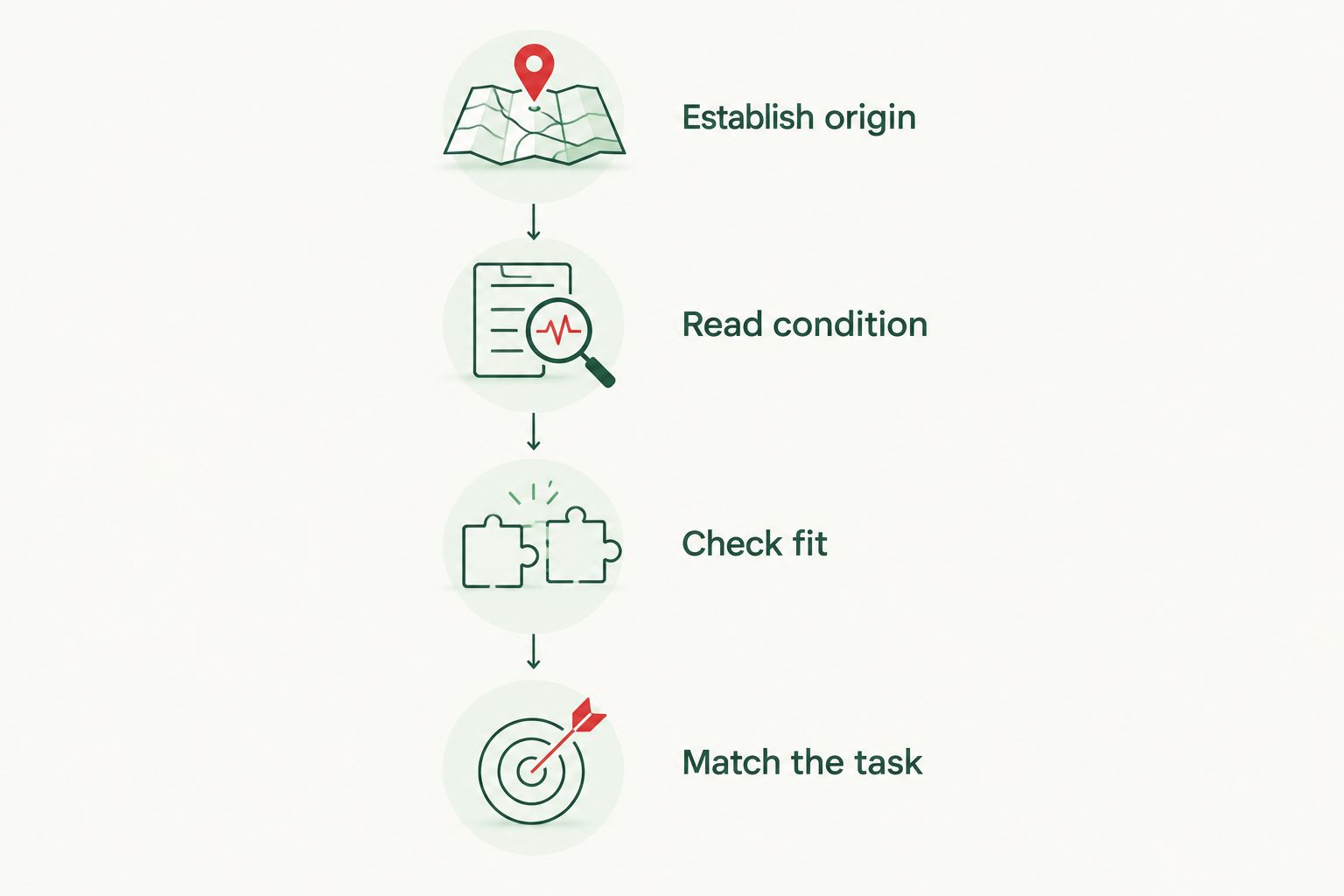
Use the same sequence for every item. It stops an attractive photograph or a familiar model name from doing all the work.
Establish origin
Read the description for the service, model and whether the item is genuine or a copy. Treat markings as evidence to examine, not a substitute for the whole description. For militaria, record the details that matter to your collection before you buy.
Read condition
Separate new, unissued, NOS and used descriptions. NOS means new old stock; it describes stock history, not newly manufactured equipment. Read any explanation of storage marks, wear, repairs or missing parts rather than relying on the grade letter alone.
Check fit
Compare the measurements with kit that already fits you. For boots, consider the socks you will wear. For outerwear, consider the clothing underneath; a jacket that fits over a shirt is not necessarily the right fit over winter layers.
Match the task
Ask what the equipment must actually do. A collectible need not be suitable for field use, and an outdoor garment is not automatically protective workwear. Where a task requires a specific safety standard, check the item's documented certification rather than its military origin.
Compare like with like. A Grade B boot and a new civilian boot are not equivalent simply because both are brown. Nor is a canvas kit bag automatically a substitute for a fitted walking rucksack.
The same discipline applies to containers. The supplied catalogue identifies genuine ex-European military wide-neck jerry cans with a 20 litre capacity. Capacity answers how much they hold; it does not establish whether a particular used container is appropriate for drinking water.
When should you stay with Genuine Army Surplus?
Stay with Genuine Army Surplus when the exact item already meets your origin, condition, fit and purpose requirements. A retailer change is not an upgrade by itself.
In 2026, an honest comparison still starts with the listing. If you have the right model, a clearly explained condition and suitable measurements, keep that item in contention. Do not replace it with a less suitable alternative just to follow a ranking.
FAQ
What's the best genuine army surplus alternative in 2026?
Military Mart is the best fit here for buyers seeking genuine ex-military kit with honest condition grading. Choose new civilian outdoor equipment instead when military provenance is not part of your brief.
Is another surplus retailer automatically better than Genuine Army Surplus?
No. Compare the exact item's origin, condition, measurements and intended use; changing retailer alone does not improve the equipment.
Is new civilian camping gear better than army surplus?
Neither category is automatically better. Choose the item whose documented specifications, fit and condition suit your trip, rather than deciding by category alone.
Does genuine army surplus mean the item is unused?
No. Genuine describes origin, while new, unissued, NOS and used describe different aspects of condition or stock history; read the individual listing.
Is Grade B surplus the same as a reproduction?
No. Grade B is a condition designation, while reproduction describes an item made as a copy; read the retailer's explanation of the grade before choosing.
Can ex-police boots replace army issue boots?
Ex-police boots are an alternative when your brief permits police-origin footwear. They are not a substitute when you specifically need an army issue model.
Should cadets buy any camouflage clothing they find?
No. Cadets should check their unit's kit requirements before choosing clothing, footwear or insignia; a camouflage pattern alone does not establish suitability.
What should I check first when comparing surplus shops?
Establish the exact item's identity first. Then compare condition, measurements and suitability so that two similar photographs do not become a false like-for-like comparison.
One last thing
Write down what you cannot compromise on before opening another listing. For a collector, that might be original issue provenance; for a working buyer, fit and condition; for a cadet, the unit's specified kit.
The right alternative is the item that meets your brief, not the shop with the longest list of military-looking products. Keep that rule beside your 2026 shortlist.


Leave a comment