

Old military cap badges are worth what comparable, authenticated examples actually sell for—not the highest asking figure attached to a similar-looking badge. For a sound valuation in 2026, identify the exact pattern, check originality and condition, then compare completed sales; selling fees and postage also affect what you keep.
- How much are old military cap badges worth? Exact identification and completed sales matter more than age alone.
- British Army cap badge valuations need matching patterns, construction, condition and evidence of originality.
- Military Mart retail listings describe badges for purchase; they are not auction results for inherited militaria.
- Photograph both sides before cleaning, repairing or separating a badge from its paperwork.
Why this matters
A badge found in a family drawer needs identification before valuation. A recognisable regimental emblem does not establish when that particular example was made, whether its fittings are original or whether it is a later reproduction.
Start with the British Army cap badge chart by regiment to narrow down the design. Treat that as the beginning of the job, not proof of age or authenticity.
Identify the badge first. Value the exact example second. That order stops you comparing a worn, repaired badge with an intact example of a different pattern simply because their fronts look alike.
How much are old military cap badges worth?
There is no single value for an old military cap badge. Its identity, originality, condition and the evidence from comparable sales determine the valuation—not the word old in a description.
For a 2026 valuation, separate the different figures you encounter. A shop listing, auction result and insurance valuation answer different questions.
| Evidence or valuation type | Best for | What it tells you | Main limitation |
|---|---|---|---|
| Completed sale of a matching badge | Estimating resale value | What a buyer paid for that example | The pattern, condition and sale terms must match |
| Dealer asking figure | Understanding the retail context | What the seller is asking | It does not establish a completed sale |
| Auction estimate | Planning a possible consignment | The auctioneer's expected outcome | It is not a guaranteed result |
| Insurance valuation | Discussing replacement cover | A replacement basis for the stated purpose | It is not necessarily a resale figure |
| Offer for a mixed collection | Selling several items together | What that buyer offers for the group | It does not give each badge an individual value |
Check whether a published auction result includes buyer's charges. When estimating your own proceeds, ask separately about seller's commission, other charges and postage rather than treating the headline result as money in your pocket.
How do you identify a cap badge before valuing it?
Work from what you can see. Copy the wording exactly, including abbreviations, and describe the central emblem without guessing the regiment from a crown or animal alone.
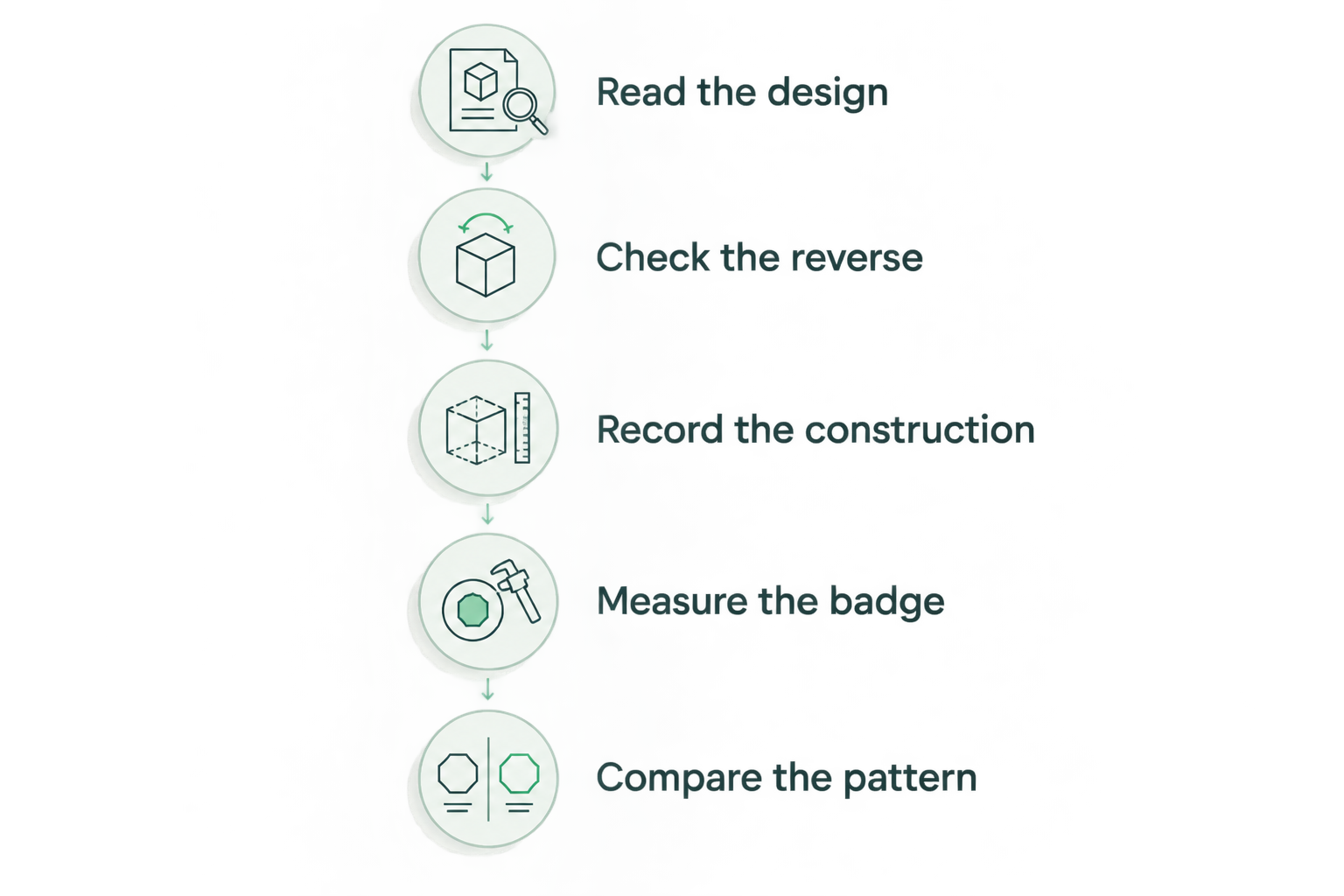
- Read the design. Record the title, motto, numerals and symbols. Distinguish a complete inscription from lettering hidden by wear.
- Check the reverse. Note maker's marks, attachment type, solder, repairs and any scratched identification.
- Record the construction. Describe separate components, visible metal colours and whether the badge appears stamped or cast. Do not identify an alloy by colour alone.
- Measure the badge. Record height and width in millimetres. Include a ruler in a separate photograph without covering the edges.
- Compare the exact pattern. Match the details against a reliable reference or an authenticated example, not merely an online listing title.
Keep observations separate from conclusions. Write slider fitting with visible solder rather than original wartime fitting unless you have evidence for that attribution.
A crown is a useful design detail, but it does not authenticate the object carrying it. Equally, a maker's name needs assessment alongside the badge's construction; a mark is evidence to examine, not a guarantee.
Why old military cap badge values vary
These factors explain why badges with similar fronts need separate assessments. None works as a reliable valuation shortcut on its own.
- Exact pattern and attribution. Confirm the regiment, unit or organisation and the specific design variant. A general resemblance is not enough for a like-for-like comparison.
- Originality. Distinguish an original issue example from a later reproduction. A reproduction has a different collecting purpose and must be described honestly.
- Condition and completeness. Record worn detail, missing parts, corrosion, damaged fittings and repairs. A clean-looking front does not cancel damage on the reverse.
- Construction and fittings. Compare materials, manufacture and attachments with references for that pattern. An unexplained difference needs investigation rather than an automatic claim of rarity.
- Documented provenance. Keep associated photographs, service papers and acquisition records. Explain exactly how they connect to the badge rather than relying on a family story alone.
- Comparable sales and buyer interest. Use results for the same type of badge in comparable condition. An exceptional result for another example is not a valuation for yours.
Age alone is not a valuation method. Neither is a disbanded regimental name, a dark surface or a seller's claim that a badge is scarce.
How do you check originality without damaging the badge?
Begin with photographs and reference material. Avoid scratch tests, bending attachments or removing a badge's finish to investigate the metal underneath.
Look at the whole object. Compare the front detail, edge profile, reverse and fittings with authenticated examples of the same pattern. Ask whether the features agree with one another rather than looking for a single supposed test that settles everything.
Surface colour is not proof of age. A bright badge is not automatically a reproduction, and a dark badge is not automatically an original.
Use the guide to spotting a fake British Army cap badge before accepting an attribution. If the construction remains uncertain, request a specialist opinion and describe the uncertainty plainly when selling.
For a 2026 sale listing, unverified attribution is more honest than attaching a confident historical description that you cannot support. Good photographs let a knowledgeable buyer assess the evidence for themselves.
What condition details should you record?
Describe damage precisely. Used is too broad to explain whether a badge has light handling marks, flattened detail, a broken attachment or a replaced component.
Front detail
Check lettering, high points, separate devices and fine areas of the design. Record missing pieces and visible distortion, and distinguish surface dirt from actual loss of metal where you can do so without cleaning.
Reverse and attachments
Check whether the fittings are present and secure without flexing them. Photograph solder, cracks and attachment points, including anything that looks repaired or altered.
Finish and previous treatment
Record polishing, paint, plating loss or other visible treatment without assuming when it happened. Do not polish a badge simply to make the valuation photographs look better. Abrasive polishing removes surface material and can soften detail.
If the badge remains attached to an old cap or display mount, photograph it in place first. Avoid forcing brittle fabric or fittings just to obtain a loose-object photograph.
How should you photograph a badge for valuation?
Prepare a simple photographic record before contacting a dealer, auctioneer or collecting specialist. Clear evidence is more useful than a dramatic photograph.
Take at least 3 photographs: a straight-on front view, a straight-on reverse view and a side view showing the fittings. Add close-ups where a mark, repair or separate component needs explanation.
Use diffuse daylight and a plain background. Keep the whole badge in focus, avoid filters and retain the original image files rather than relying on screenshots.
- Record height and width in mm.
- Keep a separate image with a ruler beside the badge.
- Photograph labels, envelopes and associated paperwork.
- Note any details that photographs do not show clearly.
For your 2026 records, date the photographs and keep each badge's notes together. If you have a collection, give each item its own reference so descriptions and pictures do not get mixed up.
How do you compare completed sales properly?
Search using the identified regiment or organisation, pattern details, construction and fitting type. Then inspect the photographs behind each result rather than trusting the title alone.
Read the condition report. A matching design with a missing fitting is not equivalent to an intact example; a lot containing several badges is not evidence of the value of each individual piece.
Keep a comparison sheet with these fields:
- Sale date and venue.
- Exact attribution and pattern.
- Construction and attachment type.
- Condition, repairs and missing components.
- Associated documents or other material.
- Whether the reported result includes charges.
Use several genuinely comparable results where possible. If the examples disagree sharply, check the differences before calculating an average that hides them.
For a 2026 assessment, prioritise relevant recent evidence while retaining older results as context. Record the actual sale dates rather than treating every result found online as current.
Where does retail surplus fit into a valuation?
Military Mart is best for collectors buying clearly described surplus cap badges, not for establishing auction values. The distinction matters when you are comparing a badge offered for purchase with one inherited from a relative.
Military Mart's cap badge listings include examples described as genuine, like new, or new and unused. Those descriptions help you understand the item being offered; they do not authenticate another badge with a similar design.
Retail examples provide a useful check on names and visible features. Their limitation is equally clear: a retail listing is neither a completed auction result nor evidence that your badge belongs to the same production period.
Are older cap badges always worth more?
No—older cap badges are not automatically worth more. Compare originality, exact pattern, condition and completed sales rather than arranging badges by apparent age and assuming the oldest wins.
Treat terms such as vintage, wartime and rare as claims requiring evidence. A description does not establish the object's history merely by repeating those words.
Should you sell an inherited collection as one lot?
Selling an inherited collection together simplifies the transaction, but it does not establish what each badge is worth. Individual identification takes more work and gives you a clearer basis for comparing offers.
Before separating anything, record the original arrangement and keep associated documents with the collection. Photograph first; rearrange later. An album label or accompanying photograph is part of the evidence to preserve.
Should you clean old military cap badges before selling?
Do not polish, chemically clean or repair an old military cap badge before assessment. Those actions change the object and remove evidence that a buyer or specialist needs to examine.
Keep loose badges dry and protected from rubbing against one another. If corrosion appears active or the badge is fragile, seek conservation advice rather than trying a household cleaning method.
FAQ
How much are old military cap badges worth in 2026?
Old military cap badges need individual valuation using exact identification, originality, condition and comparable completed sales. An asking figure for a similar-looking badge does not establish what yours will sell for.
How can I find out which regiment my cap badge belongs to?
Start with the badge's wording, motto, numerals and central emblem, then compare the complete design with a reliable regimental reference. Confirm the reverse and construction before assigning a production period.
Does a maker's mark prove a military cap badge is genuine?
A maker's mark does not prove authenticity on its own. Assess the mark alongside the design, manufacture, fittings and references for that exact pattern.
Is a broken fitting important when valuing a badge?
A broken fitting is an important condition detail and must be disclosed. Compare the badge with similarly damaged examples rather than assuming an intact example gives a direct valuation.
Can Military Mart retail listings tell me my inherited badge's value?
Military Mart retail listings describe the badges offered for purchase, not a valuation of your inherited example. Use matching completed sales and an assessment of your badge's originality and condition.
What photographs should I send for a cap badge valuation?
Send clear front, reverse and side photographs, plus close-ups of marks, fittings and damage. Include measurements and photographs of any associated labels or paperwork.
Should I repair a loose slider before getting a valuation?
Do not repair a loose slider before assessment. Photograph it clearly and disclose the fault so the badge can be examined in its existing condition.
One last thing
The most useful evidence might be beside the badge rather than on it. Before emptying a drawer or dismantling a display, photograph the envelopes, handwritten labels, cap and paperwork exactly as you found them.
Keep the family account too, but label it as an account rather than confirmed service history. A careful record preserves the distinction between what you know, what you were told and what still needs checking.


Leave a comment