

There is no single safe weight limit for a military ammo box: use the verified load rating for the exact model, then check the condition of the individual tin. A box’s ability to contain heavy kit does not establish what its handle, lid or stacking arrangement can safely support.
- How much weight can an ammo box hold? Only an exact-model load rating supports a specific weight limit.
- Military Mart surplus storage boxes suit buyers who check condition and intended use before loading kit.
- Payload, gross weight, handle load and stacking load describe different limits; do not treat them as interchangeable.
- Without a verified rating, do not assign a safe kilogram limit or use the box to support people.
How much weight can a military ammo box safely hold?
The safe limit must come from documentation for the exact box, not its appearance or calibre designation. Check whether that documentation describes contents weight, total loaded weight, carrying or stacking. Those are different questions.
For a 2026 surplus purchase, start with the model identification and condition description. Military Mart’s 50 cal ammo tin is a relevant storage option to investigate, but the product name alone does not establish a carrying capacity.
| Load description | What it means | What it does not establish |
|---|---|---|
| Payload | Weight of the contents | Total weight you must lift |
| Gross weight | Box plus contents | Whether a particular handle is fit to carry it |
| Handle load | Load permitted through the carrying arrangement | A safe seating or stacking load |
| Stacking load | Permitted load from boxes above, under stated conditions | A safe carrying load for each box |
A marking describing an original ammunition packing arrangement is not automatically a general-purpose safe working load. Establish what the marking means before using it to justify a load of tools, fixings or camping gear.
Why this matters
An ammo tin can become awkward to carry before it looks full. Dense workshop kit uses little space, while clothing fills a box without adding the same weight. Internal space is not a weight allowance.
The practical question is not just whether the contents fit. You need to know whether the box remains suitable for the load, whether its carrying parts are sound and whether you can move it safely along the intended route.
For 2026 workshop and camping use, keep the distinction simple: choose the box for the contents, then check the loaded weight and handling arrangement separately. Military origin does not remove those checks.
Which weight marking should you look for?
Look for an identifiable model, maker’s information and documentation that explicitly describes the permitted load. Match the details to the actual box, including its construction and carrying arrangement. A similar-looking tin is not enough.
Payload means contents only
A payload limit concerns what goes inside. It does not include the empty container unless the specification explicitly says otherwise. When you weigh a packed box, distinguish the contents weight from the reading for the whole package.
Do not subtract an empty weight taken from an unrelated online listing. Weigh your own box if you need its empty weight, especially when inserts, fittings or modifications are present.
Gross weight includes the box
Gross weight is the complete loaded package. That is the weight you move from the shelf to the vehicle, not just the kit inside. Include removable trays, padding and anything attached to the outside.
A gross-weight marking still needs context. Establish whether it describes the original packed contents or a permitted operating limit before treating it as a loading instruction.
Carrying and stacking need separate evidence
A box resting on its base follows a different load path from one suspended by its handle. Stacking adds another arrangement, with weight transferred through the contact points between containers.
Do not turn a storage claim into a lifting claim. If the documentation covers only one use, it does not answer the others. Ask for clarification rather than filling the gap with an assumed safety margin.
How do you check an ammo box before loading it?
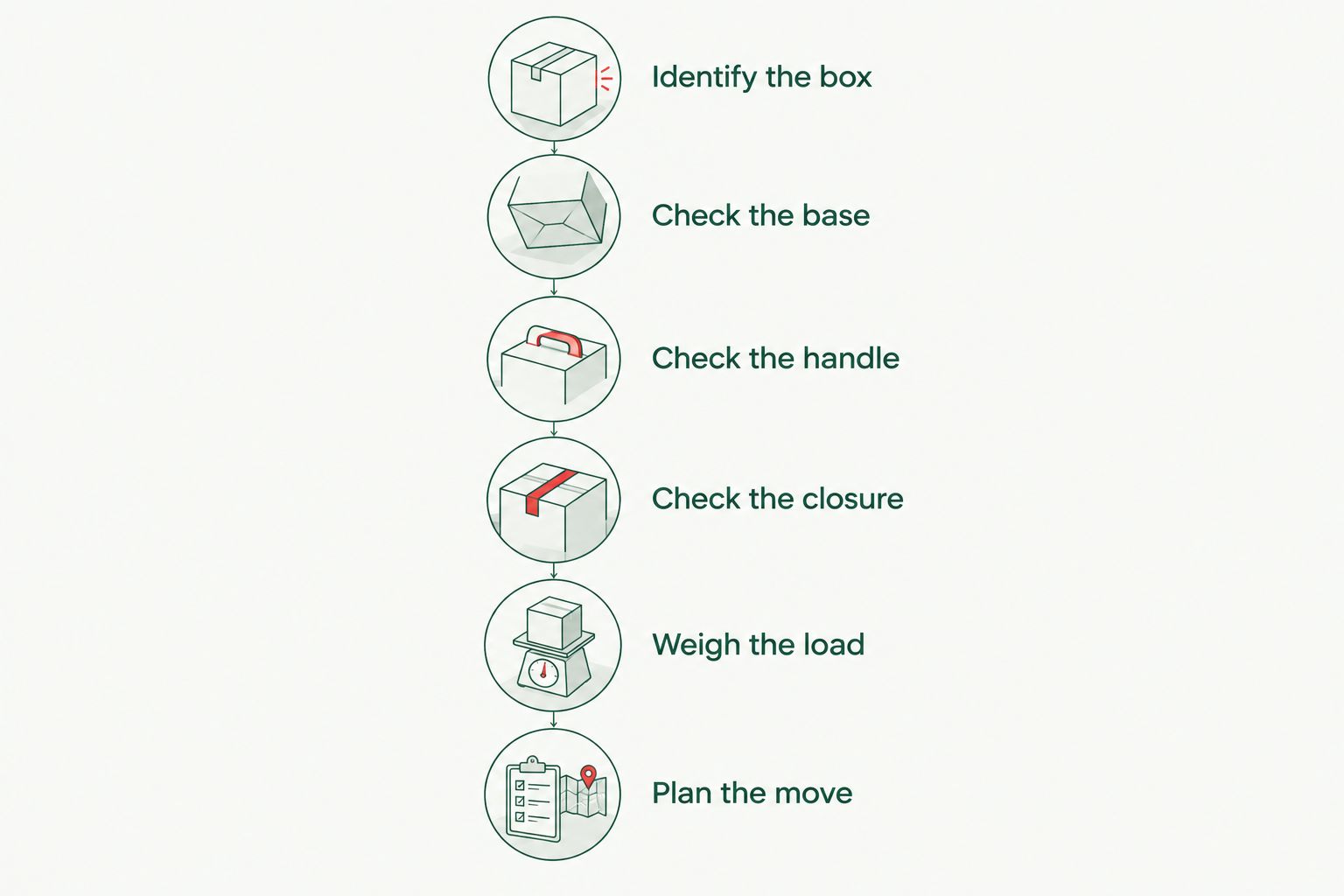
Use the same sequence for a workshop tin, camp storage box or collectible chest. An inspection helps identify reasons to reject a box; it does not certify an unknown load capacity.
- Identify the box. Record its markings, construction and any model information. Check that the documentation belongs to that design rather than a broadly similar container.
- Check the base. Empty the box and examine the underside, corners and seams. Look for holes, significant corrosion, distortion and repairs that need further assessment.
- Check the handle. Examine the grip, pivots, brackets and attachment points. Stop using the handle for carrying if an attachment is loose, cracked or visibly damaged.
- Check the closure. Inspect the hinge, latch and surrounding metal. Close the lid without forcing it; contents must not prevent the closure from engaging properly.
- Weigh the load. Weigh the complete packed box on suitable scales. Compare the result with the relevant verified limit and assess the handling task separately.
- Plan the move. Clear the route and decide where the box will be placed. Split the contents or use suitable handling equipment if carrying the package is awkward.
The order matters. There is little point weighing a carefully packed load if the handle bracket is already damaged, or searching for a capacity figure before identifying the box.
Keep fingers clear of the latch and hinge during inspection. If the lid needs pressure from the contents to stay shut, repack the box rather than using the latch to compress the load.
Why an ammo box’s usable load varies
A general answer cannot replace the details of the container in front of you. These checks apply to a 2026 purchase just as they do to a tin already sitting in the shed.
- Exact design. Steel tins, wooden chests and plastic containers have different construction. Do not transfer a rating between them because their outside dimensions look similar.
- Present condition. Corrosion, cracks, loose fittings and distorted panels need attention before loading. Cosmetic wear and structural damage are not the same thing.
- Carrying arrangement. Check the handle and its attachments, not just the body. A sound base does not prove that the carrying parts are sound.
- Load distribution. Loose, dense objects can shift during movement. Pack them securely and avoid concentrating the contents against a damaged panel or closure.
- Intended use. Shelf storage, hand carrying, vehicle transport and stacking involve different demands. Confirm the limit relevant to the actual task.
- Alterations. Drilled holes, replacement handles and added brackets change the original arrangement. Do not assume that original documentation covers an altered box.
Condition grading is not a kilogram rating. Read the seller’s grading explanation for what it covers, then seek separate evidence for any load-bearing claim.
How should you pack heavy kit in an ammo tin?
Start with the job, not the available space. Separate dense fixings or tools from bulky, lightweight kit if combining them creates an awkward package. There is no benefit in filling every gap when you still have to lift the result.
Keep the contents restrained so they cannot slide into the lid or strike the sides during normal handling. Use suitable dividers or packing for the items involved. Do not force an oversized tool diagonally across the box and rely on the closure to hold it down.
Protect the contents from each other as well as from the container. Bare terminals and sharp edges need appropriate protection; a metal tin is not, by itself, suitable packaging for every item. Follow the equipment manufacturer’s storage instructions where those apply.
For a 2026 kit sort-out, weigh the finished package before choosing its shelf position. Keep frequently moved heavy kit where you can reach it without stretching or lifting overhead. Check the shelf’s rating separately from the box’s rating.
Label the contents and measured gross weight if other people will move the box. That label records what you packed; it does not certify the container or guarantee that the load is suitable for every person.
Which surplus storage box suits the job?
Choose a storage format for access, contents and condition before considering appearance. Military Mart surplus storage suits practical buyers who want genuine issue kit with condition information. A military description still does not replace a documented load limit.
The following options illustrate different storage arrangements, not a ranking by strength. None should receive an assumed payload simply because it is described as military issue or Grade A.
| Storage option | Best for | Stated construction or condition | Limitation to check |
|---|---|---|---|
| Genuine British Military "Laycorn" (Lacon) Steel Storage Box – Grade A | Buyers wanting side-opening steel storage | Genuine MOD issue; side-opening steel; modular stackable design | Confirm the permitted carrying and stacking loads separately |
| Polish Army Wooden box chest for PM wz-1943 | Collectors seeking a wooden issue chest | Authentic Polish Army issue; Grade A | Check wood, joints and fittings; the issue designation is not a payload rating |
The steel option offers side access and a stated modular stacking design. The trade-off is that a stackable design description does not tell you how much weight the complete arrangement permits.
The wooden chest offers a different format for a collection or storage project. Its condition needs assessing as timber construction, not by applying the same checks used for a steel tin. Choose it for the format and provenance, not an unsupported strength claim.


Can you sit or stand on a military ammo box?
Do not use an ammo box as a seat or step unless it is specifically rated for that purpose. A carrying capacity would not establish a safe person-supporting load. Use equipment designed for seating or access instead.
Can you stack loaded ammo boxes safely?
Stack loaded boxes only within the documented stacking limits and arrangement for that model. Check the supporting surface and the condition of every container in the stack. Matching shapes or a flat lid do not establish a safe stack height.
Can you test the handle by adding more weight?
Do not use an improvised overload test to establish a safe carrying capacity. A handle surviving one lift does not provide a verified rating or show how it will behave after repeated use. Seek model-specific documentation instead.
FAQ
How much weight can an ammo box hold safely?
There is no universal safe weight limit for an ammo box. Use the verified rating for the exact model and load arrangement, then check the individual container’s condition.
Does 50 cal mean an ammo tin has a weight rating?
No, a 50 cal designation is not a weight rating. It does not state how much kit the tin or its handle can safely carry.
Is a Grade A ammo box certified for heavy loads?
Grade A is a condition description, not a certified load capacity. Read the seller’s grading explanation and check load documentation separately.
Should I include the empty ammo box when weighing my kit?
Include the empty box when measuring gross weight. Payload describes the contents, while gross weight includes the container and everything packed or attached to it.
Can I carry a rusty ammo tin by its handle?
Do not rely on a handle with corrosion damage, cracks or loose attachments. Inspect the handle mountings and surrounding metal, and remove a damaged box from carrying use.
Does a watertight seal mean an ammo box is strong enough for tools?
No, a watertight seal does not establish a carrying capacity. Water protection and load capacity require separate evidence.
Can I use an ammo box as a workshop step?
Do not use an ammo box as a step unless it is specifically rated for supporting people. Use a purpose-built step instead.
What should I do if I cannot verify an ammo box’s load limit?
Do not assign the box a safe kilogram limit. For a task that requires a known capacity, choose a container with a documented rating for that use.
One last thing
Write the measured loaded weight on the contents label, not an invented maximum capacity. Those labels do different jobs: one tells the next person what they are about to move; the other makes a claim about the container.
Before packing a surplus tin in 2026, ask a better question than whether it looks strong: can you identify the box, verify the relevant limit and inspect the parts carrying the load? If not, choose rated storage for the task rather than guessing.


Leave a comment