

An ex-military Land Rover is worth buying in 2026 if you want a hands-on restoration, a military collection vehicle or an older working vehicle with an inspection-backed maintenance plan. It is not the right choice if you need trouble-free daily transport and have no room for repairs or downtime. Buy on structural condition, mechanical evidence and paperwork—not military paint or a claimed service history.
- Is an ex military Land Rover worth it? Yes for a prepared enthusiast; not as an uninspected daily driver.
- Check chassis, bulkhead, drivetrain and civilian registration before committing to an ex-MOD vehicle.
- Military provenance supports authenticity; it does not prove present mechanical condition.
- Military Mart suits surplus buyers who value genuine kit and clear condition descriptions.
Is buying an ex-military Land Rover worth it in 2026?
Yes, when the individual vehicle fits your intended use and passes an independent inspection. Military ownership is part of its history, not a substitute for checking what survives underneath.
Military Mart deals in genuine surplus, military vehicles and spares. The same buying discipline applies across that kit: establish what it is, establish its condition, then decide whether it suits the job.
| Intended use | Best for | Main advantage | Main drawback | Verdict |
|---|---|---|---|---|
| Military restoration | Enthusiasts with workspace and specialist support | Preserving a vehicle's documented service configuration | Missing or altered fittings complicate restoration | Buy only after identifying the restoration work |
| Weekend use and lawful green laning | Owners comfortable maintaining older vehicles | Combining a vehicle hobby with outdoor use | Repairs and recovery arrangements need planning | Buy after inspection and a proper road test |
| Daily transport | Buyers with backup transport and realistic expectations | Regular use of a vehicle you enjoy | Downtime conflicts with essential journeys | Skip if uninterrupted transport is essential |
| Overlanding conversion | Builders who assess the base vehicle before adding equipment | A project built around your own requirements | Conversion work does not fix an unsuitable chassis or drivetrain | Wait until the base vehicle is proven |
These are buying decisions, not promises about every ex-military Land Rover. A well-documented vehicle with sound structure deserves a different assessment from an incomplete project wearing similar paint.
Why this matters
An ex-MOD Land Rover is a used vehicle first and a piece of military history second. Authenticity matters to collectors. Roadworthiness matters to everyone who intends to drive it.
Keep those assessments separate. An original military fitting is not evidence of a healthy gearbox, while replacement civilian parts do not automatically make a usable vehicle a bad purchase.
Before viewing, write down whether you want a restoration, a weekend vehicle or dependable transport. The right vehicle is the one that meets that brief without relying on repairs you cannot undertake.
What should you inspect before buying?
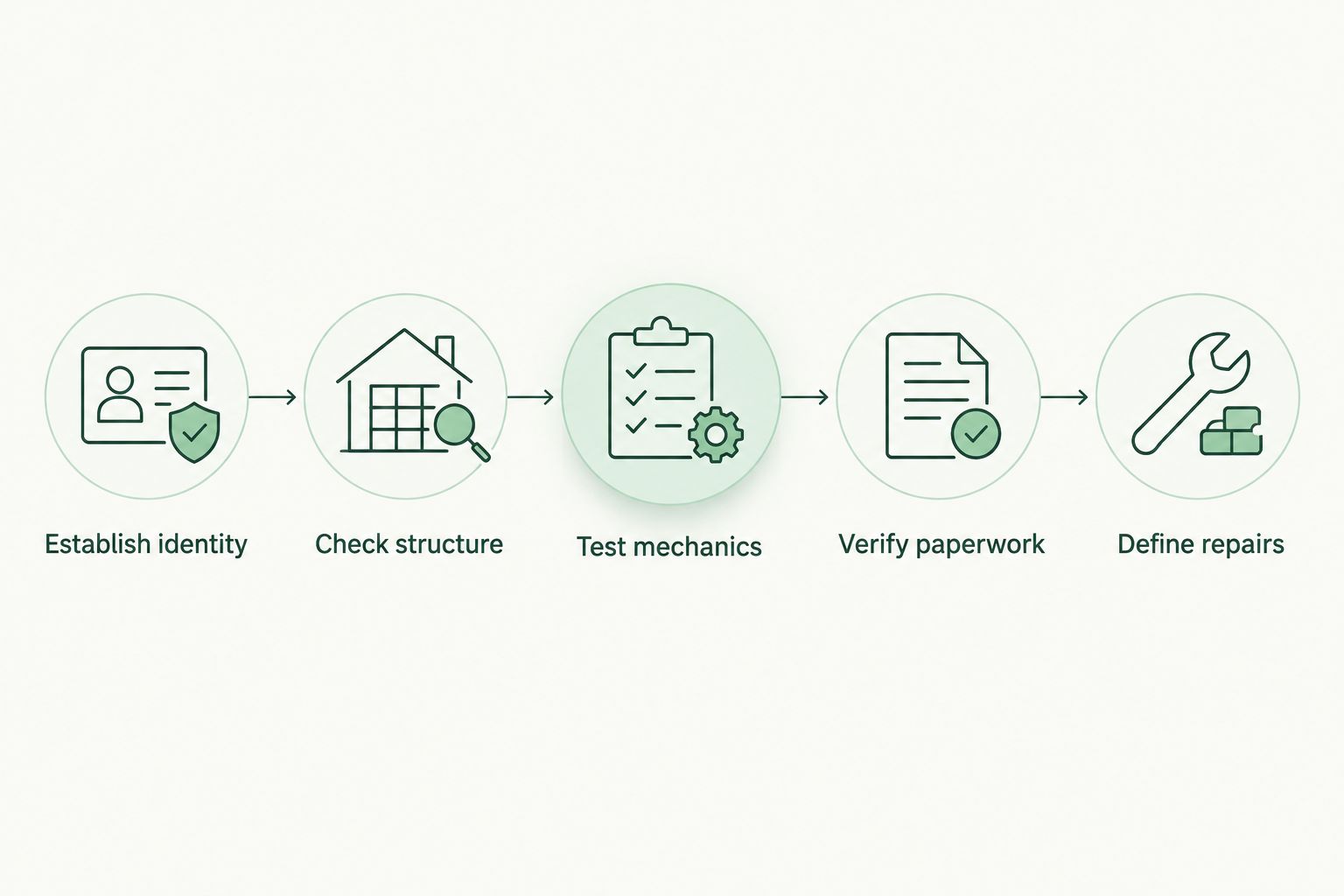
Use the following sequence to organise the viewing. It keeps identity and structural questions ahead of cosmetic details or accessories.
Establish identity
Match the vehicle's identification markings to the documents presented. Ask for evidence supporting the military history, rather than accepting camouflage, markings or a seller's description as proof.
Check what the paperwork actually establishes. A service document, disposal document and civilian registration record answer different questions; do not treat one as a replacement for the others.
Check structure
Have a competent Land Rover specialist inspect the chassis, bulkhead, outriggers, crossmembers and mounting points. Ask the inspector to distinguish surface corrosion from deterioration requiring structural repair.
Look closely at previous welding and areas covered by fresh coatings. New paint is neither proof of sound metal nor proof of concealment: it is a reason to inspect what lies beneath.
Never crawl beneath a vehicle supported only by a jack. Arrange safe access on suitable workshop equipment if the viewing location prevents a proper underside inspection.
Test mechanics
Request a cold start and confirm whether the engine has already been warmed. Watch how it starts, idles and responds, then let a specialist assess smoke, noises, leaks and cooling-system behaviour.
During an insured, lawful road test, check braking, steering, clutch operation and gear selection. Have the inspector assess the transfer box and four-wheel-drive controls using the correct procedure for that particular vehicle; do not experiment with unfamiliar controls.
Verify paperwork
Establish whether the vehicle is already registered for civilian road use. If not, confirm the current DVLA requirements and which supporting documents accompany the sale before committing.
Check the actual vehicle's MOT position, insurance eligibility and any proposed modifications. Do not assume that military history creates an exemption or that a registration document proves mechanical soundness.
Define repairs
Ask for a written inspection report separating safety defects, essential repairs and optional improvements. Identify parts by the vehicle's actual specification, including changes made since disposal.
Then decide who will do the work and where it will happen. A repair list is useful only when you have the skills, workshop access or specialist help to complete it.
Is an original military configuration the right choice?
Best for: collectors and restorers with a clearly defined historical brief. Start by identifying the configuration you intend to preserve, then compare the vehicle against supporting records and appropriate reference material.
Record missing fittings, replacement components and civilian alterations. Ask whether included loose parts actually belong to this vehicle, rather than assuming everything accompanying it is correct issue equipment.
The advantage is a restoration with a clear purpose. The drawback is that historical accuracy creates a different parts requirement from simply making a vehicle usable.
Keep removed original components labelled and documented. An alteration that suits a practical owner is not necessarily appropriate for a historically focused restoration. Buy for the evidence and completeness, not the appearance alone.
Is a modified vehicle better for practical use?
Best for: owners who prioritise usability over preserving an original configuration. Judge each modification by its installation, documentation and suitability for your intended use.
Ask who carried out engine changes, electrical alterations, seating work or accessory installations. Have the inspector examine mountings, wiring protection and any structural work, and tell the insurer about relevant modifications.
The benefit is equipment selected for a practical purpose. The drawback is extra work to establish exactly what has been fitted and how future replacement parts should be identified.
Do not assume a modified vehicle is improved merely because the equipment list is longer. Buy only when the alterations are understood and properly assessed.
Why does buying an ex-military Land Rover vary so much?
In 2026, the useful comparison is between individual vehicles, not between military and civilian paint schemes. These factors determine how demanding ownership will be:
- Structural condition: identify corrosion, previous repairs and mounting-point condition before assessing cosmetic finish.
- Mechanical condition: judge the engine, transmission, brakes and steering through inspection and testing, not a brief demonstration.
- Documentation: establish identity, military provenance, registration position and evidence of work already completed.
- Completeness: list missing fittings against your intended restoration or practical specification.
- Modifications: identify alterations and check their installation, suitability and disclosure to the insurer.
- Your support arrangements: establish workspace, tools, specialist access and backup transport before taking on the project.
Treat each factor as a separate decision. Good paperwork does not cancel structural defects, and a sound chassis does not establish that undocumented alterations are suitable.
Does ex-MOD mean it has been well maintained?
Ex-MOD identifies a previous owner; it does not establish present condition. Ask for the records that accompany the specific vehicle and check what period they cover.
A service history is useful evidence, but it does not describe everything that happened after the last recorded entry. Ask about subsequent use, storage, repairs and alterations, then compare the answers with the inspection findings.
Be equally careful with mileage claims. Check whether the reading is supported and whether instrument changes are documented; do not use a low displayed reading to dismiss corrosion or mechanical defects.
Military Mart's army surplus business places importance on honest condition descriptions. Apply that same standard to a vehicle: a description should identify known defects, not replace an inspection with the word genuine.
What should you check about military electrics?
Confirm the installed electrical system before buying accessories or attempting repairs. Military Land Rovers do not all share the same configuration, and previous owners' alterations need checking too.
A 12 V accessory must not be connected directly to a 24 V supply unless it is designed for that input. For a dual-rated 12 V/24 V accessory, still check the manufacturer's wiring instructions, protection requirements and intended use.
Ask a vehicle electrician to identify the system and examine added circuits, battery connections, earths and abandoned wiring. Do not infer the voltage from military appearance or from a switch panel alone.
The practical benefit of understanding the electrics is straightforward: you can specify compatible equipment and document repairs correctly. The limitation is equally clear—an accessory's voltage rating says nothing about the condition of the vehicle's wiring.
What should your ownership plan include?
Separate making the vehicle safe and usable from making it look right. Brakes, steering, tyres, structure and essential mechanical repairs belong ahead of paint, markings and camping equipment.
For a 2026 purchase, establish these arrangements before collection:
- A suitable place to keep the vehicle and carry out permitted work.
- A specialist inspection and an agreed list of immediate repairs.
- Insurance covering the actual vehicle, configuration and intended use.
- A lawful collection or transport plan if roadworthiness is unresolved.
- A method of identifying parts from the installed components.
- Backup transport if the Land Rover will support essential journeys.
Record repairs as you complete them. Photographs, component details and invoices help the next mechanic understand what is fitted, rather than repeating the identification work.
Do not begin an overlanding build until the base vehicle has been inspected and its essential repairs completed. Adding camping gear is a separate project, not a mechanical assessment.
Would hiring make more sense for a production or event?
Hire is the relevant alternative when you need a military vehicle for a defined film, promotional event or static display rather than ongoing ownership. Set out the required appearance, location, dates and whether the vehicle must move during the booking.
Military Mart supplies military vehicles and equipment for TV, film and promotional hire. Confirm the specific vehicle and arrangements for your brief rather than assuming a particular Land Rover is included.
Hiring avoids taking on a restoration project for a single production requirement. Its limitation is that the vehicle and permitted use must match the agreed booking. This is an event and production option, not a substitute for personal vehicle ownership.
Can you use an ex-military Land Rover every day in 2026?
An ex-military Land Rover suits daily use only when its condition, insurance and practical limitations match your journeys. Test the actual vehicle on an appropriate route and assess seating, visibility, controls and weather protection yourself.
If missing a journey would create a serious problem, arrange backup transport. Do not make essential travel depend on an unfamiliar project vehicle.
Is an ex-military Land Rover a good investment?
An ex-military Land Rover is not a guaranteed investment. Buy because you want to own, use or restore that vehicle, and assess its documentation and condition without assuming future appreciation will cover the work.
Keep a record of alterations and retain relevant original components. That supports an informed future sale without promising a financial return.
Should you buy a restoration project or a usable vehicle?
A restoration project suits a buyer with workspace, skills and a defined restoration brief. A usable vehicle suits someone who wants to drive sooner, but still needs inspection and evidence supporting its condition.
Compare what remains to be done, not how confidently each vehicle is advertised. Choose the workload you can finish.
FAQ
Is an ex military Land Rover worth it for a first-time owner?
An ex-military Land Rover is worth considering for a first-time owner who arranges a specialist inspection and has a realistic maintenance plan. It is a poor fit if you need uninterrupted transport without repairs or downtime.
Does genuine ex-MOD history prove a Land Rover is reliable?
Genuine ex-MOD history does not prove current reliability. Check the specific vehicle's records, structural condition and mechanical performance separately.
What's the most important thing to check before buying?
Establish vehicle identity and structural condition before planning cosmetic work. Have a competent specialist inspect the chassis, bulkhead and previous structural repairs.
Are all military Land Rovers 24 V?
Military Land Rovers do not all share the same electrical configuration. Confirm the system installed in the actual vehicle before connecting accessories or replacing electrical components.
Can I drive an ex-military Land Rover home after buying it?
Drive it home only after confirming roadworthiness, registration, insurance and applicable legal requirements. Arrange suitable transport when any of those points remains unresolved.
Should I modify an ex-military Land Rover for camping straight away?
Complete the base vehicle's inspection and essential repairs before starting a camping conversion. Check proposed loads, mountings and insurance implications before adding equipment.
Does Military Mart deal with military vehicle projects?
Military Mart sells military vehicles and spares and supplies vehicles and equipment for TV, film and promotional hire. Confirm the requirements of your specific project rather than assuming a particular vehicle or component is included.
One last thing
Before buying in 2026, ask the inspector to describe the vehicle without mentioning its paint, markings or military history. If the remaining description is unresolved structural work, unidentified alterations and uncertain paperwork, you have a project—not a ready-to-use vehicle.
Buy the vehicle you can properly maintain, not the military appearance you can picture on the driveway.


Leave a comment