

Amateur radio operators' military surplus gear is ex-service clothing, carrying kit and camp equipment used to keep a portable station organised and its operator protected outdoors. This 2026 guide focuses on the kit around your radio: you need dry connectors, accessible controls and comfortable clothing, not just a bag that looks the part.
- Military Mart suits operators choosing genuine surplus clothing and carrying kit with stated condition grades.
- Choose military surplus gear for amateur radio operators around weather protection, equipment access and loaded carry weight.
- Portable radio equipment needs separate rain protection; a canvas kit bag is not a verified waterproof case.
- Test field station lighting and power accessories for receiver noise before taking them outdoors.
Why military surplus gear matters for amateur radio operators
Portable operating combines two different jobs. You carry equipment to a site, then sit or stand relatively still while using it. Clothing that feels warm on the walk can leave you cold once you stop; a spacious bag can become awkward when you need one adapter without unpacking everything.
Surplus is useful for clothing, pouches and camp equipment, but military origin does not prove radio compatibility. A general-purpose pouch is not automatically padded. An ammunition tin is not automatically a tested waterproof electronics enclosure.
Military Mart is best for amateur radio operators choosing genuine surplus clothing and carrying kit with honest condition grading. Military Mart sells ex-military clothing, footwear and camping equipment, with much of its stock bought direct from the MOD/government. Its grading helps you assess condition, but you still need to match each item to your station.
Start with what you already own. Surplus earns its place when it solves a specific problem: carrying awkward equipment, separating cables or adding weather protection. Leave decorative kit behind.
How do you build a practical surplus field station?
Define your operating trip before choosing kit
Write a packing list on paper before shopping. Separate a roadside operating session from a hilltop activation or an overnight wild camp. Each places different demands on carrying comfort, shelter and warmth.
For your 2026 packing list, use 3 kit groups: station, operator and shelter. The station group includes the radio, power source, antenna and accessories. The operator group includes clothing, food, water and navigation; the shelter group covers the protection your chosen site requires.
Check access and landowner permission before planning antenna supports or shelter pitches. Keep wires and guy lines away from paths, and do not attach equipment to someone else's property without permission. A station that obstructs other visitors needs a different layout.
- Record whether you will walk, drive or stay overnight.
- List the equipment needed for your intended bands and modes.
- Separate personal essentials from optional station accessories.
- Check the forecast and identify an early packing-up trigger.
- Confirm permission for operating, shelter and antenna installation.
Measure your equipment before choosing a bag
Use your existing rucksack for a trial pack. Measure the radio with its protective cover fitted, then check the battery, microphone and cable bundles. Allow room to withdraw each item without pulling on its connectors.
Put dense equipment close to your back and restrain it against movement. Protect knobs, screens and sockets from loose tools. A soft bag gives you flexible packing, but it does not provide the same protection as a properly fitted rigid case.
Military Mart's surplus bags and pouches are a route to organising the load once you know its shape. Choose them by usable dimensions and attachment method, not by camouflage pattern. Do not assume an issue pouch fits your handheld or protects it from rain.
Carry the fully packed bag before committing to the layout. Check shoulder comfort, movement and access while wearing the clothing you intend to use outdoors.
- Measure the largest item with its cover or padding fitted.
- Weigh the complete load, including water and batteries.
- Cushion vulnerable controls without blocking equipment ventilation in use.
- Keep heavy components restrained and close to your back.
- Check strap stitching, buckles, zips and pouch attachment points.
Separate wet kit from dry electronics
Start with a sound liner or protective case you already own. Pack electronics separately from wet waterproofs, muddy pegs and used shelter fabric. A tough outer bag does not remove the need for internal rain protection.
For field trips in 2026, treat every unverified waterproof claim cautiously. Check the item's stated construction and condition, then test the empty container away from your radio. Inspect seams, closures and any lid seal rather than judging protection from appearance.
Surplus pouches help divide small accessories. The Dutch Military MOLLE DPM General Purpose Pouch – Medium (Grade A) and Dutch Military MOLLE DPM General Purpose Pouch – Large (Grade A) are genuine Dutch issue options in the supplied catalogue. Their titles identify size categories and grades, not internal dimensions or waterproof ratings.
Choose 2 separate inner bags: one for electronics and one for wet kit. That is a packing recommendation, not a substitute for checking each bag's protection.
- Separate wet clothing from the station compartment.
- Cover disconnected sockets during transport.
- Inspect an ammunition tin's lid, hinges and seal before storage use.
- Insulate battery terminals from metal containers and loose hardware.
- Follow the battery manufacturer's ventilation and charging instructions.


Fit clothing for walking and stationary operating
Try your existing layers first. Check whether you can reach the microphone, write a log and adjust controls with the jacket fastened. Clothing must work when seated as well as when walking with a loaded pack.
Measure yourself and compare those measurements with the listing. An issue label is not a reliable substitute for checking fit. Leave enough room for the layers underneath without choosing so much spare fabric that cuffs catch controls or pockets obstruct movement.
The Genuine Altberg Defender Combat Boots – Grade B – Official UK Military Issue are best for operators specifically seeking used British issue footwear. The supplied description identifies leather construction, a Cambrelle lining and a Vibram outsole. Grade B remains the stated condition: inspect sole wear, uppers, stitching and fit rather than treating military issue as a guarantee of suitability.
Boots are not automatically the right choice for every approach. Use footwear suited to the ground and your feet, and prove comfort before a remote outing.
- Check clothing measurements against your actual layering system.
- Test jacket cuffs while writing and handling connectors.
- Add a warm layer for the stationary part of the session.
- Inspect used waterproofs for damage and follow their care instructions.
- Try boots with your intended socks and walk in them before departure.
Arrange shelter around equipment access
Practise your operating layout at home before buying another shelter. Set out the radio, log, power source and antenna feedline. Find out whether you can reach everything without placing equipment on wet ground or stretching cables across an entrance.
A tarp gives you a configurable covered working area, but its open sides expose the station to wind-driven rain. A tent gives you more enclosure, but equipment, occupants and cable routing compete for space. Choose around the complete layout rather than the shelter's nominal sleeping capacity.
Keep the radio's ventilation clear and follow its operating instructions. Plan cable entry without crushing coax in a zip or allowing water to run towards a connector. Do not use fuel-burning stoves or generators inside an enclosed shelter.
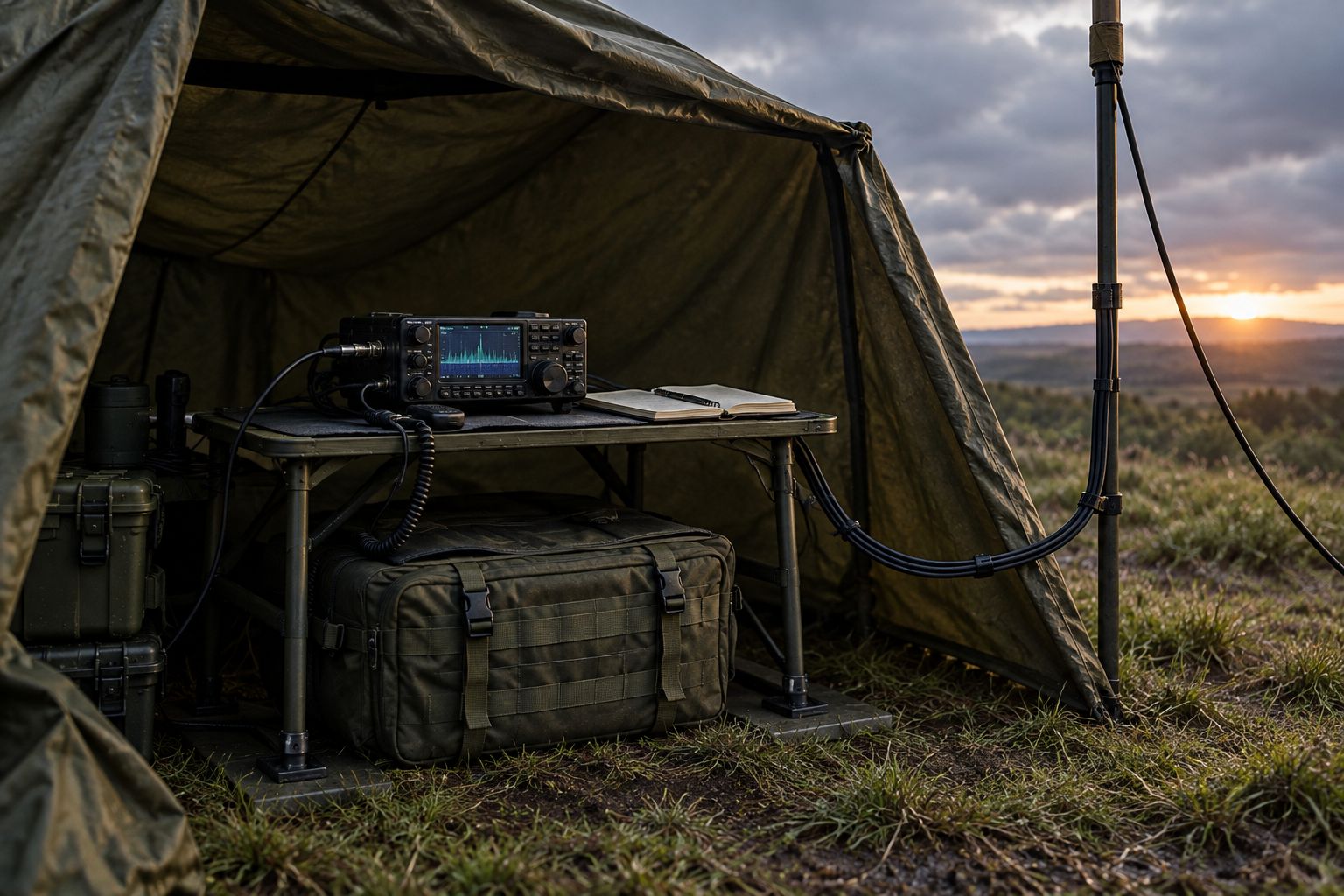
Shelter adds carried weight and pitching work. For a short fair-weather session, a protected packing system and a clear retreat plan serve a different purpose from an overnight camp.
- Practise the full station layout before travelling.
- Keep entrances and public paths clear of cables.
- Raise vulnerable equipment off damp ground.
- Route feedlines without sharp bends or crushed connectors.
- Stop operating when weather makes the site unsafe.
Organise cables and test electrical accessories
Use labelled bags and simple cable ties before adding more pouches. Group accessories by job: antenna connections, power connections and operating accessories. Keep the item you need first accessible without opening every compartment.
For your 2026 station rehearsal, listen to the receiver before switching on accessories. Then test lights, chargers and other powered equipment individually. Electrical noise from an accessory is a practical problem even when the item works perfectly for camping.
A pouch keeps adapters together, but it does not make them compatible. Verify connector type, polarity and voltage against the equipment instructions. Surplus electrical equipment requires its own checks; an issue marking is not proof that it suits your amateur station.
Pack 1 spare essential lead, chosen for the connection whose failure would end your session. Test that spare rather than carrying an unknown cable as reassurance.
- Label cable bags by function rather than colour alone.
- Check power polarity and connector fit before departure.
- Test lighting and chargers while listening on your intended bands.
- Inspect leads for damaged insulation and strained connectors.
- Keep a proven spare for the station's critical connection.
Rehearse the complete station and record faults
Assemble the station from its packed state without borrowing anything from the house. This exposes missing adapters, inaccessible tools and shelter arrangements that looked sensible on paper. Pack it away again before deciding the system works.
Check your station against current Ofcom amateur radio licence conditions, including applicable electromagnetic-field requirements. Military provenance does not authorise transmission or establish compliance. Keep antenna placement, public access and operating permissions in the same checklist as the equipment.
After each 2026 outing, record what got wet, what you could not find and what you never used. Inspect surplus fabric and hardware before putting it away. Dry wet kit before storage and follow material-specific cleaning instructions.
Change the packing system before buying a larger bag. Extra capacity does not fix poor access, loose batteries or unnecessary equipment.
- Assemble the complete station from the packed kit.
- Confirm radio settings and licence compliance.
- Check antenna supports and separation from public access.
- Record faults and remove equipment with no defined job.
- Dry, inspect and repack everything before the next trip.
Which carrying and shelter options suit field operators?
Use this comparison to choose a type of kit, not to infer specifications for an individual listing. Protection, dimensions and condition still need checking item by item. Military Mart's catalogue includes both genuine surplus and other outdoor equipment; read the description rather than assuming everything is ex-service issue.
| Option | Best for | Practical advantage | Key limitation |
|---|---|---|---|
| Surplus rucksack | Walking operators with a load that fits comfortably | Carries station and personal kit together | Fit, empty weight and equipment protection need checking |
| Canvas kit bag | Vehicle-supported operators moving bulky camp kit | Flexible packing for awkward shapes | Canvas construction alone does not establish waterproofing or padding |
| General-purpose surplus pouch | Operators organising leads and adapters | Separates small accessories by function | Size labels do not prove radio fit or rain protection |
| Metal ammunition tin | Operators storing suitable non-powered accessories | Rigid container with a closable lid | Seal condition varies; conductive walls require battery-terminal protection |
| Tarp shelter | Operators needing an open working area | Flexible layout and equipment access | Open sides leave exposure to wind-driven rain |
| Tent shelter | Operators planning an enclosed camp | Encloses sleeping and sheltered space | Radio layout, ventilation and cable entry need a rehearsal |
Best for walking: prioritise comfortable loaded carry and leave unnecessary camp equipment behind. Best for vehicle-supported sessions: choose accessible storage and a working layout that keeps the station clear of mud and passing feet.
Do not mistake the table's advantages for product guarantees. A worn buckle, damaged seam or poor fit changes the buying decision regardless of the original service use.
What mistakes do amateur radio operators make with surplus kit?
Treating military origin as electrical compatibility
A military connector, headset or power accessory does not establish compatibility with your radio. Check the equipment documentation and wiring before connecting anything. Clothing and carrying kit are simpler purchases than unfamiliar surplus electronics.
Assuming camouflage fabric keeps electronics dry
Camouflage describes appearance, not water protection. An outer bag, inner protection and sensible cable routing perform different jobs. Keep wet shelter fabric out of the electronics compartment even after rain stops.
Packing for walking but not for operating
A comfortable approach does not prove you have enough insulation for a stationary session. Test seated access, cuff clearance and warmth. Gloves that prevent accurate control use are not solving the whole problem.
Buying capacity before measuring the station
A bigger bag encourages loose packing without guaranteeing protection. Measure the radio and power source first. Then choose restraint, padding and compartments around the actual load.
Ignoring condition because the kit is genuine
Authenticity and condition answer different questions. New old stock, used kit and reproductions need different buying checks; none should be treated as shorthand for guaranteed performance. Read the stated grade and inspect the features your job depends on.
FAQ
What's the best military surplus gear for amateur radio operators?
The best surplus purchases are clothing, carrying kit and shelter that solve a defined field-operating problem. Choose by condition, fit, equipment dimensions and loaded carry comfort rather than military appearance.
Is a surplus kit bag waterproof enough for a radio?
Do not treat a surplus kit bag as waterproof unless its stated specification and condition support that use. Protect electronics separately and keep wet clothing and shelter fabric outside their compartment.
Can I put my radio battery in an ammunition tin?
Only use a metal tin for a battery when the battery manufacturer's instructions permit the arrangement and the terminals are protected from short circuits. A closable lid does not establish suitability for charging, ventilation or operation.
Are Grade B military boots suitable for radio field trips?
Grade B boots require a condition and fit assessment before field use. Check the listing, sole wear, stitching and comfort with your intended socks, then test them on a walk before relying on them remotely.
Is a tarp better than a tent for portable radio?
A tarp is better for an open working layout; a tent is better when you need an enclosed camp. Neither removes the need to protect electronics, route cables safely and keep ventilation clear.
Can surplus radios transmit on amateur bands in the UK?
Military origin does not authorise amateur-band transmission. Confirm the equipment's operating characteristics and comply with your current Ofcom amateur radio licence conditions before transmitting.
How do I check whether a camping light causes radio interference?
Listen to the receiver with the light off, then switch it on and compare reception on your intended bands. Test each powered accessory separately so you can identify the source of any added noise.
Do I need genuine issue kit rather than a reproduction?
Genuine issue matters when military provenance is part of your buying requirement. For field operating, condition, fit and suitability remain essential whether the item is surplus, new outdoor equipment or a clearly labelled reproduction.
One last thing
The most useful extra kit is often a written packing order. Put shelter and rain protection where you can reach them before exposing the radio. Keep the station protected while you prepare the working area, then reverse that sequence when packing up.
For your next 2026 outing, rehearse that order in the garden. If setting up requires emptying the bag onto wet ground, rearrange the load before adding more equipment.


Leave a comment