

Across three ammo boxes with complete listed dimensions, the average calculated cuboid volume is 39.1 litres, ranging from 19.6 to 75.5 litres—but those figures are not usable storage capacities. This 2026 guide to ammo box sizes and capacities uses Military Mart product descriptions to separate listed measurements, calculated volume and stated capacity.
- Military Mart ammo box sizes and capacities need model-specific checks: calibre names do not establish storage volume.
- Three dimensioned ammo boxes span 19.6–75.5 litres in calculated cuboid volume, not confirmed usable capacity.
- The Polish / Russian ZU-23 Crate Ammo Box lists approximately 32 litres and a weight of 12kg.
- Choose surplus storage by internal clearance, lid access and condition—not the largest dimension alone.
Why this matters
An ammo box can fit your shelf and still fail to take your kit. Wall thickness, partitions, the lid opening and fittings all affect what goes inside; handles and catches affect where the box fits outside.
Military Mart is best for surplus storage buyers who want genuine issue kit and item-specific condition descriptions. The trade-off is that different military patterns do not provide a uniform set of measurements, so compare the actual descriptions rather than treating every ammo tin as a standard size.
What sizes do the listed ammo boxes measure in 2026?
Calculated cuboid volume means multiplying the three listed dimensions. It gives a common mathematical comparison, not a measurement of the space available inside.
| Ammo box type | Listed dimensions | Calculated cuboid volume | Best for, subject to fit checks | Main limitation |
|---|---|---|---|---|
| 40mm Ammo Tin grade B | 47 × 16 × 26cm; axis order not stated | 19.6 litres | Buyers needing a narrow listed dimension | Grade B description flags corrosion/paint condition |
| Swedish Army Vintage Wooden Ammo Box | 43 × 26 × 20cm; axis order not stated | 22.4 litres | Collectors wanting a wooden box with rope handles | Age-related imperfections are stated |
| Polish / Russian ZU-23 Crate Ammo Box | 86cm wide × 39cm deep × 22.5cm high | 75.5 litres | Buyers needing a long wooden crate | Listed weight is 12kg; stated capacity is approximately 32 litres |
| Overall: three listed boxes | Complete measurement sets only | Mean 39.1 litres; range 19.6–75.5 litres | Comparing listed size on the same calculation | Not an average usable capacity |
The Polish / Russian ZU-23 Crate Ammo Box has the largest calculated cuboid volume at 75.5 litres; the 40mm Ammo Tin grade B has the smallest at 19.6 litres. The Swedish Army Vintage Wooden Ammo Box sits between them at 22.4 litres.
Source and method: this 2026 comparison uses the supplied Military Mart descriptions for these three products, multiplying listed dimensions in centimetres and converting cubic centimetres to litres, rounded to one decimal place. The descriptions do not establish a consistent internal-versus-external measurement basis, so the calculated figures cannot establish usable capacity or a market-wide average.
Why does the ZU-23 list approximately 32 litres?
The Polish / Russian ZU-23 Crate Ammo Box description gives both its dimensions and an approximate capacity of 32 litres. Multiplying its listed dimensions produces 75.5 litres, which is a different figure.
Do not replace the stated 32-litre capacity with the calculated 75.5-litre figure. The description does not explain the difference, so neither figure proves that a particular object fits. Get internal measurements before choosing the crate for a close-fitting insert or piece of equipment.
How should you use these benchmarks?
Use the 2026 table to make a shortlist, then check the measurements that decide fit. These are the practical takeaways:
- For a narrow storage space: start with the 40mm Ammo Tin grade B and its listed 16cm dimension. Confirm the axis and whether handles or catches extend beyond it.
- For a smaller wooden footprint: compare the Swedish Army Vintage Wooden Ammo Box at 43 × 26 × 20cm against your shelf and contents. Do not treat its calculated 22.4 litres as internal capacity.
- For long equipment: investigate the Polish / Russian ZU-23 Crate Ammo Box, listed at 86cm wide. Check internal length and the opening before relying on that width.
- For regular carrying: consider weight separately from size. The ZU-23 description lists 12kg before you add your own kit.
For the buying sequence, use the guide to choosing the right ammo box size for your storage needs. Start with the object you need to store, not the military marking on the lid.
What do ammo box names actually tell you?
Calibre labels identify the box type or its original application. They are not litre capacities: a 40mm tin is not a 40-litre container, and a 50 cal marking does not tell you its internal dimensions.
Model names need the same care. A tall tin, a medium-calibre box and a wooden crate should not be treated as interchangeable because all appear under ammo storage.
| Named option | Facts stated in the supplied description | Best for | What to check before choosing |
|---|---|---|---|
| Genuine US / Italian Military 50 Cal Ammo Tin – Grade A | Genuine military issue; rubber seal; described as near-mint | Buyers prioritising a sealed metal tin in the described condition | Internal dimensions, seal condition and fit |
| Genuine Military Tall 50 Cal Ammo Tin – Grade Used | Steel construction; rubber seal; stackable storage | Buyers investigating a taller metal storage format | Actual height, internal clearance and used condition |
| PA156 Large Metal Mortar Ammo Box - Brand New Genuine Military Surplus | Metal storage container; described as oversized | Buyers investigating a larger metal format | Measurements rather than the word oversized |
| L17A1 Medium Calibre Ammo Box - Brand New Genuine Military Surplus | Manufactured to MOD Drawing No. SV575A | Collectors identifying this particular box pattern | Dimensions and suitability for the intended contents |
These descriptions establish useful differences, but they do not support a shared capacity ranking. Choose the named pattern only after its measurements match your job.
Which measurements should you check before buying?
Measure the contents first, including any case, padding or protective wrapping. Then compare the internal space, the opening and the outside of the box separately; each answers a different question.
- Contents: record the widest, longest and tallest parts of the packed item.
- Internal clearance: check the usable space around partitions, braces and fittings.
- Lid opening: confirm that the packed item passes through the opening.
- External fit: allow room for handles, catches and opening the lid.
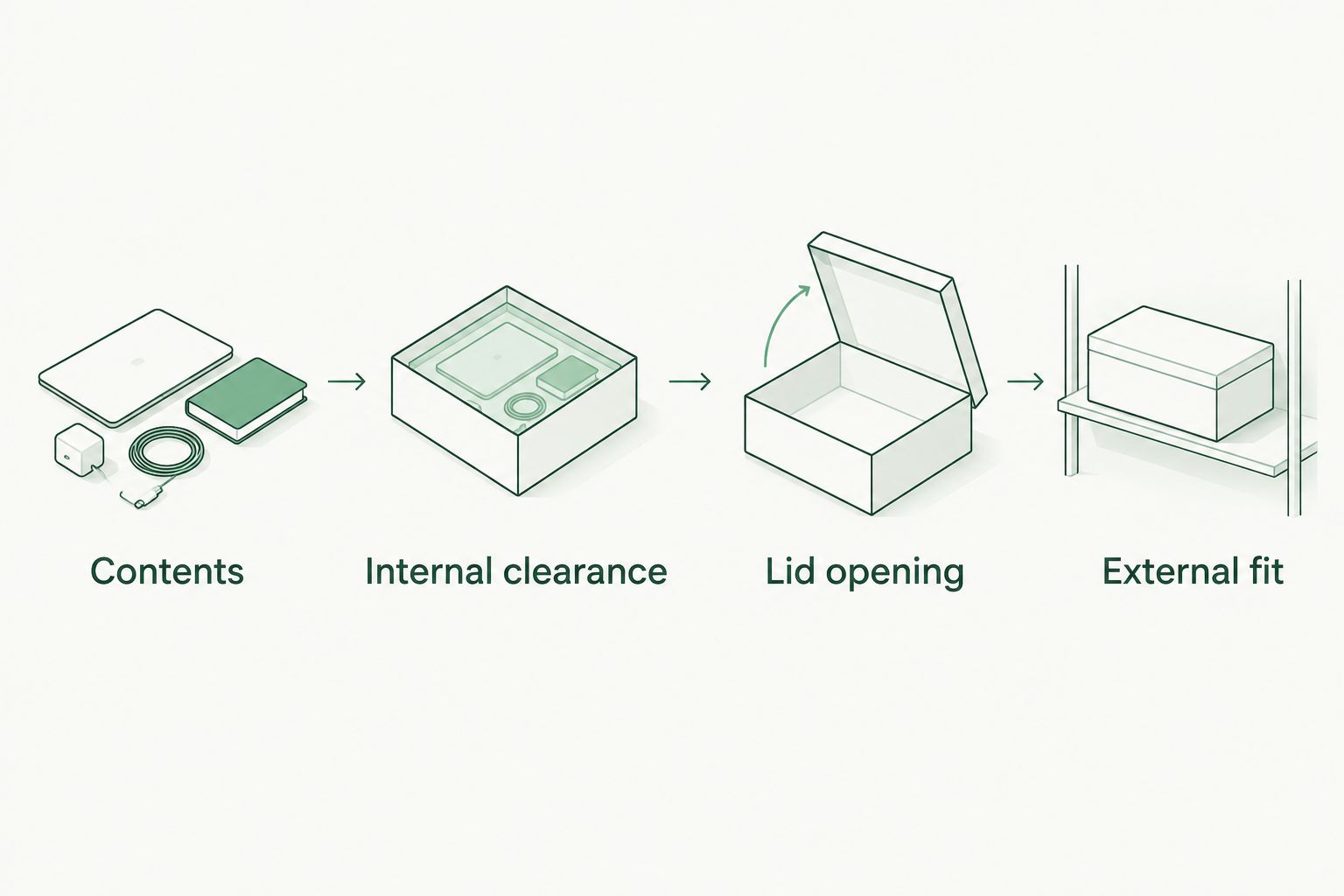
For a shelf, check the space above the box as well as the shelf depth. A hinged lid needs opening room; a removable lid still needs somewhere to lift clear and set down.
For a vehicle, measure the access route. A box that fits the final storage position is no use if it will not pass through the doorway or boot opening in the orientation you need.
How do you calculate volume without overstating capacity?
For dimensions in centimetres, multiply length by width by height, then divide by 1,000 to obtain litres. Keep the measurement basis attached to the result: internal measurements describe a different space from external measurements.
The 40mm Ammo Tin grade B illustrates the distinction. Its listed 47 × 16 × 26cm dimensions produce a calculated cuboid volume of approximately 19.6 litres, but the description does not identify that as usable internal capacity.
Round a comparison figure sensibly. Extra decimal places do not make an uncertain measurement basis more reliable, and a litre total does not describe whether a long, rigid object fits.
For rigid kit, compare dimensions before litres. For loose items in organisers, check the organiser dimensions too; unused gaps around trays are not useful storage just because they sit inside the box.
Which dimensioned boxes are worth a closer look?
These three boxes underpin the size comparison. None is the automatic choice for every workshop, wild camp or collection; each suits a different shape and condition requirement.
40mm Ammo Tin grade B
Best for: buyers investigating a narrow metal storage format. The description states genuine ex-MOD surplus, a removable lid, two handles and a stackable design. Listed dimensions are 47 × 16 × 26cm.
The compromise is condition. The Grade B description flags corrosion/paint condition, so assess that against what you intend to store rather than choosing on dimensions alone. Verdict: Hold until condition and internal fit are confirmed.
Swedish Army Vintage Wooden Ammo Box
Best for: collectors wanting a wooden box with rope handles. The description lists a leather tag lock and dimensions of 43 × 26 × 20cm, with Grade A condition qualified by age-related imperfections.
Those details suit an authenticity-led purchase, but they do not establish weatherproofing or a safe carrying load. Check the wood, joints, handles and closure before using an old crate for regular transport. Verdict: Hold until condition suits the intended use.
Polish / Russian ZU-23 Crate Ammo Box
Best for: buyers investigating a long wooden storage crate. The description states Polish Army issue, Grade A, dimensions of 86 × 39 × 22.5cm, approximately 32 litres and a weight of 12kg.
The long format is the reason to investigate it; the stated weight is the reason to plan handling before filling it. Resolve the internal measurements rather than relying on the larger calculated cuboid figure. Verdict: Hold until usable space and handling are confirmed.


How do condition and seals change the decision?
Condition is separate from size. A tin can have the right dimensions but an unsuitable closure, while a wooden crate can suit a collection without being the right container for damp-sensitive equipment.
Military Mart's surplus storage descriptions distinguish new, used and graded items, with individual qualifications. Read those qualifications: the Swedish wooden box explicitly allows age-related imperfections, while the 40mm tin flags corrosion/paint condition.
A rubber seal is a feature to inspect, not permission to assume an immersion rating. For your 2026 buying check, examine the seal, lid alignment, catch and contact surfaces; use separate suitable protection for contents that must stay dry.
FAQ
What are the average ammo box sizes and capacities in 2026?
There is no single average capacity established by this comparison. Three dimensioned ammo boxes average 39.1 litres in calculated cuboid volume, with a range of 19.6–75.5 litres, but those figures are not confirmed usable capacities.
How big is the 40mm ammo tin?
The 40mm Ammo Tin grade B lists dimensions of 47 × 16 × 26cm. The description does not identify the axis order or establish that these are internal measurements, so confirm both for close-fitting storage.
How many litres does the ZU-23 wooden ammo crate hold?
The Polish / Russian ZU-23 Crate Ammo Box description states approximately 32 litres. Its listed dimensions are 86cm wide, 39cm deep and 22.5cm high; do not substitute their calculated cuboid volume for the stated capacity.
Are all 50 cal ammo tins the same size?
Do not assume that every 50 cal ammo tin has the same dimensions. The supplied range includes a separately named tall version, so check the specific tin's measurements before choosing an insert or storage position.
Can I work out usable capacity from outside dimensions?
Outside dimensions do not establish usable internal capacity. Walls, fittings, partitions and the lid shape affect the space available, so use internal measurements for packing decisions.
Does Grade A mean an ammo box is waterproof?
A condition grade alone does not establish waterproof performance. Check the individual description, seal and closure, and do not infer a tested immersion rating from the grade.
Which ammo box is best for tools and workshop kit?
The best ammo box for tools is the one that fits the packed tools, opens in its storage position and has suitable condition and handling arrangements. Compare internal clearance and weight before choosing by litre capacity.
One last thing
Make a full-size cardboard template of your packed kit before choosing a close-fitting box. Include the organiser or padding, then check the opening—not just the inside floor.
The smallest opening can decide the purchase before the largest dimension matters. That is the useful rule to take from this 2026 size comparison.


Leave a comment