

The basic army cadet badge chart by rank is: cadet, no rank badge; lance corporal, 1 chevron; corporal, 2 chevrons; sergeant, 3 chevrons; staff sergeant, 3 chevrons with a crown above. This 2026 Military Mart reference explains those badges, separates rank from training awards, and shows what to check before changing your uniform.
- Military Mart’s army cadet badge chart by rank is a recognition guide, not permission to wear insignia.
- Lance corporal wears one chevron; corporal wears two; sergeant wears three.
- Staff sergeant adds a crown above three chevrons; a crown alone is not the same badge.
- Cadet rank, proficiency badges and cap badges identify different things.
- Confirm your rank, badge pattern and attachment with your detachment before changing cadet kit.
Why this matters
A badge can be genuine military issue and still be wrong for your cadet uniform. Rank, qualification, affiliation and appointment are different things. Matching the camouflage background does not make them interchangeable.
Military Mart’s cadet kit reference is best for cadets and parents identifying insignia before checking requirements with their detachment. Use the chart to recognise the basic pattern. Use your unit’s instructions to decide what you are authorised to wear.
What does each Army Cadet Force rank badge look like?
A chevron is the angled stripe used on these rank badges. For the basic Army Cadet Force ranks below, the number of chevrons increases from 1 at lance corporal to 3 at sergeant; staff sergeant retains 3 chevrons and adds a crown.
| Rank or reference point | Chevron count | Crown above chevrons | Recognition cue |
|---|---|---|---|
| Overall reading rule | 1–3 chevrons on the striped ranks below | Present on staff sergeant | Read the complete design, not just the stripes |
| Cadet | No rank chevrons | No | No cadet rank badge |
| Cadet lance corporal | 1 chevron | No | One angled stripe |
| Cadet corporal | 2 chevrons | No | Two angled stripes |
| Cadet sergeant | 3 chevrons | No | Three angled stripes without a crown above |
| Cadet staff sergeant | 3 chevrons | Yes | Three angled stripes with a crown above |
Within this basic-rank chart, staff sergeant is the highest rank shown, with 3 chevrons and a crown; cadet is the entry rank, with no rank badge. Sergeant and staff sergeant share the same stripe count, so the crown is the deciding feature.
Reference scope: UK Army Cadet Force basic cadet ranks, presented as a 2026 recognition guide using Army Cadet Force public rank guidance and the British Army’s Ranks reference, both undated. This is not a promotion timetable, a complete senior-appointment chart or a badge-placement diagram.
Rank is a category, not a measured performance result. There is no useful average rank badge. The overall row gives you a reading rule rather than a statistical benchmark.
How should you use this rank chart?
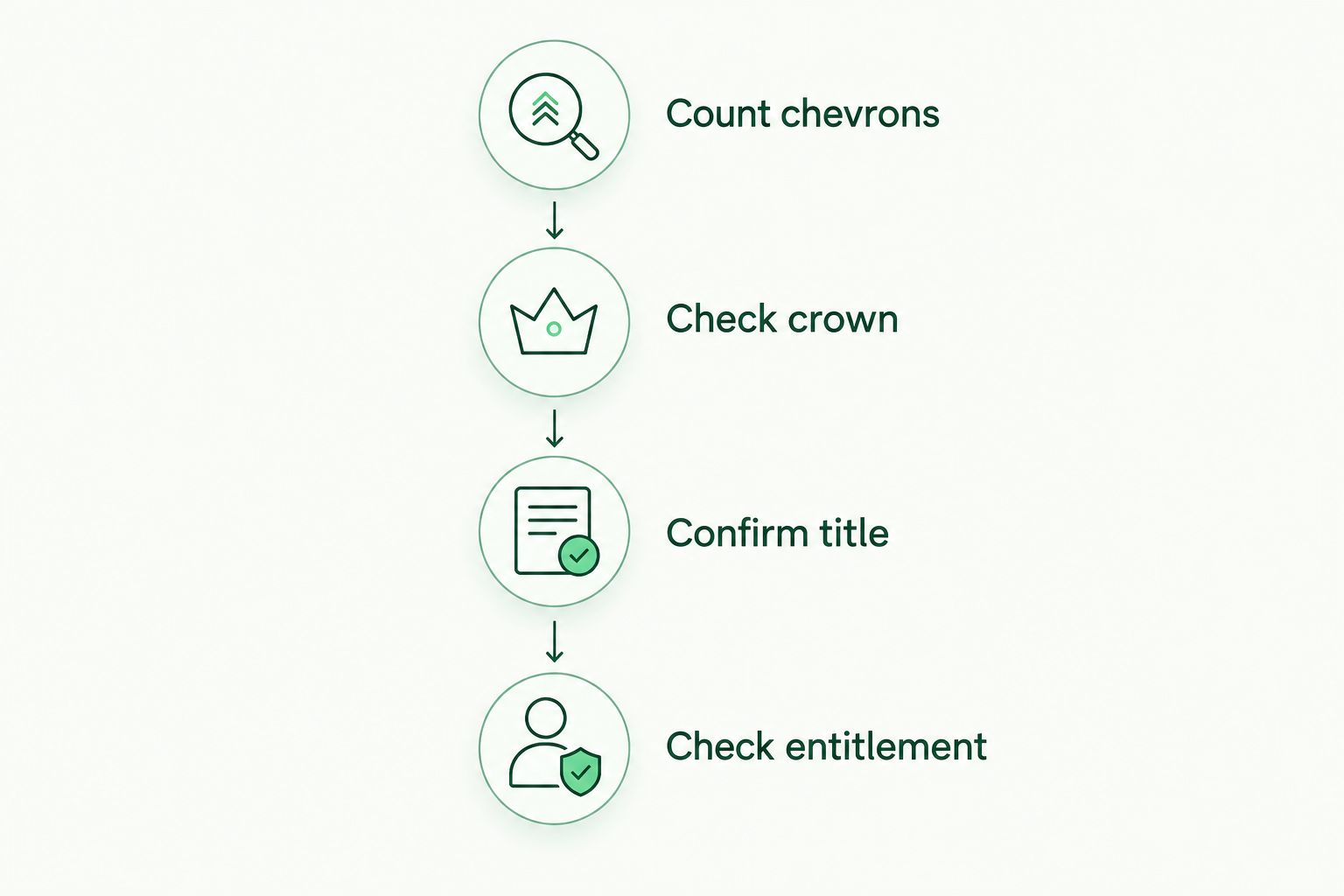
Use the visible features first. Then check the title and entitlement. That keeps badge identification separate from the decision about wearing it.
- Count chevrons. One indicates lance corporal, two corporal and three either sergeant or staff sergeant within this chart.
- Check crown. Three chevrons without a crown identify sergeant; three with a crown above identify staff sergeant.
- Confirm title. Match the complete badge to the rank your detachment has confirmed, including any authorised regimental wording.
- Check entitlement. Wear the insignia authorised for you, not the badge you expect to earn next.
Do not stop after counting stripes. A folded slide, a worn embroidered crown or an incomplete photograph can hide the feature that distinguishes two ranks. Examine the whole badge before naming it.
The chart is useful when sorting kit, checking a uniform after promotion or helping a parent understand a replacement request. It does not replace the instructions given at the detachment.
Is a cadet rank badge the same as a proficiency badge?
No. Rank insignia identifies rank; proficiency badges identify training achievement. A cap badge identifies affiliation rather than your place in the rank structure.
That distinction matters when you look at a uniform covered in badges. The number of patches does not tell you the wearer’s rank. Find the rank insignia and read its design instead.
| Badge type | What it identifies | Useful for | What it does not establish |
|---|---|---|---|
| Rank insignia | The wearer’s authorised rank | Recognising the rank shown | Every qualification the wearer holds |
| Proficiency badge | Achievement within a training scheme | Recognising training progress | Automatic entitlement to a higher rank |
| Qualification badge | A particular qualification or award | Recognising the achievement represented | General authority over other cadets |
| Cap badge | Unit or regimental affiliation | Identifying the affiliation displayed | Cadet rank |
| Name tape | The wearer’s name | Identifying an individual | Rank or qualification |
Keep rank and achievement separate when checking cadet kit. Completing training and receiving promotion are not the same event. Do not replace a rank slide simply because a proficiency badge has changed.
Likewise, a military qualification patch is not a substitute for a cadet award. A similar design or background colour is not evidence that the badge is approved for your uniform.
What about company and regimental sergeant major badges?
The basic chart above stops at staff sergeant. Senior cadet ranks and appointments, including company sergeant major and regimental sergeant major, require identification from the relevant cadet organisation’s approved reference.
Do not extend the stripe-count rule to every senior badge. A crown on its own is not the same design as a crown above three chevrons. Other emblems also need to be read as complete designs, not treated as extra stripes.
For a senior appointment, ask for the full title and the approved badge example. Avoid choosing insignia from a seller’s abbreviation alone. Similar military titles can appear in adult-service, cadet and historical contexts.
This 2026 guide keeps basic stripe recognition separate from senior appointment identification. If your detachment confirms an appointment beyond the ranks tabulated here, follow its badge specification rather than improvising from the chart.
Does this chart apply to the CCF, Air Cadets or Sea Cadets?
This chart’s scope is the Army Cadet Force. It is not a universal chart for every UK cadet organisation.
A Combined Cadet Force Army section uses an Army context, but you should confirm your contingent’s authorised titles and uniform instructions. Air Cadets and Sea Cadets have their own rank structures and insignia references. An Army chart is not the right yardstick for either.
Before identifying an unfamiliar badge, establish:
- The cadet organisation and, where relevant, the service section.
- Whether the wearer is a cadet or an adult member of staff.
- Whether the item shows rank, appointment, qualification or affiliation.
- Whether the uniform is current, historical or assembled for display.
An adult instructor’s badge should not be added to a cadet chart merely because both appear at the same parade. Start with the wearer’s organisation and role, then identify the emblem.
Are rank slides and sewn badges interchangeable?
No. A matching rank design does not make two attachment formats interchangeable. A rank slide fits a suitable uniform tab; a sew-on badge needs the authorised position on the appropriate garment.
Both formats can show familiar insignia. The attachment method and uniform requirement decide which one belongs on your kit. Do not alter a garment just to accommodate a badge bought in the wrong format.
| Format | Best for | Practical advantage | Limitation |
|---|---|---|---|
| Rank slide | A uniform with a suitable rank tab, when authorised | Can be removed without unpicking stitches | Must fit the tab and match the required pattern |
| Sew-on badge | A garment with an authorised sewn-badge position | Fixed attachment once correctly fitted | Removal involves unpicking; placement must be confirmed first |
| Hook-and-loop badge | A garment with a matching authorised panel | Detachable attachment | A backing panel does not make every patch permissible |
Check the badge face, backing and garment together. A photograph showing only the front cannot confirm how the badge attaches. Ask for clarification before modifying either item.
Military Mart’s army cadet badges and insignia guide covers the wider badge category. Keep this rank chart beside your unit’s uniform instructions rather than treating either buying guide as dress authority.
Where should you put a cadet rank badge?
Follow the instructions for the specific uniform your detachment has authorised. Do not copy badge placement from an unrelated jacket, an old photograph or another cadet organisation.
Check the garment before attaching anything. Identify its rank tab or authorised badge position, then confirm the correct badge format. A seam that looks convenient is not a placement instruction.
For a sew-on item, lay the garment flat and check the proposed position with staff before stitching. Keep pockets, fastenings and moving parts clear. Check the finished work from the front with the garment hanging naturally, not only while it is flat on a table.
For a slide, check that it fits the intended tab and remains readable when worn. Do not trim the insignia or fold away part of the design to force a fit. The whole badge must remain visible for reliable identification.
How do you check surplus insignia and condition?
Origin, condition and entitlement answer different questions. Genuine issue describes what an item is; condition describes its state; authorisation decides whether it belongs on your uniform.
Military Mart sells genuine ex-military kit and uses condition grading. Read the individual description rather than assuming every surplus badge is new, current or suitable for cadet wear. Reproductions also need to be identified as reproductions, not passed off as issue items.
Inspect insignia for:
- Clear, complete embroidery, including the crown where present.
- Fraying around the edges or damage to the backing.
- Fading that makes the design difficult to read.
- Old stitch holes, cut edges or signs of alteration.
- An attachment format that matches the intended garment.
Used does not mean incorrect, and new does not mean authorised. A well-preserved historical badge can be useful to a militaria collector but unsuitable for a current cadet uniform. Condition alone cannot settle that question.
What should parents check before replacing a badge?
Ask the cadet to confirm the requirement with their detachment before ordering. A request for a sergeant badge needs more detail than the rank name alone: the required format, pattern and garment matter too.
For a 2026 uniform check, use this sequence:
- Confirm the rank. Use the rank staff have authorised, not an anticipated promotion.
- Confirm the format. Establish whether the garment takes a slide, sew-on badge or another approved attachment.
- Confirm the pattern. Match the required design and background rather than choosing the nearest-looking item.
- Check existing kit. Identify what needs replacing before buying another version.
- Check before attaching. Have the item and position confirmed before making permanent alterations.
Keep the request specific. A clear photograph of the required item, supplied or approved by the detachment, is more useful than a broad search for army badges.
Do not buy extra qualification patches to finish the look. Cadet uniform reflects authorised rank, affiliation and achievements; it is not a collection of decorative military patches.
Can you identify rank from a photograph?
You can identify a basic rank when the complete insignia is visible and the organisation is known. You cannot reliably distinguish sergeant from staff sergeant if the photograph crops out the space above the chevrons.
Start with the clearest badge view. Look for the full embroidered design, not shadows, folds or stitching on the garment. Count the stripes only after separating the badge from the camouflage pattern beneath it.
If the image is unclear, leave the identification unresolved rather than guessing. A partial badge should not become the basis for a purchase, a uniform alteration or a correction directed at another cadet.
For historical photographs, establish the period and organisation before using a current reference. This 2026 chart is a basic recognition aid, not a catalogue of every historical insignia pattern.
FAQ
What does one stripe mean on an Army Cadet Force rank badge?
One chevron identifies cadet lance corporal in the basic Army Cadet Force rank sequence. Confirm that the item is rank insignia rather than another type of badge.
What rank has two stripes in Army Cadets?
Cadet corporal wears two chevrons. The complete insignia and the cadet organisation should be clear before you identify the wearer’s rank.
What is the difference between cadet sergeant and staff sergeant badges?
Cadet sergeant has three chevrons; cadet staff sergeant has three chevrons with a crown above. Counting stripes alone does not distinguish them.
Does a new cadet wear a rank badge?
A cadet without promotion does not wear a cadet rank badge. Other authorised insignia, such as a cap badge, serves a different purpose.
Does earning a proficiency badge automatically change my rank?
No, a proficiency badge and a rank badge represent different things. Change your rank insignia only when your detachment confirms the promotion and uniform requirement.
Can I use a British Army badge on my cadet uniform?
Only use a badge that your detachment confirms is correct for your cadet uniform. Genuine British Army origin does not by itself establish cadet entitlement, pattern or placement.
Is this army cadet badge chart by rank suitable for Air Cadets?
No, this chart covers basic Army Cadet Force ranks. Air Cadets use their own rank structure and insignia reference.
Should I sew on a new badge as soon as it arrives?
Check the badge, garment and authorised position with your detachment before sewing. Permanent attachment should follow confirmation, not a guess based on a product photograph.
One last thing
The smallest feature can change the identification. Sergeant and staff sergeant both show three chevrons; the crown above them makes the difference. Check that area before replacing a faded badge or naming a rank from a photograph.
Military Mart’s practical recommendation is to identify first, confirm second and attach last. That order keeps genuine surplus kit separate from the question of what belongs on your cadet uniform.


Leave a comment