

Best overall: Morakniv Garberg Black Blade Carbon with Leather Sheath. Best for measured camp-kit planning: Morakniv Kansbol with Multimount. Best for first-time bushcraft users: Hi-Viz 860 Magenta Pink Companion Morakniv. This 2026 fixed blade survival knife guide ranks practical carbon and stainless steel options, with construction, maintenance and safe handling ahead of steel-name bragging.
- The Morakniv Garberg Carbon is the best overall fixed blade survival knife here for buyers prioritising full-tang construction.
- The Morakniv Kansbol suits camp-kit planning, with a stated 109 mm blade and 177 g weight.
- The Morakniv Companion suits first-time bushcraft users wanting stainless steel and a patterned high-friction grip.
- Carbon steel needs corrosion care; stainless steel still needs cleaning and drying.
- Choose a bushcraft knife by its complete construction, not an unverified alloy name.
Why does blade steel matter?
A knife for a wild camp spends time around wet timber, food and damp kit. Steel affects corrosion resistance and edge behaviour. It does not tell you whether the handle fits, the sheath retains the blade or the knife suits your work.
Military Mart sells outdoor and bushcraft kit alongside genuine army surplus. Military Mart’s best overall fixed blade survival knife pick here is the Morakniv Garberg Carbon for buyers who prioritise full-tang construction. That is a construction-led recommendation, not a claim that every carbon blade beats every stainless blade.
For this 2026 shortlist, the useful split is carbon versus stainless steel. Exact alloy grades, heat treatment and edge geometry matter too, but a broad steel description cannot establish those details. Avoid buying on a steel reputation borrowed from a different model.
What makes the best fixed blade survival knife?
Judge the complete tool before looking at the ranking. These six criteria separate useful camp gear from a knife that merely looks the part.
- Steel identity: distinguish carbon from stainless. Only treat an exact alloy designation as established when the manufacturer names it for that model.
- Construction: check how the blade connects to the handle. Full tang is a construction feature, not permission to use a knife as a pry bar.
- Cutting geometry: match blade thickness and edge shape to your work. Thickness alone does not prove cutting performance or strength.
- Grip: look for secure control without pressure points. A patterned high-friction grip is useful, but hand fit still matters.
- Sheath: check coverage, retention and attachment. A good blade with an insecure sheath is unsuitable travelling kit.
- Maintenance: choose a steel you will actually clean, dry and sharpen. Neglected stainless steel is not maintenance-free equipment.
Blade steel picks at a glance
This 2026 table ranks complete knives by their useful role, rather than pretending that broad steel families form an absolute performance ladder. Companion colours are not separate steel recommendations.
| Rank and knife | Best for | Stated steel | Standout feature | Key limitation |
|---|---|---|---|---|
| First: Morakniv Garberg Black Blade Carbon with Leather Sheath | Full-tang outdoor use | Carbon steel | Full-tang blade, 3.2 mm thick | Carbon steel requires deliberate corrosion care |
| Second: Morakniv Kansbol with Multimount | Measured camp-kit planning | Stainless steel | Stated blade dimensions and weight | Steel family alone does not establish edge retention |
| Third: Hi-Viz 860 Magenta Pink Companion Morakniv | First-time bushcraft users | Swedish cold-rolled special stainless steel | Patterned high-friction grip | Not the full-tang recommendation in this shortlist |
There is no honest universal winner on steel alone. The Garberg earns first place through its stated construction; the stainless models serve different users and maintenance priorities.
1. Morakniv Garberg Carbon: best for full-tang outdoor use
The Morakniv Garberg Black Blade Carbon with Leather Sheath is the carbon-steel option in this shortlist. Its full-tang blade is stated as 3.2 mm thick. The leather sheath is named in the product title.
Full tang means the blade steel continues through the handle. That gives you a clear construction specification to assess, rather than relying on a survival label. It still does not make the knife a substitute for a saw, axe or dedicated levering tool.
Morakniv Garberg Carbon pros
- Full-tang construction is explicitly stated.
- The stated 3.2 mm blade thickness helps you compare blade sections.
- The named carbon-steel version provides a clear steel-family choice.
- A leather sheath is specified with this version.
Morakniv Garberg Carbon cons
- Carbon steel needs protection from moisture and corrosion.
- Blade thickness alone does not establish slicing ability.
- The steel-family label does not establish an exact alloy or hardness.
Best for: outdoor users who specifically want a full-tang carbon-steel knife and accept the care routine that comes with it.
For a damp 2026 camping trip, plan how you will dry the blade and sheath before packing them away. A surface finish does not remove the need to care for exposed steel, particularly at the cutting edge.
Verdict: Buy the Morakniv Garberg Carbon if full tang is your priority and you will maintain carbon steel.
2. Morakniv Kansbol: best for measured camp-kit planning
The Morakniv Kansbol with Multimount is a stainless-steel fixed blade. Its listing states a 109 mm blade, 226 mm total length, 2.5 mm blade thickness and 177 g weight. It also states compatibility with a firestarter.
Those measurements make the Kansbol easier to assess against your existing kit. They do not tell you the edge angle, and a quoted weight needs a clear scope before comparison with another knife’s bare-blade weight.
Morakniv Kansbol pros
- Stainless steel suits buyers prioritising corrosion resistance.
- The 109 mm blade length provides a concrete size reference.
- Blade thickness and total length are stated.
- Firestarter compatibility is explicitly described.
Morakniv Kansbol cons
- Stainless steel still needs cleaning and drying.
- The listing’s weight should not be compared with differently scoped weights.
- Steel family does not establish the knife’s precise wear resistance.
Best for: campers who want stated dimensions when planning how a fixed blade fits their gear.
The Kansbol’s 2.5 mm blade is thinner than the Garberg’s stated 3.2 mm blade. That is a dimensional comparison, not proof that either knife cuts better. Edge geometry and the material being cut remain important.
Verdict: Buy the Morakniv Kansbol if stated dimensions and stainless-steel maintenance suit your camp kit.
3. Morakniv Companion: best for first-time bushcraft users
The Hi-Viz 860 Magenta Pink Companion Morakniv Stainless Steel Knife uses Swedish cold-rolled special stainless steel. Its description identifies a patterned high-friction grip. That makes grip and ordinary outdoor cutting the sensible starting points for assessing it.
Treat the Companion as a cutting tool. Learn controlled use and sharpening before deciding that a thicker blade or different steel will solve a problem with technique.
Morakniv Companion pros
- Stainless steel reduces the corrosion-care burden compared with plain carbon steel.
- The patterned high-friction grip is an explicitly stated feature.
- The named model gives beginners a straightforward outdoor option.
Morakniv Companion cons
- It is not the full-tang recommendation in this shortlist.
- The broad steel description does not identify an exact alloy grade.
- A grip description cannot guarantee comfort in your hand.
Best for: beginners choosing a stainless-steel bushcraft knife for controlled cutting tasks.
For your first knife in 2026, prioritise a secure grip, safe sheath use and an edge you can maintain. Do not turn handle colour into a steel ranking: the other listed stainless Companion colours are alternatives, not separate performance classes.
Verdict: Buy the Morakniv Companion for a first outdoor cutting tool; skip it if your requirement is explicitly full tang.
How are these knives ranked?
The order follows the buying criteria: stated construction first, useful specifications next, then grip and maintenance fit. It is a practical shortlist, not a laboratory comparison of edge retention, corrosion or impact resistance.
Carbon steel takes the first slot because the Garberg has stated full-tang construction. Stainless steel takes the remaining slots for different reasons. The Kansbol offers useful measurements, while the Companion puts a stated high-friction grip into a straightforward beginner choice.
Do not read this ranking as carbon steel being inherently tougher than stainless steel. Alloy composition, heat treatment and blade geometry affect performance. A complete knife recommendation needs more than the words carbon or stainless.
Which steel should you choose for a wet camp?
Choose stainless steel if reducing corrosion maintenance is your main concern. Choose carbon steel if you want the particular knife’s construction and will keep the blade clean, dry and protected. Neither choice excuses leaving the knife wet in its sheath.
Keep these three priorities separate:
- Corrosion care: stainless steel generally resists corrosion better than plain carbon steel.
- Edge maintenance: sharpening effort depends on the alloy, hardness and abrasive, not simply the stainless label.
- Construction: tang design and blade geometry belong to the whole knife, not its steel family.
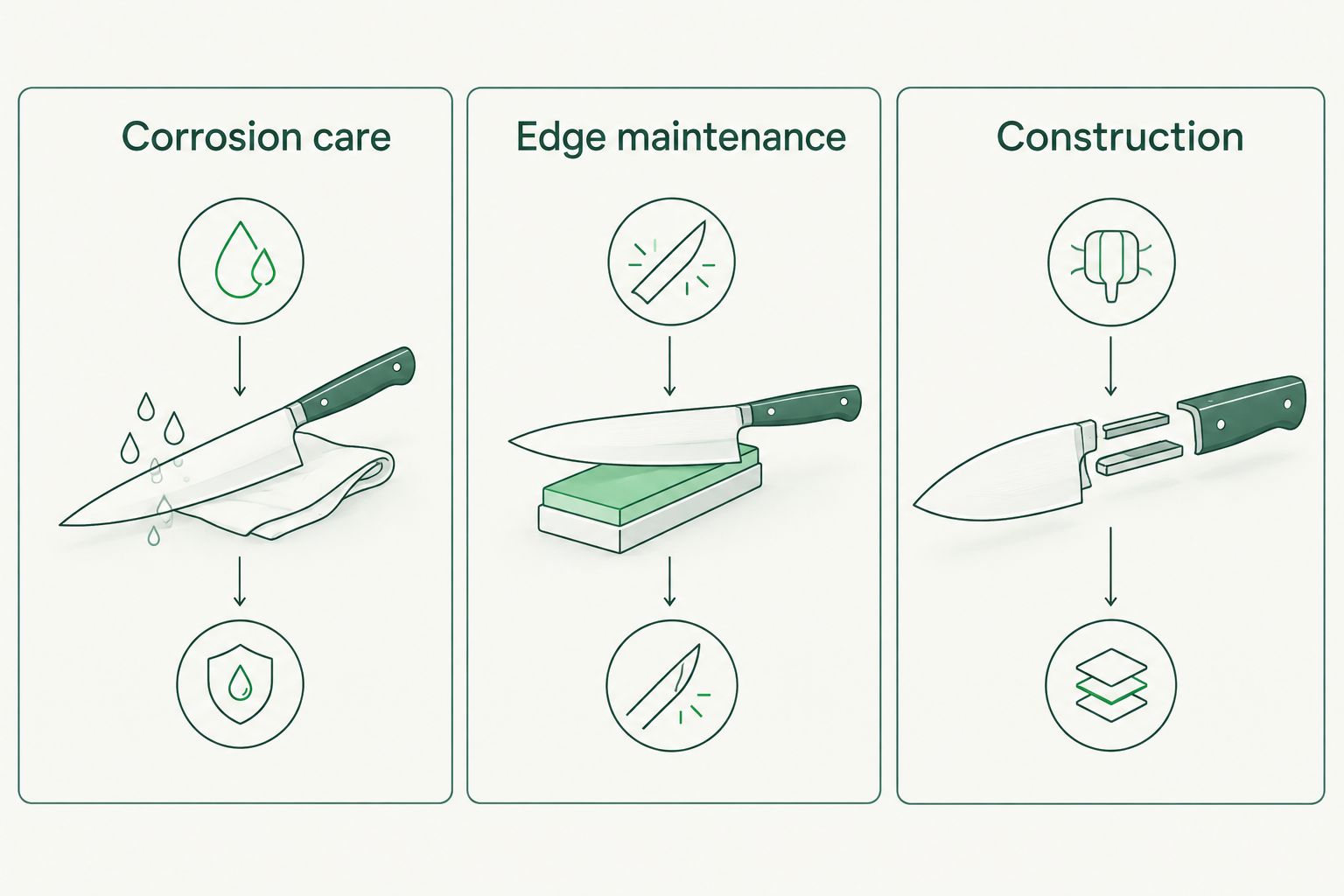
A sharpening stone cannot compensate for the wrong tool choice. Carry an abrasive suited to your blade, practise at home and follow the manufacturer’s care instructions. Avoid assigning a universal sharpening angle to every knife in this list.
What should you check before ordering?
At Military Mart, assess the named knife on its own description. Genuine military surplus elsewhere in the catalogue does not make every outdoor knife military issue.
Use this short inspection sequence:
- Read the model name. Confirm carbon or stainless and the named sheath or mounting version.
- Check condition. Read the stated condition rather than assuming new, used or new old stock.
- Check dimensions. Compare blade length, overall length and thickness with your actual tasks.
- Check the sheath. Establish how the blade is covered, retained and attached to your kit.
- Plan maintenance. Decide how you will clean, dry, store and sharpen the knife.
For a used knife, inspect corrosion, edge damage, handle security and sheath wear. Honest condition grading describes condition; it does not establish steel chemistry or suitability for a particular task.
Once you have chosen your construction and care priorities, these are the three named knives from the shortlist.


Can you carry a fixed blade knife in the UK?
A fixed blade knife does not fall within the small, non-locking folding pocketknife exception. In public, a lawful good reason or other applicable legal authority is required. Ownership and public carry are separate questions.
For your 2026 trip, check current official guidance for the UK jurisdiction involved and the landowner’s rules. A bushcraft label, sheath or camping destination does not automatically establish lawful carry. Keep transport tied to the legitimate activity, and follow applicable age-verification requirements when buying.
Cadets and organised outdoor groups should follow their organisation’s rules. Do not assume a personal knife is permitted because the activity takes place outdoors.
Which fixed blade survival knife should you choose?
Choose the Morakniv Garberg Carbon as the default if full-tang construction is your main requirement. Choose the Morakniv Kansbol when stated dimensions and stainless steel are the better fit. Choose the Morakniv Companion when you are starting out and want a stainless outdoor cutting tool with a stated high-friction grip.
Military Mart’s 2026 shortlist puts the whole knife ahead of the steel label. Keep that order when comparing other models: construction, task fit, grip, sheath and care routine. An impressive alloy name cannot rescue an unsuitable handle or insecure sheath.
FAQ
What’s the best fixed blade survival knife in this guide?
The Morakniv Garberg Carbon is the best overall pick here for buyers prioritising full-tang construction. Its stated blade thickness is 3.2 mm, and carbon steel requires deliberate corrosion care.
Is carbon steel better than stainless steel for a survival knife?
Neither steel family is universally better for a survival knife. Stainless steel generally offers better corrosion resistance than plain carbon steel, while exact alloy, heat treatment and geometry determine other performance characteristics.
Which knife is best for a beginner in bushcraft?
The Hi-Viz 860 Magenta Pink Companion Morakniv is the beginner pick in this shortlist. Its description states a stainless-steel blade and patterned high-friction grip; safe handling and sharpening practice remain essential.
How big is the Morakniv Kansbol blade?
The Morakniv Kansbol listing states a 109 mm blade and 226 mm total length. It also states 2.5 mm blade thickness and 177 g weight; confirm the weight’s scope before comparing it with another knife.
Does a full-tang knife mean I can use it as a pry bar?
No, full-tang construction does not make a knife a pry bar. Use a dedicated tool for levering and follow the knife manufacturer’s intended-use guidance.
Can I carry a fixed blade survival knife in public in the UK?
A fixed blade knife generally requires a lawful good reason or other applicable legal authority for public carry. It is not covered by the small, non-locking folding pocketknife exception; check current official guidance for your jurisdiction.
Does stainless steel need cleaning after camping?
Yes, a stainless-steel knife still needs cleaning and drying after camping. Remove residue, dry the blade and sheath, and follow the manufacturer’s storage and maintenance instructions.
One last thing
Check the sheath before admiring the edge. A knife spends much of a trip packed away, so secure retention and safe coverage matter every time you move your kit. If the sheath is damaged or fails to retain the blade, stop using it until the problem is corrected.


Leave a comment