

Best overall military tarp format for solo wild camping: a basha sheet. Best for combining wearable cover with shelter: a Norwegian Army poncho tent sheet. Best for a traditional canvas setup: a Romanian Army tent half. This 2026 guide explains how to compare usable size, complete carrying weight and surplus condition before choosing your kit.
- Choose a basha-format military tarp for a dedicated solo shelter; check dimensions against your complete sleeping setup.
- Consider a Norwegian Army poncho tent sheet when you want wearable cover and shelter from the same item.
- Choose a Romanian Army canvas tent half for traditional kit, after checking its fittings and condition.
- Military Mart military tarp buyers should compare complete packed weight, not fabric weight alone.
Why does military tarp size and weight matter?
A military tarp has to cover your sleeping kit after you pitch it, not just look generous when spread flat. Lowering the sides for protection reduces the space underneath. Raising them gives you more room but exposes more of the shelter to wind-driven rain.
Start with your intended pitch. The basha sheets for solo wild camping guide covers that dedicated shelter format. A wearable poncho sheet and a canvas tent half solve different problems, so neither belongs above a basha simply because it looks more substantial.
For Military Mart military tarp buyers, usable coverage comes before camouflage pattern. Weight matters next, including the cord, pegs and supports you actually carry. A smaller sheet is not a saving if it leaves the foot of your sleeping bag exposed.
What makes the best military tarp?
Use these criteria before comparing individual options. They matter more than a military description or a familiar camouflage pattern.
- Usable coverage: Check the pitched roof over your sleeping bag, mat and gear, including clearance from sloping fabric.
- Complete carrying weight: Compare the sheet with its necessary rigging, not one bare sheet against another complete shelter kit.
- Attachment layout: Check where reinforced loops, eyelets and joining fittings sit, and whether they support your intended pitch.
- Material and upkeep: Identify the fabric and any coating before choosing cleaning, repair or reproofing products.
- Condition: Inspect seams, corners, closures and repairs. A tidy central panel does not prove sound attachment points.
- Actual purpose: Separate dedicated shelter sheets, wearable ponchos and tent components. Similar-looking kit is not automatically interchangeable.
Which military tarp formats rank best at a glance?
This 2026 ranking is a buying order by use case, not a claim that one named sheet is the lightest or largest. Confirm the measurements and complete weight of the particular item before treating it as a size-and-weight winner.
| Rank and option | Best for | Standout feature | Size check | Weight check | Key limitation |
|---|---|---|---|---|---|
| 1. Basha sheet | Dedicated solo wild-camp shelter | Shelter-first format | Coverage over your complete sleeping setup | Sheet plus required rigging | Does not replace wearable waterproofs |
| 2. Norwegian Army poncho tent sheet | Combining wearable cover and shelter | Poncho and tent-sheet format | Shelter dimensions, not just worn fit | Compare against the separate kit it replaces | Cannot be worn while pitched overhead |
| 3. Romanian Army canvas tent half | Traditional canvas kit | Canvas tent-half format | Single-panel shape and joining arrangement | Include any additional panels and supports | A tent half is not automatically a complete tent |
1. Basha sheet: best military tarp format for solo wild camping
A basha is a shelter sheet rather than a fitted tent. You rig it using suitable attachment points and supports, choosing the pitch around the site and weather. It is the first format to consider when your main job is keeping a solo sleeping setup under cover.
Do not buy on the word basha alone. Check the actual dimensions, attachment layout and fabric specification. Those details determine whether the sheet suits a low ground pitch, an open-sided shelter or your particular hammock arrangement.
Basha sheet pros:
- A dedicated shelter format keeps the buying decision focused on coverage.
- You can choose the pitch to suit the ground and available supports.
- An open-sided setup lets you inspect and adjust the rigging easily.
Basha sheet cons:
- Open edges need careful positioning against wind-driven rain.
- The sheet does not provide ground insulation or insect protection.
- Pegs, cord and any carried supports add to the packed load.
Best for: A solo camper who wants a separate overhead shelter and already has suitable sleeping kit and waterproof clothing.
Verdict: Buy the basha format for dedicated solo shelter, once its dimensions and complete weight suit your load.
2. Norwegian Army poncho tent sheet: best for dual-purpose cover
The Norwegian Army poncho tent sheet combines wearable cover with a shelter-sheet format. That makes it a relevant comparison when you want an item to do more than one job. Check its dimensions and closures before deciding how it fits into your camp setup.
Compare the whole clothing-and-shelter system. Removing a separate item only helps if the poncho sheet genuinely covers both jobs on your trip. You still need a plan for staying dry when the poncho is pitched over your sleeping kit.
Norwegian Army poncho tent sheet pros:
- Combines poncho and shelter-sheet functions.
- Offers an alternative to packing separate items for those roles.
- Suits buyers specifically looking for military poncho-sheet kit.
Norwegian Army poncho tent sheet cons:
- You cannot wear the sheet while it is serving as your pitched roof.
- Wearable fit does not establish adequate sleeping coverage.
- Closures and any openings need checking in the intended shelter configuration.
Best for: A camper who has deliberately planned around dual-purpose kit, rather than simply trying to remove weight from a packing list.
Verdict: Buy for a planned poncho-and-shelter role; skip it as an automatic substitute for a dedicated basha.
3. Romanian Army canvas tent half: best for traditional canvas kit
The Romanian Army canvas tent half is a canvas shelter component. Consider it when traditional material and the tent-half format are part of what you want. Treat it as a panel to assess, not proof of a complete enclosed shelter.
Check its edges, joining fittings and intended arrangement. If you plan to connect panels, confirm compatibility before buying. Matching country names or a similar appearance does not establish that separate pieces will join correctly.
Romanian Army canvas tent half pros:
- Provides a canvas option for buyers who specifically want that material.
- Suits a traditional military shelter-kit approach.
- Lets you assess the panel and its joining arrangement before building a setup.
Romanian Army canvas tent half cons:
- Additional panels or supports change the complete carrying weight.
- The single-panel shape needs checking against your sleeping footprint.
- Canvas requires suitable drying and material-specific care.
Best for: A traditional-kit enthusiast who accepts the packing and maintenance requirements of the chosen canvas setup.
Verdict: Buy for a deliberate canvas setup; skip it when your only priority is the lowest carried weight.
How should you compare military tarp size properly?
Measure your sleeping setup before shopping. Lay out the mat, sleeping bag and anything else that must stay under cover. Include the space occupied by your feet inside the bag, rather than measuring your height alone.
Compare that footprint with the proposed pitch. A flat sheet's width is not the same as its sheltered floor width once the sides slope down. Keep bedding clear of the fabric and position gear where runoff cannot drain onto it.
Use these checks in order:
- Sleeping footprint: Lay out the kit you actually use.
- Pitched coverage: Allow for sloping sides and exposed ends.
- Attachment points: Check that the sheet supports that shape.
- Site fit: Leave room for safe anchoring without blocking paths.
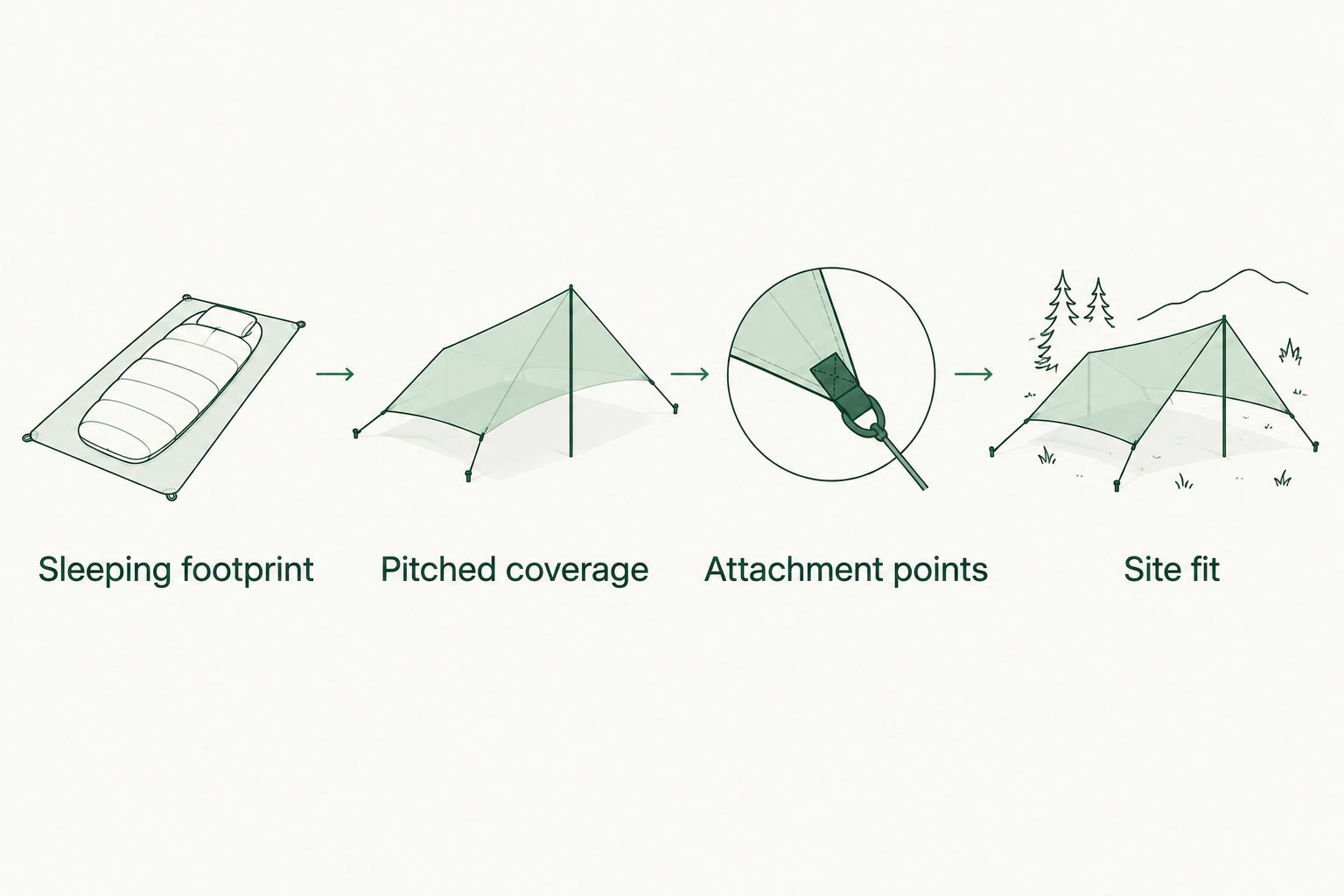
Keep units consistent. 1 m equals 100 cm, so convert measurements before comparing listings. A long rectangle and a broad square can have similar fabric area while offering different shelter shapes.
For a 2026 buying shortlist, write down length, width and shape separately. Do not reduce the decision to surface area alone. A sheet still has to put its coverage where your sleeping kit needs it.
How should you compare military tarp weight?
Weigh the complete shelter in the form you will carry it. Include the sheet, storage bag, cord, pegs and any poles packed specifically for that shelter. Keep shared kit separate so you do not count it twice.
Use the same units throughout: 1 kg equals 1,000 g. Record the complete total in grams if that makes your comparisons easier. A quoted fabric weight is not the same measurement as a ready-to-pitch shelter weight.
Your comparison should answer these questions:
- Does the quoted weight cover the sheet alone or the complete kit?
- Which supports will you carry rather than find at the site?
- Does the poncho option replace another item you would otherwise pack?
- Does a tent-half setup require another panel?
- Can you pack wet shelter fabric separately from dry sleeping kit?
The lightest useful shelter is the lightest complete setup that covers your actual needs. Cutting pegs or cord from the total does not make an incomplete setup a fair comparison.
What should you inspect on a surplus tarp?
Condition deserves its own place in a 2026 comparison. Genuine issue describes origin; it does not establish the present condition of every seam, coating or fitting. Military Mart uses condition grading, but read the individual description as well as the grade.
Spread the sheet out where you can inspect both faces. Look closely at corners and attachment points, then check seams and closures. Distinguish cosmetic marks from damage affecting the way the shelter tensions or sheds rain.
- Fabric: Look for holes, thinning, tears and questionable repairs.
- Seams: Check for opening stitches and stressed joins.
- Fittings: Inspect loops, eyelets, buttons and other closures.
- Coatings: Check for peeling or sticky surfaces where applicable.
- Storage condition: Investigate persistent damp smells before packing the item away.
New old stock still needs inspection after storage. Used kit needs inspection too. Neither label replaces checking the particular sheet and following its material-specific care instructions.
How were these military tarp formats ranked?
The order follows the buying criteria above: intended role, usable coverage, complete load, fittings and condition. A basha comes first for dedicated solo shelter. The poncho sheet earns its separate place through dual-purpose use, while the canvas tent half serves traditional-kit buyers.
No measured size or weight winner is implied between those named products. Use this 2026 shortlist to choose the right format, then rank individual sheets using confirmed measurements. That keeps the recommendation tied to the kit rather than an unsupported league table.
Which military tarp should you choose?
Choose a basha-format sheet as the default for a dedicated solo wild-camp shelter. Choose the Norwegian Army poncho tent sheet when its wearable role is part of your plan. Choose the Romanian Army canvas tent half when canvas and the traditional setup are deliberate priorities.
Before committing, make sure the item passes the coverage, complete-weight and condition checks. Reject a sheet that fails your sleeping footprint, even if its packed dimensions look convenient. Practical fit wins over a military label.
FAQ
What's the best military tarp for solo wild camping?
A basha-format sheet is the default choice for a dedicated solo overhead shelter. Check its dimensions against your sleeping setup and include rigging in the carrying weight.
Is a Norwegian Army poncho tent sheet better than a basha?
A Norwegian Army poncho tent sheet is better suited to a planned wearable-cover-and-shelter role, not automatically better as a dedicated shelter. You cannot wear it while it is pitched over your kit.
How big should a military tarp be?
A military tarp should cover your complete sleeping setup in its intended pitch, with bedding clear of the fabric and exposed edges. Flat dimensions alone do not establish sheltered floor space.
How much should a military tarp weigh for backpacking?
Compare complete shelter weight against your carrying plan rather than using a universal target. Include the sheet, cord, pegs, storage bag and any dedicated supports.
Can a Romanian Army canvas tent half replace a complete tent?
Do not treat a Romanian Army canvas tent half as a complete tent without confirming the full arrangement. Check the panels, joining fittings and supports required for the shelter you intend to build.
Does genuine military issue mean a used tarp is waterproof?
Genuine military issue identifies origin, not the current weather resistance of a particular used sheet. Inspect fabric, seams and any coating, then check the shelter before relying on it overnight.
Can I use a military tarp without a sleeping mat?
A military tarp does not replace a sleeping mat. The overhead sheet provides cover, while suitable ground insulation remains a separate part of your sleeping system.
One last thing
Rehearse the wet pack-up, not just the tidy pitch. Decide where the damp sheet and muddy pegs will go without soaking your sleeping bag. Military Mart buyers choosing between shelter formats should make that packing check part of the decision, not discover the problem at the end of a wild camp.


Leave a comment