

Best overall for a managed security site: licensed UHF radios with surveyed coverage. Best for geographically separated teams: cellular push-to-talk. Best for straightforward local use: compliant PMR446 radios. This 2026 guide ranks police and security radios by coverage approach, not unsupported kilometre claims.
- Choose police and security radios by tested coverage, lawful frequencies and compatibility, not advertised maximum distance.
- Licensed UHF with repeaters suits managed sites where buildings interrupt direct radio coverage.
- Cellular push-to-talk suits geographically separated teams but depends on network coverage and service continuity.
- PMR446 suits straightforward local communication; shared channels and limited power restrict its role.
Why does radio range matter for security work?
A radio needs to reach control from the loading bay, stairwell and far gate, not just across an empty field. Buildings, terrain, antenna position and interference all affect whether a message gets through. An advertised maximum distance does not establish coverage at your venue.
Military Mart is a practical source of police and security surplus clothing and carrying kit, not a substitute for a radio coverage survey. For the operational buying questions, see the guide to police and security radios for door supervisors and security work.
Private security radios also need separating from police operational communications. A genuine ex-police handset does not give its next owner permission or technical access to police networks.
What makes the best police and security radios?
Judge a system against these criteria before comparing handsets. For a 2026 deployment, the radio, infrastructure and operating procedure belong on the same checklist.
- Usable coverage: Speech must reach the required posts in both directions, including behind closed doors.
- Lawful operation: Frequencies, equipment and infrastructure must match the applicable Ofcom authorisation or licence exemption.
- Team compatibility: Match the frequency band, analogue or digital mode, programming and accessories. Matching channel numbers alone proves nothing.
- Shift readiness: Check battery condition, charging arrangements, controls and audio while wearing normal working kit.
- Failure planning: Establish what staff do when a radio, repeater, mobile network or power supply fails.
- Condition and support: With surplus equipment, establish exactly what is included and whether programming, batteries and repairs are supported.
Coverage options at a glance
This is a ranking of coverage approaches, from network-connected communication to local direct communication. It is not a measured handset league table: a well-designed local system can outperform a network-connected handset inside a particular building.
| Rank and option | Best for | Standout feature | Key limitation |
|---|---|---|---|
| 1. Cellular push-to-talk | Teams spread across separate locations | Communication through a mobile data network | Depends on data coverage and the service platform |
| 2. Licensed UHF with repeaters | Large or obstructed managed sites | Infrastructure extends coverage beyond direct handset paths | Requires suitable authorisation, installation and maintenance |
| 3. Licensed VHF simplex | Open estates and outdoor patrol routes | Direct communication without a repeater | Terrain and obstructions still interrupt coverage |
| 4. Licensed UHF simplex | Compact venues and building-based teams | Direct local communication without mobile data | Dead spots remain where direct paths fail |
| 5. Compliant PMR446 | Straightforward local coordination | Licence-exempt operation under UK conditions | Shared spectrum, restricted power and no repeater network |
1. Cellular push-to-talk: best for teams across separate locations
Cellular push-to-talk carries group voice traffic over a data network rather than relying solely on a direct radio path between handsets. It suits supervisors coordinating staff at separate venues, provided each location has suitable connectivity. Geographic separation matters less than network access.
Cellular push-to-talk pros:
- Connects dispersed teams without a direct handset-to-handset radio path.
- Supports group communication through a managed service.
- Avoids building a private radio link between every location.
Cellular push-to-talk cons:
- Service depends on data connectivity and the platform operating it.
- A functioning phone network outside does not establish coverage in a basement.
- Offline or direct-mode functions must be checked for the specific equipment.
Best for: Multi-site security supervisors and geographically separated teams.
For your 2026 shortlist, test the actual operator and device at every required post. Include transitions between indoor and outdoor areas, then document the fallback when connectivity disappears. Verdict: Buy for dispersed operations only after network and failure testing.
2. Licensed UHF with repeaters: best for large managed sites
A repeater receives a radio transmission and retransmits it, allowing communication beyond the direct path between portable radios. Its position and antenna installation are central to coverage. This approach suits a venue where direct radios leave operational gaps.
Licensed UHF with repeaters pros:
- Extends communication beyond individual handset-to-handset paths.
- Allows coverage planning around buildings and patrol areas.
- Provides a local radio system without depending on public mobile data.
Licensed UHF with repeaters cons:
- Requires an appropriate licence arrangement and compatible programming.
- Installation, power and maintenance become operational responsibilities.
- Poor antenna placement still leaves dead spots.
Best for: Shopping centres, industrial premises and event sites requiring planned local coverage.
Do not assume every business radio licence permits a repeater. Ask the radio supplier to specify the authorisation, coverage design and power-failure arrangements together. Verdict: Buy when a survey identifies coverage gaps that infrastructure can address.
3. Licensed VHF simplex: best for open outdoor patrol routes
VHF simplex radios communicate directly, without passing through a repeater. VHF is a sensible band to evaluate for open estates and outdoor patrols, but it does not guarantee a longer working distance than UHF. Hills, buildings, vegetation and antenna arrangements affect the result.
Licensed VHF simplex pros:
- Supports direct communication without fixed repeater infrastructure.
- Does not require a mobile data connection.
- Gives outdoor teams a band option to compare during a survey.
Licensed VHF simplex cons:
- Terrain can block the required communication path.
- VHF equipment does not communicate with UHF equipment merely because both are business radios.
- The operating frequencies must match the licence.
Best for: Open estates, rural event grounds and outdoor patrol routes with suitable tested coverage.
Compare VHF and UHF on the same route with equipment configured lawfully. Keep handset position and test locations consistent so the comparison means something. Verdict: Buy when the outdoor coverage test supports VHF; skip a band-only range promise.
4. Licensed UHF simplex: best for compact building-based teams
Licensed UHF simplex gives staff direct local communication without a repeater or public mobile network. It is a practical starting point for a compact venue. Whether it covers the whole building depends on the structure and the working positions.
Licensed UHF simplex pros:
- Works directly between compatible handsets.
- Avoids repeater installation where direct coverage is sufficient.
- Supports a locally managed radio fleet.
Licensed UHF simplex cons:
- Concrete, metalwork and below-ground rooms can interrupt coverage.
- Handsets need matching programming, not simply the same manufacturer.
- An earpiece cannot repair a weak radio link.
Best for: Door teams, compact warehouses and building-based staff whose posts pass a direct-coverage test.
Test reception with the radio worn where staff will actually carry it. A handheld raised above your head during a demonstration is not the same setup as one on a belt beneath a jacket. Verdict: Buy for compact sites after every required post passes.
5. Compliant PMR446: best for straightforward local coordination
PMR446 is a licence-exempt radio category operating around 446 MHz under UK technical conditions. Analogue PMR446 provides 16 channels, with a maximum 500 mW effective radiated power and integral antennas. These are equipment limits, not a promised working distance.
For a 2026 UK purchase, use Ofcom's PMR446 guidance and UK Interface Requirement IR 2030 to check the category requirements. A programmable business radio does not become compliant PMR446 equipment just because someone enters a PMR446 frequency.
PMR446 pros:
- Does not require an individual spectrum licence when equipment and use meet the exemption conditions.
- Offers direct local communication without fixed infrastructure.
- Suits straightforward coordination where a site test confirms coverage.
PMR446 cons:
- Channels are shared with other users.
- Power and antenna restrictions limit system design options.
- PMR446 does not provide a business repeater network.
Best for: Small teams with local, non-sensitive coordination needs and a clear fallback.
Privacy codes filter unwanted audio; they do not encrypt speech or reserve a channel. Keep sensitive personal information off an unprotected shared radio channel. Verdict: Buy for tested local coordination; skip as an assumed site-wide security solution.
How should you test working range before buying?
Test the whole communication path, not just whether a handset makes noise near reception. Use the proposed radios, accessories and normal carrying positions. Record the places where speech becomes unclear as well as complete failures.
- Map posts: Mark control, entrances, patrol limits, stairwells, plant areas and loading bays.
- Test speech: Send a short message from each post and require an accurate reply.
- Check obstacles: Repeat with relevant doors closed and staff in normal working positions.
- Record failures: Mark dead spots and agree how they will be addressed.
- Retest changes: Repeat affected checks after changes to equipment, programming or infrastructure.
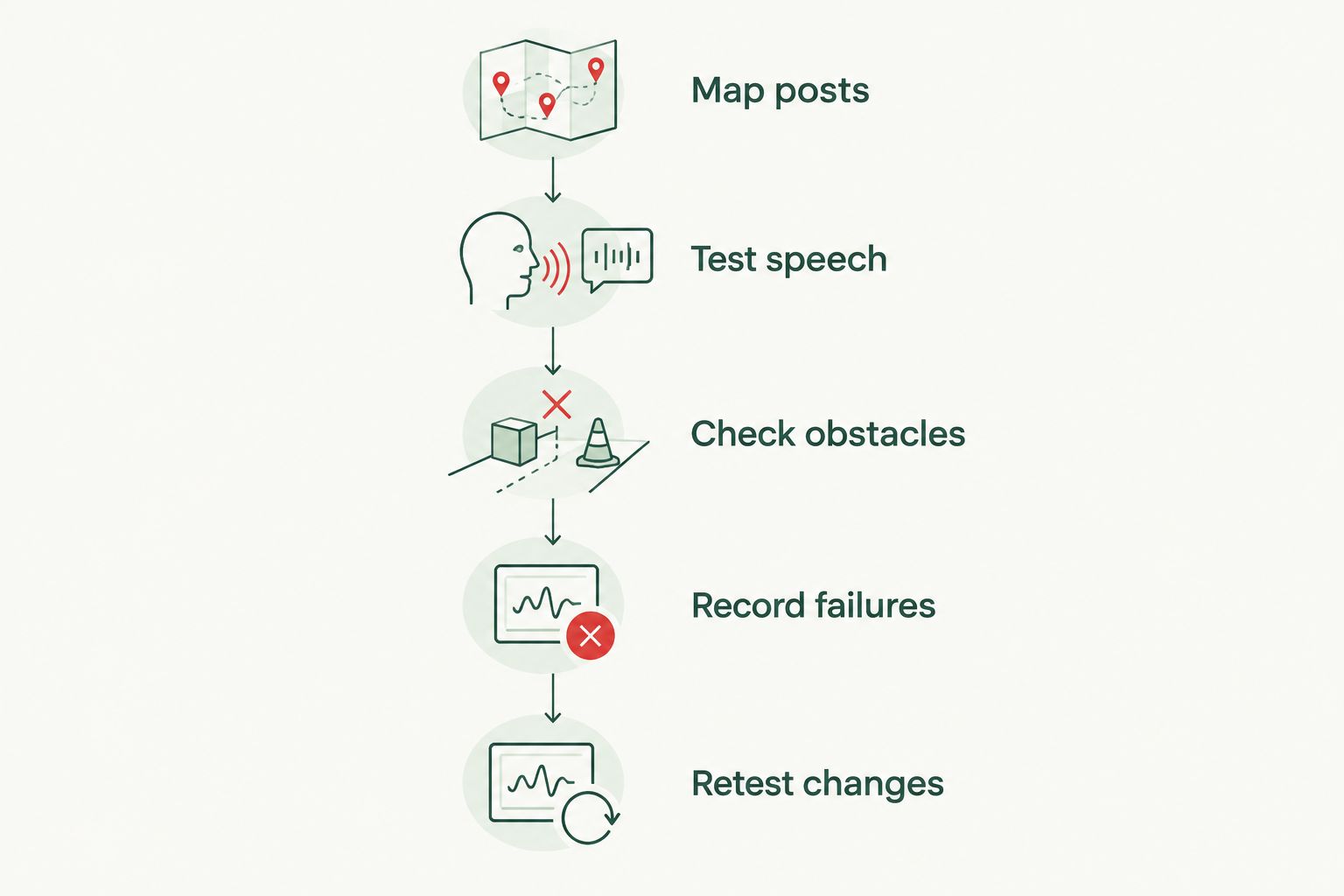
A successful call in one direction is not enough. Control must hear the patrol and the patrol must hear control. Where communication supports a safety procedure, make the acceptance criteria and fallback part of that procedure.
What should you check on surplus radios and carrying kit?
With used electronics, appearance and operational readiness are separate questions. Check the exact model, frequency band, programming access, battery condition, charger and accessory connector. Ask whether any software access or administrative lock prevents lawful reconfiguration.
Condition labels also need reading in context. A clean casing does not establish battery endurance, water resistance or compatibility with your fleet. Treat undocumented performance claims as unproven until checked.
Military Mart's police and security surplus range includes carrying equipment, but a surplus leather radio pouch is not a universal handset fit. Compare the radio's dimensions, antenna clearance and control access before choosing a holder. Retention matters when you bend, run or climb stairs.
Do not confuse a pouch, vest or armour cover with radio protection or certified personal protective equipment. Military Mart identifies several surplus armour items as display-only; that restriction remains separate from their suitability for a costume or collection.
How are these radio options ranked?
The ranking separates network-connected coverage, infrastructure-assisted local coverage and direct radio communication. Within those groups, the deciding criteria are lawful use, tested reach, compatibility, shift readiness and failure planning.
No fixed kilometre figure transfers reliably between an open field and an obstructed venue. For a 2026 procurement decision, a coverage map and recorded speech checks are more useful than a box-front maximum range.
Which police and security radios should you choose?
Start with licensed UHF simplex for a compact managed site, then add infrastructure only where the survey justifies it. Choose cellular push-to-talk when staff work across separate locations and the required network coverage is established. Evaluate VHF for open outdoor routes.
Choose PMR446 when its shared-channel limitations fit the task. Buy surplus handsets only after confirming lawful programming and serviceability. Military Mart's police and security radios buying advice follows the same practical rule as surplus kit: establish what the item actually does before judging its appearance.
FAQ
What's the best type of radio for a security team?
Licensed UHF is a practical starting point for a managed local security site. A coverage survey determines whether direct radios are sufficient or repeaters are needed.
Which security radios have the longest range?
There is no universal longest-range handset for every site. Cellular push-to-talk connects dispersed locations through data networks, while repeaters extend suitably designed local radio coverage.
Can private security staff use police radio networks?
Buying an ex-police radio does not authorise access to police networks. Private security teams need equipment and frequencies authorised for their own operation.
Do security radios need an Ofcom licence?
Licensed business radio systems require the appropriate Ofcom authorisation. Compliant PMR446 equipment is licence-exempt when operated within the exemption conditions.
Is UHF better than VHF inside buildings?
UHF is a sensible option to evaluate for building-based security, but the band alone does not establish indoor coverage. Test the actual equipment throughout the building before choosing.
Do PMR446 privacy codes make conversations private?
No. PMR446 privacy codes filter received audio but do not encrypt speech or give exclusive use of a channel.
Is a Grade A surplus radio ready for duty?
A condition grade alone does not establish operational readiness. Confirm the frequency band, lawful programming, battery condition, charger and accessory compatibility before deployment.
Will an ex-police leather radio holder fit any handset?
No. Check the holder against the handset's dimensions, controls, antenna and retention needs before using it at work.
One last thing
Test the radio after attaching the earpiece and putting on your working layers. Clear reception is useless if the microphone rubs against clothing or the transmit button is buried under a jacket. Finish the buying decision with the complete kit worn, not laid out on a counter.


Leave a comment