

Yes, you can ride an ex-military motorcycle without a special military licence in Great Britain in 2026, provided your normal motorcycle entitlement covers that particular bike. You still need insurance, road registration, vehicle tax and an MOT where required; former military service does not exempt you from civilian road rules. A car licence or CBT certificate alone does not authorise you to ride every surplus motorcycle.
- Can you ride an ex-military motorcycle without a special licence? Yes, but ordinary motorcycle licence limits still apply.
- DVLA motorcycle categories depend on capacity, power and entitlement, not military history.
- CBT normally permits learner riding only up to 125cc and 11kW from age 17.
- Military Mart suits collectors seeking genuine ex-military motorcycles; check each bike’s documents and condition before road use.
Why this matters
Buying the motorcycle and being entitled to ride it are separate matters. A genuine army bike with civilian registration still needs a correctly licensed rider. Equally, a full motorcycle licence does not make an unregistered restoration project road legal.
Start with the bike’s identity and paperwork, not its paintwork. The guide to registering an ex-military motorcycle for road use covers that separate part of the job.
This guide covers England, Scotland and Wales. For a purchase in 2026, use GOV.UK’s motorcycle licence categories and learner-riding guidance to check entitlement; Northern Ireland has separate licensing administration through DVA and nidirect.
Can you ride an ex-military motorcycle without a special licence?
Yes. There is no separate civilian motorcycle licence category for an ex-military bike. Your entitlement depends on the motorcycle’s technical specification and the categories, restrictions and dates on your driving record.
The table below summarises GOV.UK’s motorcycle licence categories for Great Britain. These are ordinary motorcycle rules, not concessions for surplus vehicles.
| Entitlement | Motorcycle limits | Main advantage | Main limitation |
|---|---|---|---|
| Provisional entitlement plus valid CBT, from age 17 | Up to 125cc and 11kW | Learner route for a qualifying small motorcycle | L plates, no pillion passengers and no motorway riding |
| Full A1, from age 17 | Up to 125cc, 11kW and 0.1kW/kg | Full entitlement within the light-motorcycle category | Does not cover a larger bike simply because it has low power |
| Full A2, from age 19 | Up to 35kW and 0.2kW/kg; not derived from a bike producing more than twice its power | Covers qualifying motorcycles beyond A1 limits | Capacity alone cannot establish eligibility |
| Full A | Unrestricted motorcycles, subject to licence codes | Covers motorcycles beyond A1 and A2 limits | Normally age 24 by direct access, or 21 through qualifying progressive access |
Older entitlements and licence restriction codes need individual checking. An automatic-only restriction, for example, matters when the surplus bike has a manual gearbox.
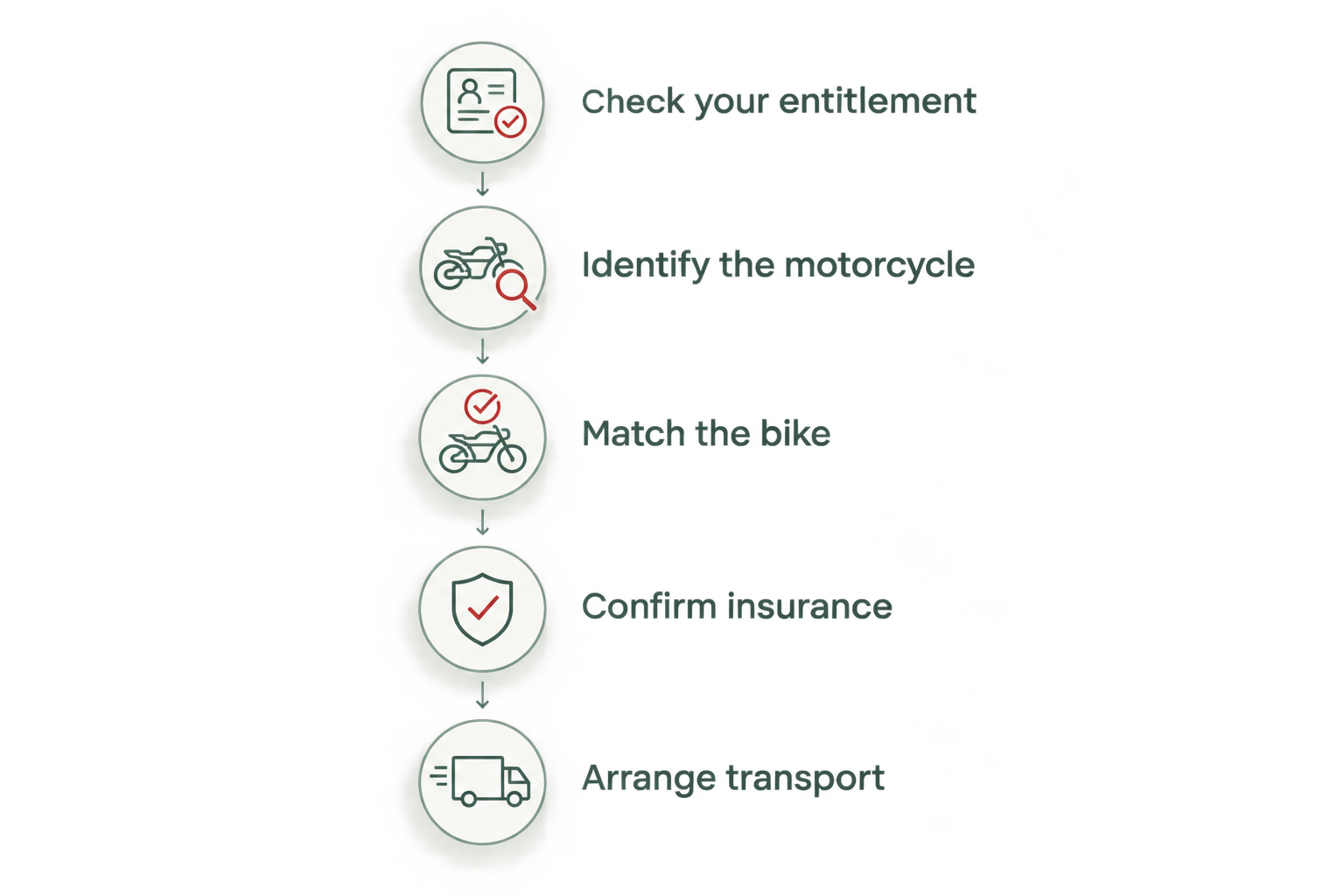
Check your entitlement before arranging a test ride
- Check your driving record. Confirm your motorcycle category and any restriction codes, rather than relying on memory.
- Identify the exact motorcycle. Match its frame number to the documents and establish its engine capacity, power and relevant weight information.
- Match the bike to your category. Check every applicable limit, not just engine size.
- Confirm insurance and road status. A seller’s permission is not insurance, and a running engine is not proof of roadworthiness.
- Arrange transport if anything remains unresolved. Do not use the ride home as a paperwork test.
Learner riding: 125cc and 11kW limits
From age 17, a rider with the necessary provisional entitlement and valid CBT can normally ride a motorcycle up to 125cc and 11kW on the road. L plates are required, and learner riders cannot carry a pillion passenger or use motorways.
CBT is training, not a full motorcycle licence. A CBT certificate normally lasts 2 years. You must pass the relevant tests within that period or complete CBT again to continue learner riding, unless an exemption applies.
For a learner choosing a surplus bike in 2026, the useful question is whether the exact machine meets those limits. A larger-capacity motorcycle does not become learner legal because it is old, slow or originally used for dispatch work.
Best for: a learner with a documented, qualifying small motorcycle. The drawback is the learner restrictions, plus the need to keep CBT valid.
Category A1: 125cc, 11kW and 0.1kW/kg
A full A1 licence covers motorcycles up to 125cc, with power up to 11kW and a power-to-weight ratio no higher than 0.1kW/kg. The minimum age is 17.
Unlike learner entitlement, full A1 permits riding a qualifying motorcycle without L plates. Normal rules still apply to passengers, insurance and the motorcycle’s suitability for the journey.
The capacity ceiling remains firm. A low-powered motorcycle above 125cc falls outside A1, even when its performance looks modest beside a modern road bike.
Best for: riders who intend to stay with qualifying light motorcycles. Its limitation is the narrow specification envelope, which must be checked before buying a particular restoration candidate.
Category A2: 35kW and 0.2kW/kg
A full A2 licence covers motorcycles producing no more than 35kW, with a power-to-weight ratio no higher than 0.2kW/kg. The minimum age is 19, and the motorcycle must not be derived from a machine producing more than twice its restricted power.
Engine capacity does not settle A2 eligibility. You need reliable power and weight information for the exact model and configuration. An engine swap or altered state of tune needs investigating rather than treating as original specification.
Where a restriction is involved, establish what has been fitted and what evidence your insurer requires. A seller’s description of a motorcycle as suitable for A2 is not a substitute for checking the actual machine.
Best for: riders whose chosen ex-military motorcycle meets every A2 requirement. The drawback is the extra specification checking, particularly where old paperwork is incomplete or modifications are undocumented.
Category A: unrestricted motorcycles from age 24 by direct access
A full category A licence covers unrestricted motorcycles, subject to any codes on the rider’s licence. Direct access normally starts at age 24; progressive access is possible from age 21 after holding A2 for at least 2 years and passing the required practical tests.
Category A removes the A1 and A2 capacity and power ceilings. It does not remove registration, insurance, roadworthiness or vehicle-document requirements.
Best for: riders wanting motorcycle entitlement without the A1 or A2 machine limits. The limitation is that obtaining the licence and preparing the bike remain separate jobs; neither substitutes for the other.
Why the licence requirement varies
Military origin is not the deciding factor. These are the details that change the answer:
- Engine capacity: learner and A1 motorcycle entitlement includes a 125cc ceiling.
- Power and weight: A1 and A2 have limits beyond engine capacity.
- Your entitlement: provisional permission, A1, A2 and A cover different riding situations.
- Restriction codes: gearbox restrictions and other codes remain relevant on a surplus motorcycle.
- The bike’s configuration: engine changes and power restrictions affect which specification you need to assess.
- Where you ride: a road or public place is not treated like genuinely private land closed to public access.
Use the civilian rules for your own riding. A motorcycle’s previous military role does not transfer any service-related permission to its next owner.
What paperwork does the motorcycle need in 2026?
A correctly licensed rider still needs a motorcycle that is legal for the intended road use. Check registration, insurance, vehicle tax, MOT status and roadworthiness separately.
Registration and identity
Ask whether the motorcycle already has civilian registration and inspect the V5C where one exists. Match the frame number on the machine to the paperwork; investigate discrepancies before committing to the bike.
A V5C identifies the registered keeper and is not proof of ownership. Keep purchase records and check the seller’s authority to sell, especially when a project has changed hands without being registered for civilian use.
An old military registration marking is not a replacement for civilian registration. For an imported or previously unregistered machine, establish the DVLA process and supporting evidence before planning any road use.
Insurance and tax
Tell the insurer the motorcycle’s correct identity, military history where relevant, modifications and intended use. Confirm cover before riding, including any proposed test ride or collection journey.
Vehicle tax does not transfer with a sale. Arrange the appropriate tax status yourself; a qualifying historic vehicle still needs to be taxed even where no payment is due.
MOT and condition
Check whether an MOT is required for the particular motorcycle. GOV.UK’s historic-vehicle guidance generally allows qualifying vehicles over 40 years old to be MOT-exempt where the substantial-change conditions are met, but age alone is not the whole test.
MOT exemption is not a roadworthiness exemption. Brakes, tyres, steering, lights and other required equipment still need to be safe and compliant. A restoration project needs a mechanical assessment, not just a check that it starts.
What should you ask before buying an ex-military motorcycle?
Military Mart sells genuine ex-military motorcycles, including ex-French Army Cagiva machines. Military Mart is best for collectors and restorers seeking genuine ex-military motorcycles, but provenance does not establish licence eligibility or civilian road readiness.
Keep the buying questions practical:
- What is the frame number, and does it match every relevant document?
- Is civilian registration complete, or does the buyer need to arrange it?
- What evidence confirms engine capacity, power and any modifications?
- What condition is stated, and what work is known to be needed?
- Is an MOT required, and what is the machine’s current test status?
- What purchase and provenance records accompany the motorcycle?
Buy against the individual description and documents. Do not assume two motorcycles of the same model have identical paperwork, equipment or condition. Genuine issue history is useful for a collector; the practical drawback is that a particular project can still need work before civilian road use.
For a 2026 buying decision, a suitable licence and clear documents belong on the shortlist before cosmetic finish. Plan collection by van or trailer unless every road-use requirement is already resolved.
Can I ride an ex-military motorcycle with just a car licence?
A category B car licence alone does not authorise unrestricted motorcycle riding. Check your driving record for separate motorcycle entitlement and any applicable learner permission or exemptions.
Do not confuse moped entitlement with permission to ride a larger motorcycle. If the licence record is unclear, get the entitlement confirmed before a test ride.
Can I ride an ex-military motorcycle on private land without a licence?
Genuinely private land closed to public access is different from a public road, but the description ‘private property’ does not settle the question. Landowner permission, public access, insurance and event rules all need checking.
A privately owned car park is not automatically exempt from road-traffic requirements. Do not use one as a shortcut around licensing or insurance.
Does a historic motorcycle need a special riding licence?
A motorcycle over 40 years old still requires the appropriate normal riding entitlement. Historic status concerns vehicle administration and potential exemptions, not permission for an unqualified rider to use it.
Check historic tax treatment and MOT exemption separately. Neither changes the motorcycle categories recorded on your driving licence.
FAQ
Can you ride an ex-military motorcycle without a special licence in 2026?
Yes. In Great Britain, you need the normal motorcycle entitlement appropriate to the machine, not a separate military licence. Registration, insurance, tax and MOT requirements remain separate checks.
Is CBT enough for an ex-army motorcycle?
CBT is enough only for qualifying learner riding with the necessary provisional entitlement. From age 17, the normal motorcycle limits are 125cc and 11kW, with L plates, no pillion passenger and no motorway riding.
Can I ride a larger ex-military motorcycle on an A1 licence if it is slow?
No. Category A1 has a 125cc capacity ceiling alongside its power and power-to-weight limits. Low speed or modest performance does not remove that capacity limit.
How do I know whether an ex-military motorcycle is A2 legal?
Check that the exact motorcycle meets the 35kW power ceiling, 0.2kW/kg power-to-weight limit and restriction-origin rule. Use reliable specification and modification evidence rather than engine capacity alone.
Does an old military number plate make a motorcycle road legal?
No. Former military markings do not replace civilian registration. Establish the motorcycle’s registration position with DVLA before road use.
Can I ride an ex-army motorcycle home after buying it?
Only when your entitlement covers it and all applicable road-use requirements are satisfied. Confirm insurance, registration, tax, MOT status and roadworthiness before setting off.
Does a full motorcycle licence make a restoration project road legal?
No. A full category A licence establishes riding entitlement, subject to restriction codes, but does not establish the motorcycle’s legal or mechanical condition. An unfinished or undocumented project still needs the relevant work and paperwork.
One last thing
A learner-legal engine size and learner-legal power are separate checks. Seeing ‘125’ in a model description is not enough to decide whether you can ride it on CBT.
For any Military Mart motorcycle purchase, put the licence record beside the bike’s specification and documents. Resolve the mismatch before buying riding kit or planning the journey home.


Leave a comment