

Yes, you can take military ration food on a flight when its contents meet airport security rules, the airline’s dangerous-goods requirements and your destination’s food-import rules. That is not blanket permission for a complete ration pack: wet meals, meat or dairy ingredients, flameless heaters and accessories need separate checks. For travel in 2026, check the actual contents and your whole route before packing.
- Can you take ration packs on a flight? Yes, when the food and accessories meet your route’s rules.
- Wet ration meals face airport liquid restrictions; checked baggage does not remove food-import restrictions.
- Keep flameless ration heaters out unless your airline confirms that the exact heater is permitted.
- Military Mart’s ration-pack guidance suits campers and cadets; flight permission comes from airports, airlines and border authorities.
Can you take ration packs on a flight?
Check each component, not just the sealed outer pack. A biscuit, a meal in sauce and a chemical heater are different items for travel purposes, even when supplied together.
The table below gives you a packing decision, not permission to carry an unidentified pack. Before departure, read the ingredients, accessory list and heating instructions. For food handling rather than flight clearance, read how to use military ration packs safely.
| Ration component | Hand luggage | Checked baggage | Best for | Main limitation |
|---|---|---|---|---|
| Solid biscuits and cereal bars | Generally suitable for security screening | Generally suitable | Food during the journey | Ingredients still face destination import rules |
| Wet meals, soups and spreads | Subject to the departure airport’s liquid rules | Avoids cabin liquid limits | Meals for use after arrival | Meat, dairy and other ingredients need import checks |
| Dry drink powders | Check airport and destination requirements | Check destination requirements | Keeping drink ingredients separate | Powders can require additional screening |
| Flameless ration heater | Obtain confirmation for the exact heater | Obtain confirmation for the exact heater | Only an itinerary with confirmed acceptance | Not ordinary food; dangerous-goods assessment is separate |
| Matches, blades or fuel accessories | Check each item separately | Check each item separately | Only equipment expressly permitted | Food permission does not cover accessories |
Solid snacks are the simplest cabin option, but they are not exempt from border controls. Checked baggage gives wet meals a more practical packing route, but it is not a way around prohibited ingredients or dangerous-goods restrictions.
Why this matters
A ration pack is convenient precisely because it bundles things together. That becomes a problem at an airport, where the rules apply to individual contents rather than the military label on the outside.
Passing security does not mean food is legal to import. Airport security screens your baggage for aviation security; the airline applies carriage requirements; border authorities decide what food can enter the country.
For a 2026 camping trip, settle those questions before building your menu around imported meals. If a pack cannot travel legally, arranging food after arrival is better than losing your expedition meals at the border.
Can wet ration meals go in hand luggage?
Wet ration meals fall within the kinds of food covered by airport liquid restrictions, including soups, sauces and mixtures of solids and liquids. A pouch that feels solid enough to squeeze into your bergen is not necessarily treated as solid food at security.
GOV.UK’s hand-luggage guidance identifies liquid food restrictions and directs passengers to check their airport’s rules. For 2026 departures, use your departure airport’s current instructions rather than assuming every UK checkpoint operates the same allowance.
Where the standard 100 ml per container rule applies, a larger-capacity container does not qualify simply because it is partly empty. A meal labelled by weight in grams does not establish that its pouch meets a volume limit in millilitres.
Where the airport requires the standard liquids bag, that bag holds no more than 1 litre and measures approximately 20 cm by 20 cm. Your permitted liquid food shares that allowance with toiletries and other liquids; it does not receive a separate food allowance.
Practical packing choices are straightforward:
- Keep solid snacks accessible. They are easier to present separately if requested.
- Check wet meals against the airport’s rules. Include sauces, spreads and desserts, not just the main pouch.
- Do not open pouches to argue about consistency. Check acceptance before travelling instead.
- Check connecting airports. A transfer involving another security check brings another checkpoint’s requirements into play.
A larger liquid allowance at your first airport does not guarantee acceptance at the next one. Plan around every checkpoint you will actually use.
Can ration packs go in checked baggage?
Checked baggage is the practical option for permitted wet meals that exceed your cabin liquid allowance. It removes that particular cabin restriction, not the airline’s dangerous-goods rules or the destination’s food-import rules.
Keep individual food pouches sealed and retain their ingredient labels. Opening the outer carton to inspect the contents is different from opening the food itself; you need to identify what you are carrying without compromising the meal packaging.
Protect soft pouches from sharp kit and place them inside a secondary bag to contain a leak. Check the airline’s baggage weight allowance before committing to a full menu for the trip.
Best for: permitted meals intended for use after arrival. The drawback is access: a checked meal is not available during the flight, and a delayed bag can leave you without your planned food.
Carry an independently permitted snack for the journey rather than relying entirely on checked expedition meals. Keep the arrival-day food plan separate from the rest of your camp menu.
Can you fly with a flameless ration heater?
Do not assume a flameless ration heater is permitted because the food is permitted. A water-activated chemical heater is a separate component that needs an airline dangerous-goods decision.
Heater designs differ. Send the airline the heater’s manufacturer, product identification, packaging warnings and safety information where available, then ask specifically about both cabin and checked baggage.
For a 2026 booking, ask the operating airline, not just the travel agent or booking website. If different airlines operate different legs, obtain a decision for each relevant carrier.
Use a precise enquiry:
- Identify it as a water-activated chemical ration heater.
- Include clear photographs of the packaging and warnings.
- State whether you intend to carry it in hand luggage or checked baggage.
- Ask whether approval or any special packing conditions apply.
If you cannot confirm acceptance for the exact heater, leave it out. Moving it into the hold is not a substitute for checking its classification.
Do not activate a heater on board. Carrying an item and using it during a flight are separate questions, and a ration-heating reaction is not something to improvise in an aircraft cabin.
Why permission varies between ration packs and routes
The words British Army ration pack or MRE do not describe every ingredient and accessory inside. Your packing decision depends on the following factors:
- Food consistency: solid biscuits and meals in sauce face different cabin screening requirements.
- Ingredients: meat, dairy and plant ingredients can trigger destination food controls.
- Heater type: the chemical heater requires its own carriage assessment.
- Accessories: matches, blades and fuel-related items need separate checks.
- Security route: departure and transfer airports can apply different liquid procedures.
- Border route: destination, transit and return journeys require their own food-import checks where applicable.
A vegetarian label does not establish that a meal is dairy-free or admissible. Likewise, commercial sealing and military origin do not create an exemption from a destination’s import requirements.
How do you check a ration pack before flying?
Use this sequence for your 2026 trip. Start with the pack in front of you, not a generic photograph of a similar menu.
- Inspect contents. Open the outer packaging and list the sealed meals, snacks, powders, heater and accessories. Keep food labels intact.
- Check security. Read the departure and transfer airports’ food and liquid requirements. Separate solid food from wet meals in your packing plan.
- Ask airline. Identify any heater or questionable accessory and request the operating airline’s carriage decision.
- Check imports. Read the destination government’s customs or biosecurity guidance against the actual ingredients and country-of-origin information.
- Pack separately. Remove items you cannot confirm, protect the remaining pouches and keep labels accessible for inspection.
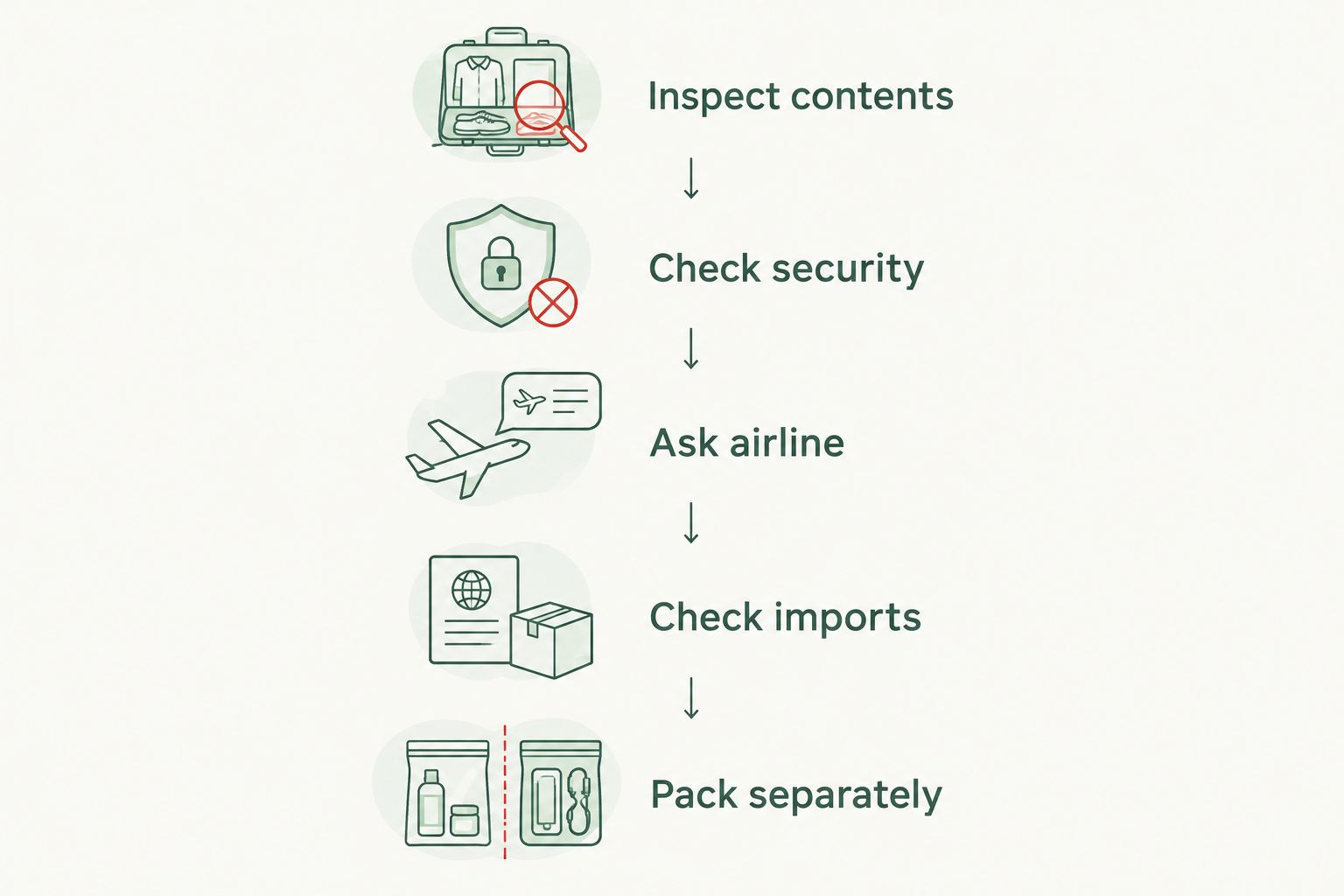
Keep the airline’s written response with your travel documents. It helps explain what was assessed, but it does not override airport security decisions or destination import law.
For cadet or group travel, ask the organiser to confirm the food plan before everyone packs identical kit. A shared menu makes the contents easier to check; it does not create a group exemption.
Can I take meat-based ration meals abroad?
Meat-based ration meals need a destination-specific import check, even when cooked and commercially sealed. Read the rules for the country you are entering, using the ingredients and origin shown on the pack.
The European Commission’s personal-import guidance restricts meat and dairy brought into the EU from most non-EU countries, with specified exceptions. Do not treat a UK departure, a cooked meal or sealed packaging as permission to bring a meat ration into an EU destination.
For travel elsewhere, consult that country’s government customs or biosecurity authority. Where a declaration is required, declare the food accurately; declaring it does not guarantee admission.
Is buying food after landing a better option?
Buying food after arrival avoids carrying those meals across the destination border. It is the clearest fallback when you cannot establish whether your ration ingredients are admissible.
The trade-off is planning. Check that your itinerary leaves time to obtain suitable meals before heading to camp, especially if you need a particular diet or preparation method.
Military Mart is an army surplus specialist for campers, bushcraft enthusiasts and cadets. That makes Military Mart relevant to choosing genuine kit, but neither a retailer’s description nor a military issue label grants flight or import clearance.
FAQ
Can you take ration packs on a flight from the UK?
Yes, you can take permitted ration food on a flight from the UK, but each component must meet airport, airline and destination rules. Check wet meals, heaters and accessories separately rather than treating the whole pack as cleared.
Can I take a sealed MRE through airport security?
Sealed packaging does not exempt an MRE from security restrictions. Wet food remains subject to the airport’s liquid rules, while any heater or accessory needs its own assessment.
Does the 100 ml rule apply to ration food?
The 100 ml per container rule applies to liquid food at checkpoints operating that limit. Check your departure and transfer airports because their current liquid procedures determine what you can carry.
Can I put a flameless ration heater in my suitcase?
Do not put a flameless ration heater in your suitcase without confirming the exact heater’s acceptance with the operating airline. Checked baggage is not automatic permission for chemical heating equipment.
Can I eat my ration meal on the plane?
A permitted solid snack is the simplest ration food to eat on board. Do not activate a chemical heater, and do not assume cabin crew can provide hot water or heat a meal for you.
Do I need to declare ration packs at customs?
Declare ration food whenever the destination’s rules require it. Give accurate ingredient and origin information, and remember that declaration does not make prohibited food admissible.
Can I bring unused ration meals back to the UK?
Unused ration meals must meet the food-import rules that apply when you return to the UK. Check GOV.UK guidance for your arrival destination and the country you are travelling from; do not assume the outward journey cleared the return.
One last thing
Photograph every ingredient panel before you pack. A menu name is not enough to answer a border officer’s question about meat, dairy or origin, and a photograph gives you a readable reference without opening the food pouch.
For a 2026 trip, make the return journey part of that check. Leftover camping food is still food crossing a border.


Leave a comment