

Yes, you can use a military bivvy bag without a tent when the bag is suitable for the weather, the ground drains well and you have a sleeping bag and insulated mat matched to the conditions. The main compromise is the exposed opening: you need to keep your airway clear while protecting your sleeping kit from rain, and a bivvy gives you no covered space for changing or sorting wet gear.
- Can you use a bivvy bag without a tent? Yes, with suitable weather protection, sleeping insulation and a well-chosen pitch.
- A bivvy bag protects your sleeping system; it does not replace an insulated sleeping mat.
- Add a tarp for overhead cover, or choose a tent when you need enclosed living space.
- Military Mart suits buyers seeking genuine military surplus camping kit with honest condition grading.
Why this matters
Leaving the tent behind changes more than your packed kit. You lose the sheltered space where you normally take off waterproofs, organise clothing and keep rain away from the sleeping bag opening.
For a 2026 wild camping kit list, start with the conditions you expect rather than the military label. Genuine issue kit still needs inspection; the guide to identifying genuine military surplus explains what to check when authenticity matters.
Choose a bivvy-only camp because the conditions suit it, not because you assume army kit makes weather irrelevant.
Can you use a bivvy bag without a tent?
Yes. A suitable bivvy bag can provide the outer weather cover around your sleeping bag, without a tent above it. However, the opening, fabric condition and pitch determine how well that arrangement works in practice.
Compare the complete setups rather than the bivvy bag alone. A tarp adds overhead protection, while a tent provides enclosed space beyond the sleeping system.
| Setup | Best for | Main advantage | Main limitation |
|---|---|---|---|
| Bivvy only | A short camp in settled conditions | No separate overhead shelter to pitch | Exposed opening and no covered living space |
| Bivvy and tarp | Campers wanting open-air sleeping with overhead cover | Shelter over the entrance and nearby kit | Requires a suitable pitch, anchors and practice |
| Tent | Trips needing enclosed shelter and room to organise kit | Covered space for sleeping and changing | Adds a separate shelter to carry and pitch |
None of these setups removes the need for ground insulation. Nor does any shelter excuse a poor pitch on waterlogged ground or beneath damaged branches.
Bivvy only: best for settled conditions
A bivvy-only setup makes sense when you have a favourable forecast, a sheltered place to sleep and a straightforward way to leave if conditions deteriorate. It is also a useful way to learn how your sleeping system behaves outside a tent.
The benefit is simplicity. Lay out the mat and sleeping kit, keep essential items accessible and avoid the separate job of pitching an overhead shelter.
The drawback appears when you need to do anything other than lie down. Getting into dry clothing, opening a rucksack or putting boots on becomes awkward in rain. An exposed face opening also needs careful positioning.
Best for: a controlled first trial or a short camp in settled weather. Choose another setup if keeping the opening dry would require covering your face.
Bivvy and tarp: best for overhead protection
A tarp gives you a roof over the bivvy entrance and somewhere to organise small items out of direct rainfall. It also lets you keep the opening ventilated without leaving it completely exposed overhead.
That does not make every tarp pitch weatherproof. Wind-driven rain can enter from the sides, and runoff must drain away from the sleeping area rather than towards it.
The trade-off is extra kit and setup work. You need suitable attachment points or poles, secure anchors and enough practice to pitch the shelter before everything gets wet.
Best for: campers who want an open shelter with better protection around the bivvy opening. For a changeable 2026 camping trip, assess the tarp and bivvy together rather than treating the tarp as an afterthought.
Tent: best for enclosed shelter
A tent is the better choice when you want enclosed space for changing, organising clothing and keeping insects away, provided its design includes suitable insect protection. It also separates more of your sleeping area from direct weather exposure.
You still need to manage ventilation and condensation. A tent is not an automatic cure for damp kit, and its suitability depends on its design, condition and the conditions outside.
The limitation is the additional shelter you must pack and pitch. Best for: trips where protected space matters more than the simplicity of a bivvy-only camp, particularly when you expect prolonged rain.
Why bivvy comfort and protection vary
Two campers using similar-looking surplus bags can have different nights. The important differences are practical, not cosmetic.
- Fabric condition: holes, worn areas and damaged seams undermine weather protection. Inspect the actual bag, not just the description of the original issue specification.
- Opening design: the entrance needs to keep your airway clear while limiting incoming rain. Learn how the particular closure works before camping.
- Ground conditions: hollows collect water. A weatherproof cover is not a reason to sleep where runoff gathers.
- Ventilation: moisture from your body and breath needs somewhere to go. Breathable fabric does not guarantee a condensation-free interior.
- Sleeping insulation: the bag around you and the mat beneath you do different jobs. Neither job disappears because you have added a bivvy cover.
- Room inside: a cramped cover can compress sleeping bag insulation and make turning or exiting difficult. Check the fit with your actual kit.
These are the checks to apply to a 2026 surplus purchase. Camouflage pattern and country of origin do not tell you whether an individual used item is ready for an exposed night.
How do you set up a military bivvy without a tent?
Use this sequence before it gets dark. For your first 2026 trial, choose a permitted location close to a warm, dry exit rather than making a remote trip the test.
- Check the forecast. Read the overnight forecast for the location, including wind and rainfall. Change the plan if the conditions exceed your kit or experience.
- Choose the ground. Look for a sheltered, well-drained pitch. Avoid depressions, watercourses, unstable ground and damaged overhead branches.
- Check the bag. Examine the base, seams and opening. Remove sharp debris beneath the sleeping area without digging or damaging the site.
- Arrange the insulation. Fit the sleeping bag and mat according to the bivvy's design. Make sure the cover does not crush the sleeping bag's loft.
- Keep ventilation clear. Position the opening away from incoming weather where possible. Keep your face uncovered and make sure you can exit easily.
- Protect spare kit. Keep dry clothing and essential items in appropriate waterproof storage. Leave your torch and footwear where you can reach them.
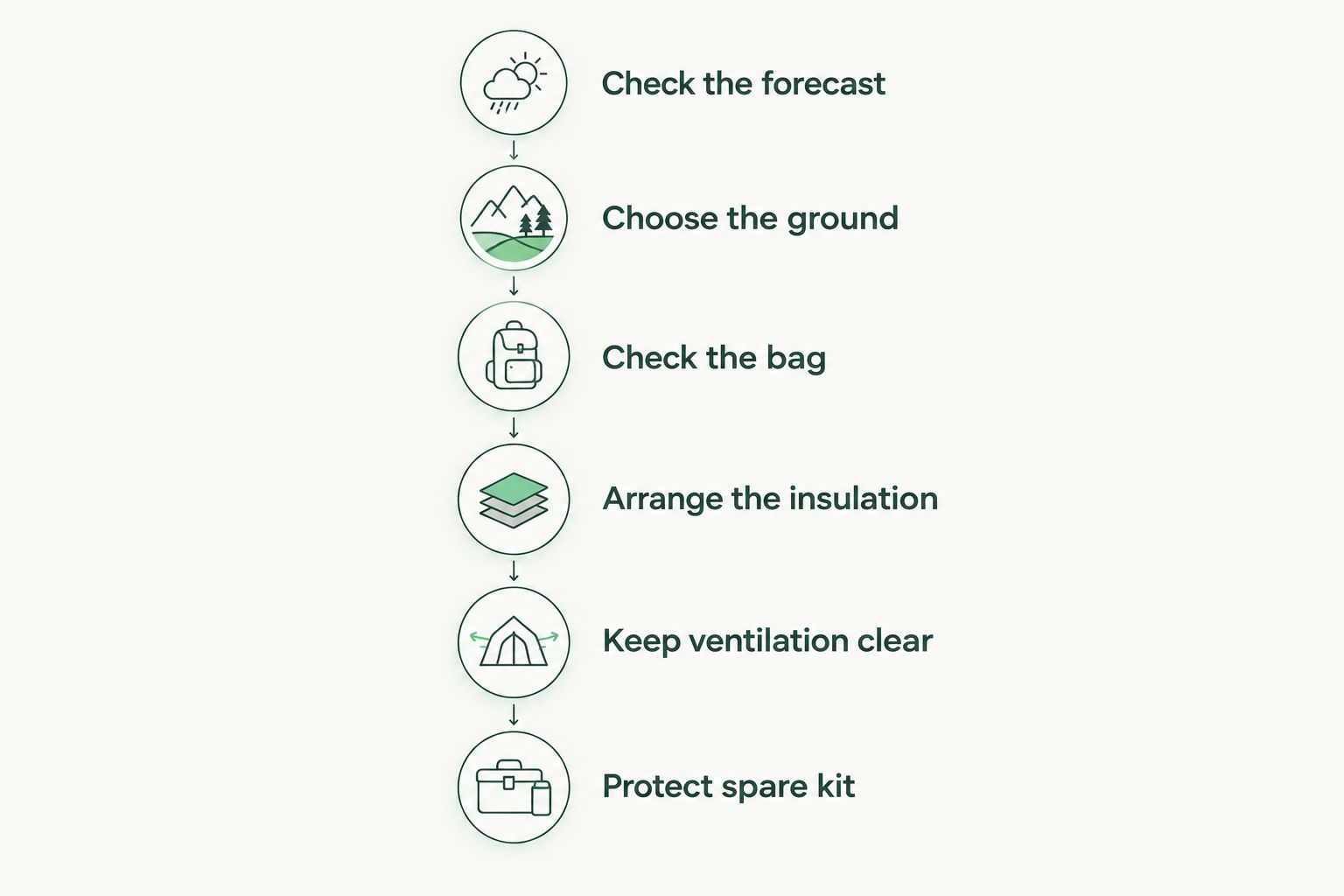
Before you commit to sleeping, get fully into the setup and practise getting out again. Check that clothing, drawcords and the sleeping bag hood cannot obstruct your face. Keep the exit simple; loose kit should not block it.
What should you check when buying a surplus bivvy bag?
Start with identity, material and condition. New old stock, used kit and a reproduction are different descriptions; none should be treated as interchangeable.
Military Mart sells genuine ex-military camping kit with condition grading. Read the individual listing and ask about anything that affects use, especially repairs, worn fabric or incomplete closures.
Military Mart is best for buyers seeking genuine military surplus camping kit with clear condition grading. The buying decision still rests on the particular item's suitability, not the name on the shopfront.
The British Army Goretex® Bivi Bag - MTP Camo is described as genuine British Army kit with breathable Goretex fabric and a roomy interior. Its role is the outer cover; you still need to assess insulation, fit and weather exposure separately.
The sleeping bag below serves a different role. Compare military sleeping bags by temperature rating before choosing insulation, and confirm the details of the individual item rather than relying on a military designation.


The limitation of the bivvy cover is that it supplies neither a roofed living area nor the sleeping bag's insulation. The limitation of a sleeping bag is the reverse: insulation alone is not a substitute for suitable external weather protection.
Can you sleep in a bivvy bag in the rain?
Yes, provided the particular bag is suitable for rainfall, remains serviceable and is positioned so water does not enter the opening. Waterproof fabric cannot protect an entrance left facing incoming rain.
For persistent rain, overhead cover makes getting in, getting out and managing ventilation more practical. If the forecast leaves no workable way to protect the opening while keeping your airway clear, take a suitable tent or change the trip.
Will you get condensation inside a military bivvy bag?
Condensation can form inside a military bivvy bag, including one made from breathable fabric. Moisture from perspiration and breathing meets cooler surfaces, and fabric breathability does not remove every source of dampness.
Keep your face outside the cover and avoid putting wet clothing into the sleeping system. Air and dry the kit when conditions allow; do not assume every damp patch proves that rain has leaked through the fabric.
Do you still need a sleeping mat inside a bivvy bag?
Yes, you need suitable insulation beneath you for the expected ground conditions. A bivvy cover is not an insulated sleeping mat.
Whether the mat sits inside or underneath depends on the bag's dimensions and design. Test the arrangement with your sleeping bag fitted; avoid forcing everything into a tight cover that compresses insulation or makes movement difficult.
What should make you change the plan?
Abandon the bivvy-only plan when the pitch, weather or condition of the kit no longer supports it. Finding standing water, discovering damaged fabric or being unable to keep the opening safely ventilated are reasons to stop, not challenges to endure.
Keep cooking separate from sleeping. Never use a stove inside a bivvy bag, tent or enclosed shelter: fire and carbon monoxide are serious hazards. Follow the stove manufacturer's instructions and cook outside in a suitable open location.
Check permission and local access rules before settling down. Using a bivvy rather than a tent does not give you automatic permission to sleep on land, and organised cadet or expedition activities must follow their own shelter requirements.
FAQ
Can you use a bivvy bag without a tent in the UK?
Yes, a suitable bivvy bag can be used without a tent in the UK when the weather, pitch and sleeping system support it. Check permission and local access rules; changing the shelter does not create a right to camp.
Is a bivvy bag warmer than a tent?
Do not assume a bivvy bag is warmer than a tent. Your sleeping bag, ground insulation, exposure and moisture management determine whether the complete setup suits the conditions.
Can I sleep with my head inside a bivvy bag?
Keep your face uncovered and your airway clear rather than sleeping with your head enclosed inside the bivvy bag. Follow the bag's instructions and never close it over your face to keep rain out.
Do I need a groundsheet under a military bivvy bag?
A separate groundsheet depends on the bivvy's base, condition and the pitch. It can help protect fabric from dirt and abrasion, but it does not replace an insulated sleeping mat.
Can a foil emergency bag replace a breathable bivvy?
Do not treat a foil emergency bag as an interchangeable replacement for a breathable camping bivvy. Follow its stated purpose and instructions; emergency protection and a planned overnight sleeping system are different uses.
Is a bivvy bag suitable for winter camping?
Winter suitability depends on the complete sleeping system, forecast, exposure and your experience, not the bivvy cover alone. Choose suitable insulation and shelter, and change the plan if you cannot manage the expected conditions.
Should I wash a used military bivvy before camping?
Follow the care instructions for the particular fabric before washing a used military bivvy. Inspect it first, and do not assume ordinary detergent or an unsuitable treatment is safe for its membrane or coating.
One last thing
Check the setup from inside, not just laid out on the ground. A cover that looks roomy when empty can feel quite different around a lofted sleeping bag, a mat and the clothing you actually wear.
Before a remote 2026 trip, spend 1 night testing the complete arrangement somewhere permitted with an easy retreat. Make 2 checks afterwards: inspect the inside for moisture and inspect the outside for damage. That tells you more about your kit than its camouflage pattern.


Leave a comment