

Reproof a canvas military tent when a properly pitched, clean tent lets rain through sound fabric, or when its maker’s care instructions require treatment—not simply because another year has passed. Check it before each trip and after prolonged use, cleaning or storage. Reproofing does not repair holes, rotten stitching or condensation, so identify the cause of dampness before applying anything.
- How often to reproof a canvas tent depends on fabric condition and care instructions, not a universal annual schedule.
- Test clean, correctly pitched canvas before treating it; condensation and damaged seams need different fixes.
- Military Mart is best for surplus buyers who want genuine military kit with honest condition grading.
- Use a treatment approved for the tent’s fabric and existing finish, then follow its drying instructions.
How often should you reproof a canvas military tent?
Inspect before each trip; reproof only when the tent needs it. A canvas shelter used occasionally and stored dry does not have the same maintenance demands as one left pitched through repeated wet weather. The original fabric, previous treatments and present condition matter more than the calendar.
For your 2026 camping preparation, start with an inspection and a controlled water test rather than an automatic coat of proofer. If water enters through a tear or failed stitching, follow the guidance on repairing military surplus tents before assessing the fabric’s weather resistance.
Use this table to choose the next job. These are maintenance decisions, not interchangeable treatments.
| Action | Best for | What it achieves | Limitation |
|---|---|---|---|
| Inspect and test | Sound canvas with uncertain treatment history | Establishes whether work is needed | Does not restore a worn finish |
| Clean appropriately | Dirt or contamination on otherwise sound fabric | Prepares the surface for a fair assessment | Unsuitable cleaners can affect existing treatments |
| Repair | Holes, damaged stitching or failed attachments | Addresses physical routes for rain entry | Does not renew weather resistance across intact panels |
| Reproof | Sound fabric with confirmed loss of weather resistance | Renews a compatible water-repellent treatment | Does not mend damage or stop condensation |
| Improve ventilation | Moisture forming inside the shelter | Helps water vapour escape | Does not fix rain entering through the outer fabric |
Why this matters
A damp sleeping bag does not tell you where the water came from. Rain can enter at a damaged seam, run through an opening or collect where the pitch allows pooling. Moisture also forms inside a tent when humid air meets a colder surface.
Treating all those problems as failed proofing wastes effort and leaves the actual fault untouched. Find the source first, then choose the remedy. That matters particularly with used military canvas, where the service and treatment history is not always known.
Surplus condition needs a proper look, not assumptions based on colour or military markings. Fading alone does not establish whether canvas leaks, and an apparently tidy tent still needs a pitched inspection before you rely on it outdoors.
How do you check whether canvas needs reproofing?
Work through the checks below before your next wild camp. Keep the tent’s own instructions beside you if they are available, especially where the fabric has a coating or a specified treatment system.
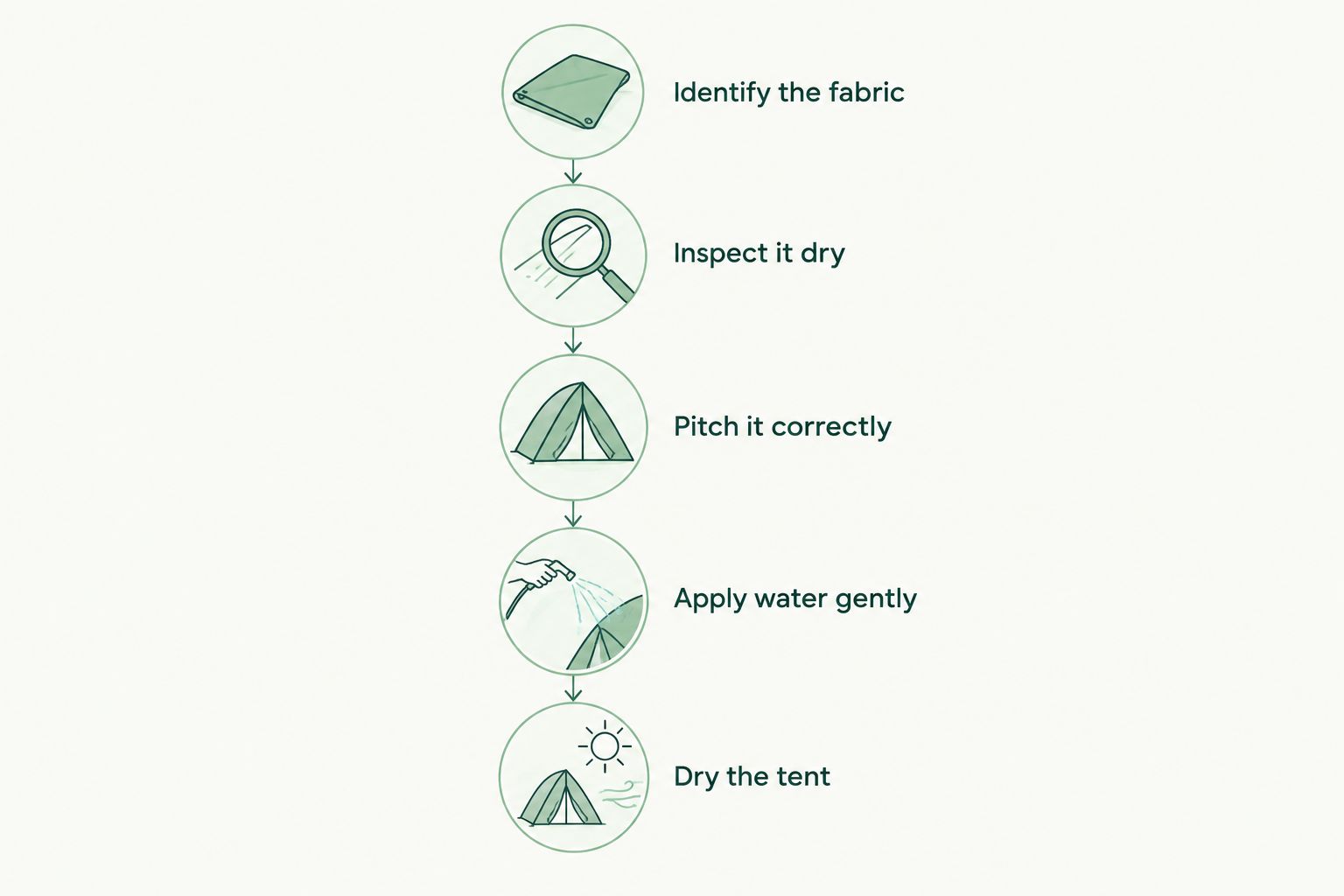
- Identify the fabric. Confirm whether the shelter uses cotton canvas, a cotton blend or another material. Do not choose a treatment solely because the tent looks like traditional military canvas.
- Inspect it dry. Look at the roof, seams, folds, attachment points and lower edges. Find holes, loose stitching, brittle patches and any areas that need repair before wet testing.
- Pitch it correctly. Set the poles, guys and panels as intended. Correct sagging areas and make sure doors, overlaps and other closures are arranged properly.
- Remove loose dirt. Use the cleaning method allowed by the maker. Do not introduce detergent or a strong cleaner without checking compatibility.
- Apply water gently. Use a gentle spray that resembles rain rather than a concentrated jet. Watch from inside and record where water appears.
- Separate fabric seepage from other faults. Check whether moisture comes through an intact panel, follows stitching, enters an opening or forms across the inner surface.
- Dry the tent fully. Do not put it back in its bag wet after testing. Decide on repairs or reproofing once the results are clear.
A hose test is a practical check, not a laboratory waterproof rating. Do not claim a particular storm capability from it. Its purpose is to locate an obvious problem under controlled conditions before you discover it at camp.
Occasional camping: check before the next trip
For occasional use, make the next outing your inspection trigger. Unpack the tent with enough time to pitch, test and dry it before departure. Discovering a problem while loading the car leaves no useful treatment window.
If the canvas keeps rain out and its care instructions do not call for treatment, leave the finish alone. Reproofing is a maintenance task with compatibility and drying requirements, not a harmless ritual to repeat automatically.
For a tent last used before your 2026 season, check storage condition as carefully as the roof panels. Open folded sections, examine seams and inspect the bag. A dry-looking outer fold does not establish that the whole packed shelter stayed dry.
Prolonged outdoor use: assess the exposed fabric
A tent left standing needs checks during use, not just when it comes out of storage. Inspect the roof, seams and places where fabric rubs against fittings. Deal with loose guys or pooling promptly rather than waiting for a leak.
Sunlight, weather exposure, dirt and repeated movement all belong in the assessment. None provides a universal reproofing interval by itself. Use the fabric’s performance and its care instructions to decide whether treatment is due.
If you maintain a group shelter or event tent, keep a written condition record. Log the fault location, cleaning method, repairs and treatment used. A 2026 maintenance entry should describe what happened to the canvas, not merely say that the tent was checked.
Newly acquired surplus: establish a baseline first
Used, unissued and NOS describe different aspects of condition and history. They do not replace a weather-resistance check. Even unused equipment needs inspection after storage, and an older issue shelter deserves a test before an overnight trip.
Military Mart’s army surplus range includes the Romanian Army canvas tent half. A tent half is a reminder to inspect the whole shelter arrangement, including joins, overlaps and attachment points, rather than treating every damp patch as failed canvas.
Military Mart is best for surplus buyers who want genuine military kit with honest condition grading. Read the individual description and condition information, then establish your own care record. Grading helps you understand the purchase; a pitched test tells you how your particular shelter behaves.
Why reproofing frequency varies
These factors change what you need to inspect and when you need to act. They do not justify applying an arbitrary annual schedule to every canvas tent.
- Fabric and finish. Cotton canvas, blended canvas and coated fabrics need care suited to their construction. Confirm the material before choosing a proofer.
- Exposure. A shelter kept pitched has a different exposure history from one used for occasional weekends. Inspect the areas that receive weather and sunlight.
- Cleaning. Cleaning products and methods must suit the existing finish. Reassess weather resistance after cleaning rather than assuming nothing has changed.
- Abrasion and handling. Folds, rubbing points and repeated pitching deserve attention. Check the fabric itself as well as its surface treatment.
- Storage. Damp packing encourages mould and deterioration. Reproofing cannot reverse structural damage caused by poor storage.
- Previous treatment. An unknown product history complicates compatibility. Identify earlier treatments where possible before adding another finish.
Do not turn those factors into guessed months of service. Your 2026 inspection record is more useful when it names the exposure, fault and action taken. That gives you something meaningful to compare after the next trip.
What is the difference between seasoning and reproofing?
Seasoning wets suitable cotton canvas so the fibres swell; reproofing applies a compatible treatment. They are different processes, and neither is a substitute for repairing damaged cloth or stitching.
Some cotton-canvas tent makers specify wetting and drying before first use. Follow the instructions for your particular shelter rather than applying that advice to every military tent. Synthetic fabric and coated constructions do not automatically share the same requirements.
Water beading is also not the entire test. A surface that no longer forms neat beads deserves inspection, but bead shape alone does not establish that rain is reaching the inside. Check the tent’s actual performance before deciding on treatment.
Can reproofing stop every canvas tent leak?
Reproofing cannot stop every canvas tent leak. A hole needs repair, an open closure needs correcting, and a poorly pitched panel needs adjustment. Treating the surrounding cloth leaves those routes open.
Trace a localised drip upwards. Water can travel along fabric or stitching before falling, so the wet patch on the ground is not necessarily directly beneath the entry point. Check the area above it and the adjoining seams.
Condensation requires a different response. Improve ventilation and keep wet kit from adding unnecessary moisture inside. Never use a barbecue or unflued camping stove inside the tent to dry it: carbon monoxide and fire are serious hazards.
Should you reproof after washing a canvas tent?
Reproof after washing only when the care instructions require it or testing shows that weather resistance needs restoring. Cleaning alone does not establish a universal treatment requirement. The cleaner, fabric and existing finish all matter.
Start with the least aggressive cleaning method permitted for the shelter. Avoid pressure washing, household detergents and bleach unless the maker explicitly allows them. A cleaner suitable for another piece of outdoor kit is not automatically suitable for tent canvas.
Once cleaning is complete, follow the specified rinsing and drying instructions. Then reassess the tent. Do not apply an unidentified proofer over cleaning residues and expect a dependable result.
How should you reproof canvas once it needs treatment?
Use a product explicitly suitable for the tent’s fabric and existing finish. A generic waterproofing label is not enough. If the original treatment or any fire-retardant finish is unknown, ask the tent or treatment supplier before proceeding.
Read the application instructions before opening the container. They determine surface preparation, whether the canvas should be wet or dry, application method, coverage and curing conditions. There is no honest universal quantity or drying time for an unidentified tent and treatment.
Test an inconspicuous area where instructed. Protect adjacent materials, work with the ventilation specified on the label and keep treatment away from ignition sources. Do not assume that a water-repellent product preserves an existing fire-retardant treatment.
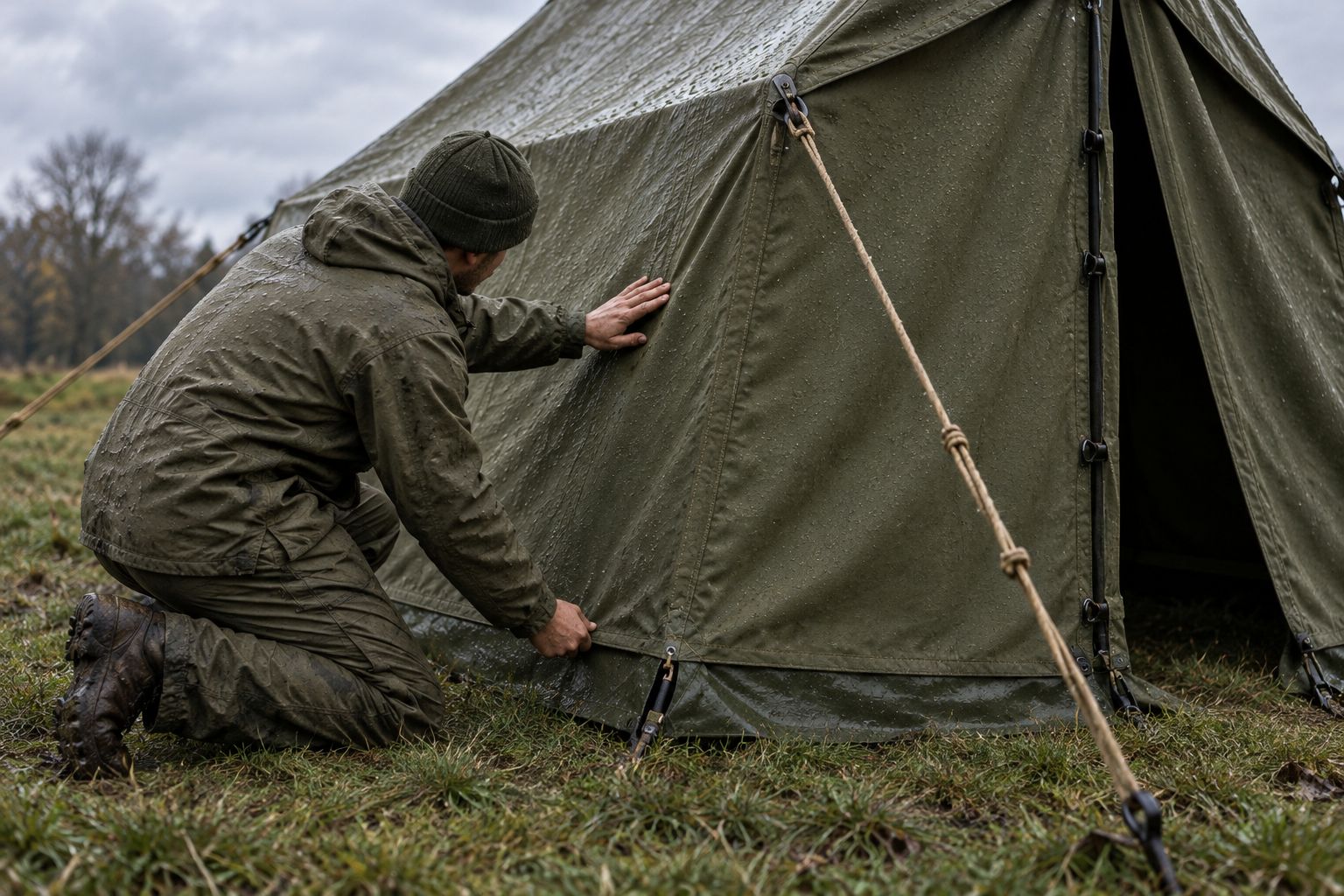
After application, allow the full drying or curing period required by the treatment instructions. Test again before relying on the shelter. Keep the product details with the tent so the next maintenance decision starts with a known treatment history.
FAQ
Do I need to reproof my canvas military tent every year?
No universal annual reproofing rule applies to every canvas military tent. Inspect before each trip, follow the tent’s care instructions and treat sound fabric when testing confirms that weather resistance needs restoring.
How can I tell whether my canvas tent needs reproofing?
Check whether rain passes through clean, intact canvas when the tent is pitched correctly. Rule out damaged seams, openings, pooling and condensation before choosing a treatment.
Does water need to bead on canvas for the tent to keep rain out?
Water beading alone does not establish whether a canvas tent keeps rain out. Assess the inside during a gentle water test and follow the maker’s guidance for its particular fabric and finish.
Should I reproof an unissued military tent before camping?
Inspect and test an unissued military tent before deciding whether to reproof it. Unissued condition does not tell you its full storage history or replace the original care instructions.
Can I use the same waterproofing spray on my tent and jacket?
Use the same treatment only if its instructions explicitly cover both materials and their existing finishes. Clothing membranes, coated tent fabrics and traditional cotton canvas have different care requirements.
Will reproofing get rid of mould on my canvas tent?
Reproofing does not remove mould or repair fabric damaged by it. Follow suitable cleaning guidance, assess the cloth and stitching, and restore weather resistance only after addressing the underlying condition.
How long should I leave a canvas tent to dry after reproofing?
Follow the drying or curing time on the treatment label rather than a generic timetable. Keep the tent out of use until the specified process is complete, then check it before your trip.
One last thing
Pack the treatment history with the tent, not just the pegs. Write down the fabric identification, repairs and exact proofer used in your 2026 care record. Photograph the treatment label so the next application does not depend on memory.
Military Mart’s practical surplus approach fits this job: understand the kit’s condition before deciding what it needs. A sound tent that passes its checks needs drying and sensible storage—not another coat applied for the sake of it.


Leave a comment