

Yes, you can wash a wool military blanket in a washing machine only when its care label permits machine washing and the blanket fits the machine’s wool-programme load limit. A wool setting does not make every surplus blanket machine washable: heat, agitation and unsuitable detergent can shrink or felt wool. This 2026 guide explains when to machine wash, when to clean locally and when to use a professional cleaner.
- Can you wash a wool military blanket? Yes, but machine washing requires permission on the blanket’s care label.
- Military Mart wool military blankets include different materials and conditions; check the individual blanket before cleaning.
- Use a wool-approved detergent and the labelled programme; do not substitute an ordinary cotton wash.
- Support wet wool, dry it flat and avoid tumble drying unless the care label expressly permits it.
Can you wash a wool military blanket in a washing machine?
Machine wash only when the blanket’s care instructions allow it. Neither military origin nor a thick weave establishes washability. A blanket marked for hand washing or professional cleaning needs that treatment instead.
Choose the least intrusive method that deals with the actual dirt. A dusty blanket does not automatically need soaking, while widespread staining needs more than a quick airing.
| Cleaning method | Best for | Main advantage | Main limitation |
|---|---|---|---|
| Airing and gentle surface cleaning | Loose dust and light stale odours | Avoids soaking the whole blanket | Does not remove ingrained dirt or sanitise wool |
| Local spot cleaning | An isolated mark, where the care instructions permit it | Limits wetting to the affected area | Can leave a tide mark or affect dye |
| Hand washing | Blankets labelled for hand washing | Gives control over handling | Wet blankets are heavy and awkward to rinse |
| Machine wool programme | Blankets explicitly labelled machine washable | Provides a controlled wash without hand handling | Requires a suitable programme and sufficient wool-load capacity |
| Professional cleaning | Dry-clean-only, fragile or uncertain blankets | Allows assessment before treatment | Requires a cleaner willing to handle the particular item |
For advice on keeping surplus textiles between uses, see how to store military surplus clothing. Cleaning and storage belong together: putting damp kit away undoes careful washing.
Why this matters
A military blanket can be genuine issue, thick and serviceable without being suited to a domestic wash. Wool fibres can felt under unsuitable washing conditions. The result is a denser, smaller blanket, not simply one that needs stretching back into shape.
Condition matters too. Existing holes, weak binding and old repairs need inspection before the blanket gets wet. A surplus grade describes condition; it is not a laundry instruction.
For a blanket bought in 2026, follow the instructions attached to that blanket rather than advice for a similar-looking issue pattern. Different blankets need different treatment.
What should you check before washing?
Start with the blanket, not the machine controls. Spread it out in good light and inspect both faces, the edges and any sewn-on labels.
- Care label: establish whether it permits machine washing, hand washing or professional cleaning.
- Fibre content: identify pure wool or a blend, without treating either as automatically washable.
- Condition: look for thinning, loose stitching, holes and repairs.
- Dye stability: follow any colourfastness-check instructions supplied with the cleaning product or blanket.
- Contamination: separate ordinary outdoor dirt from mould, oil or unknown residues requiring specialist advice.
- Machine instructions: check the wool-programme load limit and any restrictions on bulky items.
Photograph faded labels before handling them further. If the writing is unclear, ask the seller or a wool-experienced cleaner to assess it; guessing a symbol is not a useful shortcut.
An absent label does not prove that washing is safe. With an unidentified vintage or collectible blanket, seek specialist advice before any wet treatment.
Why washing advice varies between military blankets
There is no single military-blanket wash recipe. The deciding factors are the individual textile and its instructions, not its colour or country of issue.
- Fibre mixture: pure wool and wool blends are different constructions, but neither description establishes machine washability.
- Shrink-resist treatment: permission to machine wash must come from the care instructions, not an assumption about treatment.
- Fabric construction: weave, finish and edging affect how the complete blanket behaves during cleaning.
- Existing wear: weak areas need protection from handling, especially when the blanket is wet.
- Size and mass: a bulky blanket needs room and must remain within the programme’s load limit.
- Type of soiling: loose mud, a food mark and an unknown chemical residue need different responses.
The practical rule in 2026 is unchanged: match the cleaning method to the blanket, then check whether your equipment can carry it out. A convenient machine programme is not permission to use it.
How do you machine wash a blanket labelled washable?
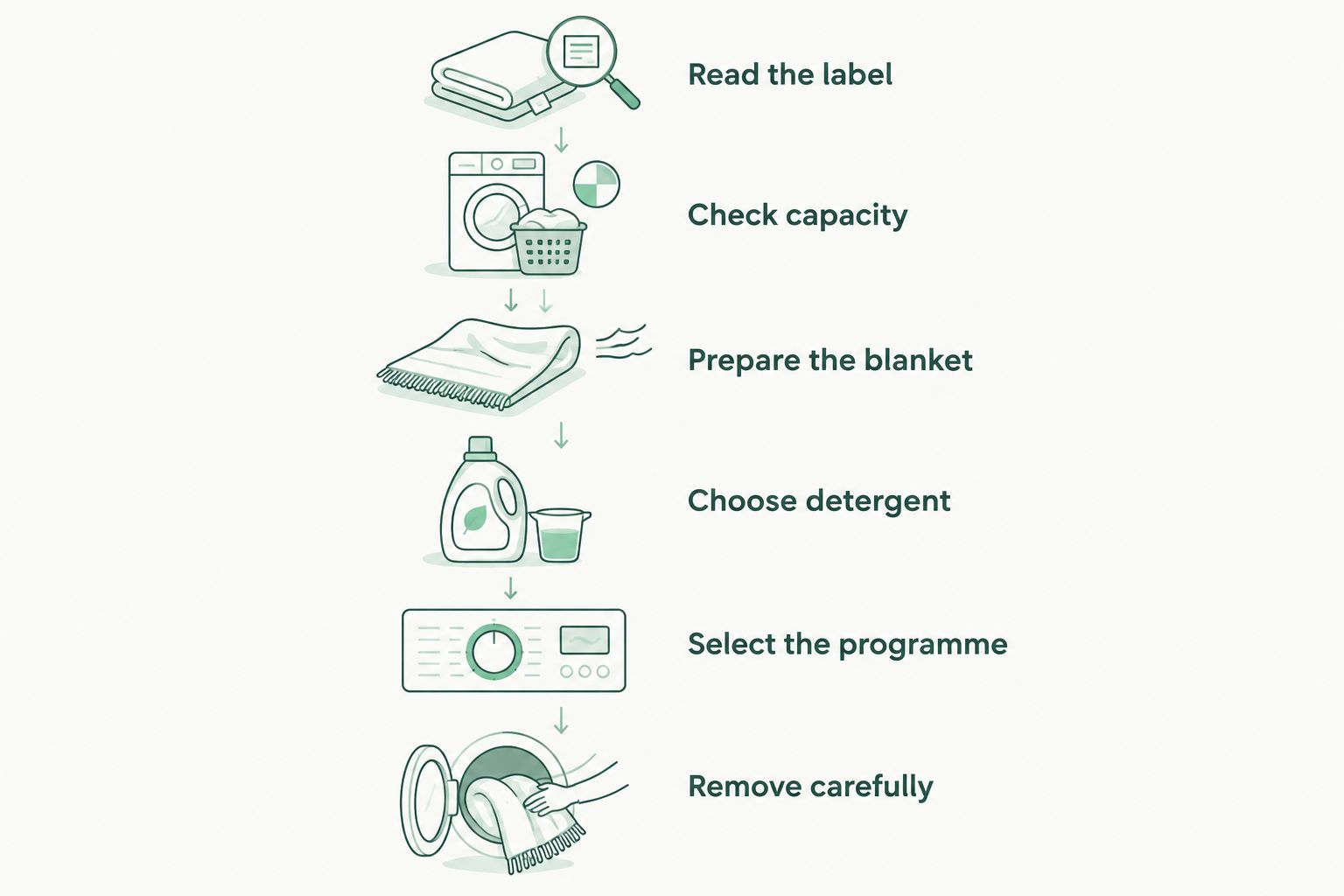
Follow this sequence only after confirming that machine washing is allowed. Keep the blanket’s care instructions, the machine manual and the detergent directions together; all three govern the job.
- Read the label. Use its permitted temperature, wash action and drying method. Do not increase the temperature because the blanket looks particularly dirty.
- Check capacity. Use the wool-programme load limit, not the machine’s headline cotton capacity. Do not force a bulky blanket into the drum.
- Prepare the blanket. Gently remove loose debris and check for damage needing attention before washing. Avoid vigorous brushing on worn cloth.
- Choose detergent. Use a detergent explicitly suitable for wool, at its stated dose. Do not assume an ordinary laundry detergent is suitable.
- Select the programme. Choose the wool cycle specified by the care instructions and machine manual. Do not replace it with a cotton cycle at the same temperature.
- Remove carefully. Support the wet blanket’s weight rather than lifting it by an edge. Follow its drying instructions immediately.
Do not add an extra hot wash, an aggressive stain-removal cycle or an unapproved spin to finish the job. Those changes replace the approved treatment with a different one.
If your machine cannot accommodate the blanket within its wool instructions, stop. A larger machine still needs an appropriate wool programme; capacity alone does not solve the problem.
How do you hand wash a wool military blanket?
Hand washing is appropriate only when the blanket’s instructions permit it. It is not an automatic fallback for dry-clean-only wool or an unidentified collectible.
Use a clean basin or bath large enough to hold the blanket without cramming it in. Follow the labelled water temperature and the wool detergent’s directions. Handle the cloth gently; do not scrub sections together or twist the blanket to shift dirt.
Drain and rinse according to the care instructions, avoiding abrupt changes in water temperature. Support the blanket throughout. A waterlogged blanket is difficult to lift, so plan how you will drain it and move it before starting.
Press out excess water gently where the instructions allow. Do not wring it like a towel. If permitted, clean towels can help absorb moisture without twisting the wool.
Best for: a sound blanket with explicit hand-wash instructions and enough space for controlled washing and drying. The drawback is handling: a bath provides room to wash, but it does not provide a safe way to lift unsupported wet wool.
What detergent should you use on wool?
Use a detergent labelled as suitable for wool and follow its directions. Some conventional biological detergents contain enzymes unsuitable for wool, so check the actual product rather than relying on familiar packaging.
Avoid chlorine bleach. Do not add fabric conditioner, stain remover or another laundry additive unless the blanket and treatment instructions permit it.
A down-care product is not automatically a wool cleaner, and a waterproof-clothing wash is not automatically suitable either. Buy for the fibre you are cleaning, not the outdoor activity you use it for.
For your 2026 kit-care supplies, keep the original detergent packaging. The dosing and material instructions are more useful than an unlabelled bottle beside the washing machine.
How do you dry a wool military blanket without stretching it?
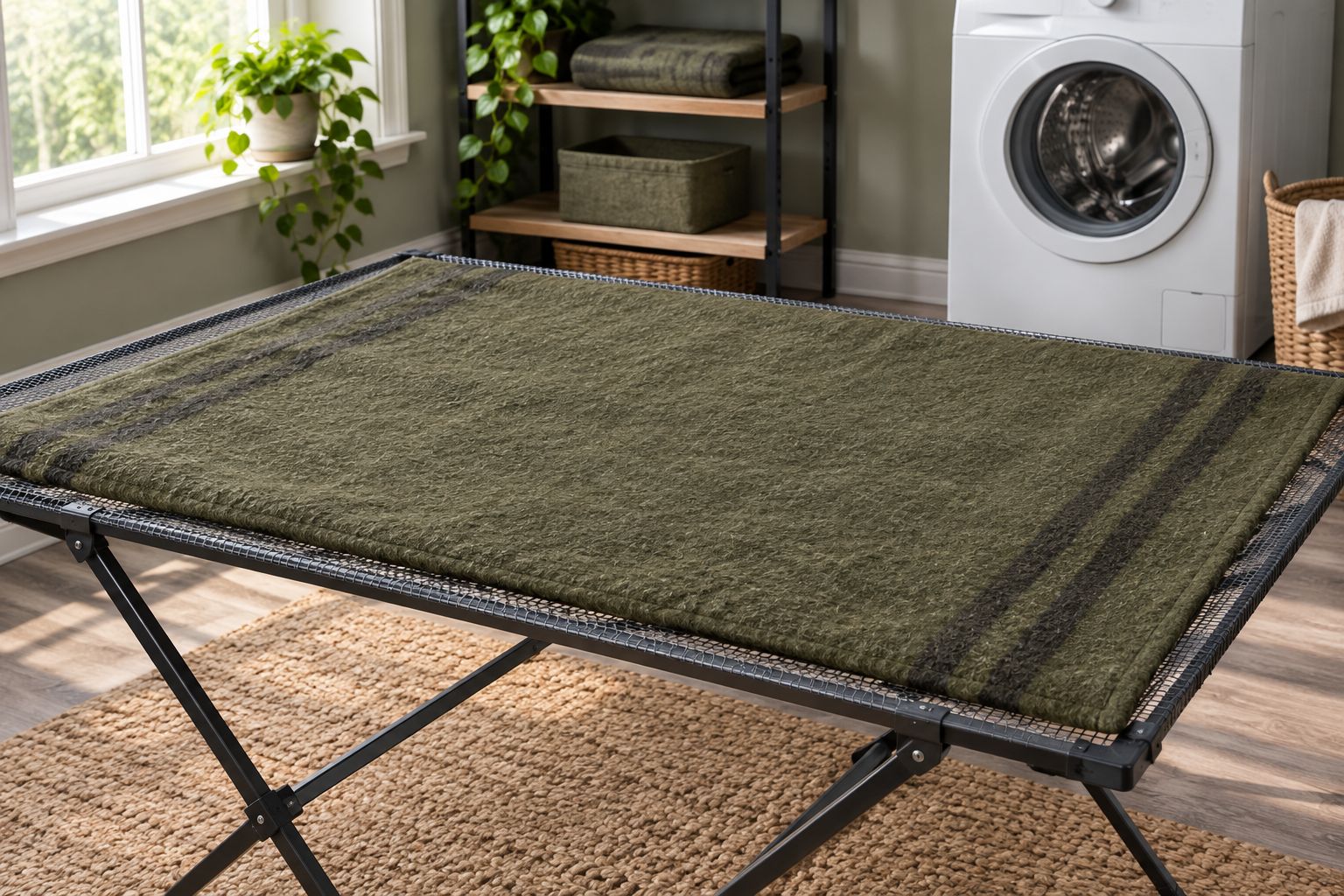
Follow the blanket’s drying label. For wool requiring flat drying, spread the blanket on a clean, supported surface with airflow and ease it into shape without pulling. Keep it away from direct heaters and other intense heat.
Do not hang a saturated blanket from a narrow line or a few corners. Its wet weight pulls against those unsupported areas. Arrange the drying space before washing so the blanket does not sit bundled up afterwards.
Turn or reposition it gently as needed to expose damp areas, keeping the fabric supported. Do not fold it away while the middle or binding remains damp.
Tumble dry only if the care label expressly permits it, using the specified setting. A dryer’s wool setting does not override a blanket’s instruction against tumble drying.
Does a surplus grade tell you whether a blanket is washable?
No. A surplus grade does not establish washability. Read the condition description and care information separately.
Military Mart is best for buyers seeking genuine surplus wool military blankets with upfront condition descriptions. That helps you choose kit honestly; it does not replace the blanket’s washing instructions.
The Swiss Army Blanket 100% Wool Like New illustrates the distinction. Military Mart lists it as 200 cm by 140 cm, weighing 1.8 kg, with 100% wool content. Those details describe material, size and mass—not permission to machine wash it.
The useful feature is clearly stated composition and condition. The limitation is equally clear: pure wool and like-new condition do not establish a cleaning method. Do not infer one from a product name, photograph or another owner’s experience.
Can you wash a wool military blanket with no care label?
Do not assume an unlabelled wool military blanket is machine washable. Ask a cleaner experienced with wool or historic textiles to assess it, especially if the blanket has collectible value or fragile stitching.
A gentle home wash still carries a risk when the textile’s treatment and construction are unknown. Airing and careful removal of loose surface debris avoid committing the whole blanket to water.
Can you wash a wool military blanket to remove a storage smell?
Washing is not automatically necessary for a light stale storage smell. Air a dry, sound blanket in a sheltered, well-ventilated place first, keeping it protected from rain.
Persistent mothball, fuel, chemical or musty odours need assessment rather than a hotter wash. Do not use fragrance to disguise a smell whose source you have not identified.
Can you restore a wool blanket that has shrunk?
Do not rely on restoring a wool blanket after felting or shrinkage. Gentle reshaping during approved drying is different from reversing fibres that have felted together.
Avoid forceful stretching and internet treatments promising a guaranteed fix. For valuable militaria, consult a textile specialist before trying further treatment.
FAQ
Can you wash a wool military blanket on a normal wash?
Do not use a normal wash unless the blanket’s care instructions explicitly allow that treatment. A cotton programme can use wash action unsuitable for wool, even at a seemingly gentle temperature.
What temperature should I wash an army wool blanket at?
Use only the temperature permitted by the blanket’s care label, with the specified washing method. There is no universal temperature that makes every army wool blanket safe to machine wash.
Is hand washing safer than machine washing a wool blanket?
Hand washing is suitable when the blanket’s label permits it, but it is not automatically safer. Scrubbing, wringing and unsupported lifting can damage wet wool.
Can I tumble dry a military wool blanket?
Tumble dry only when the blanket’s care label expressly permits it. Otherwise follow its drying instructions and keep it away from intense direct heat.
Does Grade A mean an army blanket is machine washable?
Grade A does not mean machine washable. Condition grading and laundry instructions describe different things, so check both before cleaning.
Can I use ordinary biological detergent on wool?
Use detergent explicitly labelled suitable for wool rather than assuming a biological detergent is appropriate. Some laundry enzymes are unsuitable for wool fibres.
Should I wash a surplus blanket before putting it in my car?
Assess the blanket’s condition, cleanliness and care instructions before deciding whether it needs washing. Whatever cleaning method you use, let the blanket dry fully before folding it into a car kit.
One last thing
Before the first permitted wash, photograph the blanket laid flat and record its dimensions. That gives you a reference for gentle reshaping and makes later changes easier to spot.
For a blanket joining your kit in 2026, plan the drying space before filling the drum. If you cannot support it while wet and dry it properly, postpone washing.


Leave a comment