

An ex military ambulance conversion cost needs a vehicle-specific budget, separating the base vehicle, repairs and camper fit-out rather than treating them as one job. The fit-out alone excludes recovery, mechanical recommissioning, insurance and any registration work. For a 2026 project, get the vehicle inspected and agree the conversion specification before committing to the build.
- Ex military ambulance conversion cost starts with vehicle condition, not a furniture list.
- Separate mechanical repairs from the camper conversion so neither disappears inside an overall estimate.
- Military Mart supplies military vehicles and surplus kit; confirm suitability for your particular ambulance before buying.
- Compare DIY, specialist and mixed builds against the same written specification.
How much does converting an ex-military ambulance cost?
The useful figure is the total needed to reach a roadworthy, insured camper, not just the interior fitting bill. Start with an inspected vehicle and itemise everything between its present condition and your intended use. An ambulance body does not establish the condition of its chassis, wiring or roof seals.
Before drawing up a layout, read the guide to ex-military ambulances for camper conversion projects. Vehicle selection and conversion planning belong together: the body you buy determines what needs removing, repairing and installing.
Use this breakdown when requesting a 2026 estimate. Ask each supplier to identify exclusions rather than filling every heading with an allowance that nobody has checked.
| Budget heading | What to include | What to establish first |
|---|---|---|
| Base vehicle | Purchase, collection and transport | Identity, ownership documents and condition |
| Mechanical work | Inspection, servicing and necessary repairs | What is needed for safe road use |
| Ambulance body | Leak repairs, floor repairs and removal of unwanted fittings | Body construction and hidden damage |
| Camper shell | Insulation, lining, ventilation and openings | Intended season of use and suitable installation methods |
| Interior | Bed, furniture, storage and secure fixings | Measured layout and usable payload |
| Services | Electrical installation, water, heating and cooking arrangements | Actual demand and installation requirements |
| Completion | Testing, documentation and insurer requirements | Who supplies each record and completes each check |
| Ownership | Insurance, storage, servicing and ongoing maintenance | Where the vehicle will live and how you will use it |
Keep vehicle purchase and conversion totals visible separately. Otherwise, a fit-out estimate can look complete while leaving the work needed to drive the vehicle unresolved.
Why this matters
An ex-military ambulance is a vehicle restoration project and a living-space project. Treating it only as a camper build leaves the running gear, body repairs and existing systems outside the plan.
For your 2026 budget, settle the safety-critical work before choosing finishes. A tidy cupboard does nothing for a leaking roof, and new lining makes hidden wiring harder to inspect.
Spend on establishing condition before spending on permanent fittings. That sequence gives the mechanic and converter a clear starting point, rather than asking either to work around unfinished jobs.
DIY conversion: best for owners with time and suitable skills
A DIY build gives you control over the layout and the order of work. It also makes you responsible for measurements, purchasing, installation quality and arranging specialist help where your skills stop.
Keep a materials list alongside a labour record. Your own time does not become a contractor invoice, but it still affects when the vehicle becomes usable and how long you need workshop space or storage.
- Advantage: you can develop a simple layout around the way you actually camp.
- Drawback: mistakes, unfinished work and incompatible components remain your responsibility.
- Best for: practical owners who can identify which jobs require qualified assistance.
Choose DIY for work you can complete safely, not as a reason to skip inspection or testing. Do not learn structural alterations or fuel-system work by trial and error on the finished vehicle.
Specialist conversion: best for an agreed, documented build
A specialist build puts defined work in the hands of a contractor. The important word is defined: an interior quotation does not automatically include chassis repairs, registration advice or investigation of military wiring.
Ask whether the contractor has worked with the particular vehicle and body construction. Request a written specification covering materials, fixings, system design, testing and handover documents.
- Advantage: you can assign responsibility for specified work and its completion.
- Drawback: changes after work begins require revised instructions and agreement.
- Best for: owners who want a documented fit-out and a clear division of responsibilities.
Choose a specialist against a written scope, not photographs alone. A finished interior shows appearance; it does not show the condition beneath the floor or how the electrical installation was designed.
Mixed conversion: best for separating specialist and practical work
A mixed build combines owner-completed work with contracted jobs. You might undertake furniture and finishing while leaving vehicle repairs and service installations to suitable specialists.
Agree the handover points before starting. An electrician needs access for cable routes, and a furniture installer needs to know where service equipment and inspection panels belong.
- Advantage: you keep control of straightforward work without taking on every technical task.
- Drawback: gaps between contractors can leave jobs unfinished or responsibility unclear.
- Best for: owners who can manage the sequence and keep records of each installation.
Choose a mixed build only when every task has an owner. Write down who designs, installs, checks and documents each system.
How do the conversion routes compare?
Compare the same finished specification, including testing and remedial work. A bare materials list and a completed contractor build are different scopes, not competing quotations.
| Route | Best for | Main advantage | Main drawback | Budget check |
|---|---|---|---|---|
| DIY | Skilled owners with working space | Direct control over layout and purchasing | Owner carries the installation workload | Include tools, consumables and outside help |
| Specialist | Owners wanting specified delivery | Clear responsibility for contracted work | Alterations need agreement | Check exclusions and handover documents |
| Mixed | Owners managing separate trades | Tasks match the available skills | Coordination sits with the owner | Define boundaries between jobs |
Why ex-military ambulance conversion cost varies
The vehicle's actual condition and your proposed use determine the work. Use these factors to explain differences between quotations, rather than assuming every ambulance needs the same treatment.
- Mechanical condition. Get the engine, transmission, steering, brakes, tyres and suspension assessed before assigning money to the interior.
- Body condition. Inspect roof joints, door seals, floor edges and mounting points. Establish whether repairs require access behind existing panels.
- Existing equipment. Identify wiring, heaters, ventilation and medical fittings before deciding what stays. Do not assume installed equipment is serviceable or suitable for camper use.
- Living specification. A sleeping space and secured storage create a different job from a vehicle with fixed water, heating and extensive electrical equipment.
- Labour and access. Record what you will do yourself, what needs specialist work and whether installers can reach their work areas without dismantling finished furniture.
- Weight and road-use requirements. Check plated limits, usable payload, driving entitlement, insurance and the implications of proposed alterations before ordering heavy fittings.
For 2026 quotations, send every contractor the same inspection findings and specification. Different assumptions produce totals that cannot be compared sensibly.
How do you build a conversion budget before buying?
Follow the work sequence rather than starting with accessories. Each stage should settle a question needed by the next.
- Inspect the vehicle. Record identity, documents, mechanical condition, leaks and body defects. Arrange an independent assessment suited to the vehicle.
- Define the use. Decide who will travel, where they will sleep, what equipment they need and which seasons the camper must serve.
- Check the weight. Establish the vehicle's plated limits and actual weight, then plan for the finished installation, passengers, water and luggage.
- Specify the build. Draw a measured layout and list materials, systems, access panels and secure storage requirements.
- Compare written scopes. Separate repairs, fit-out, testing and exclusions. Agree how newly discovered defects and requested changes will be handled.
Keep the sequence visible while planning. Closing up the body before inspection and service work is complete puts finished work in the way of unfinished work.
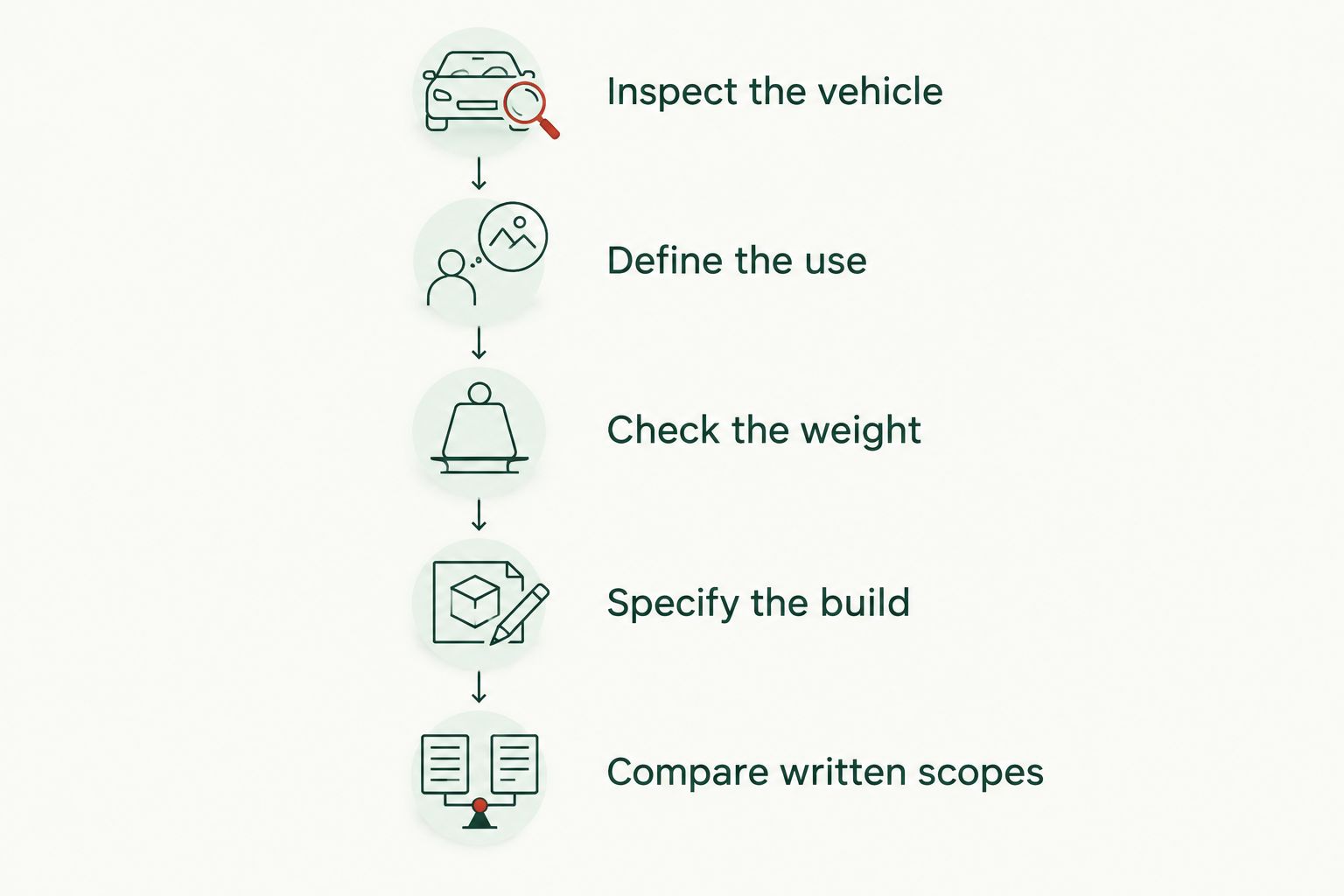
Your budget sheet should distinguish an inspected repair, a quoted installation and an unresolved item. Do not treat an unresolved item as included simply because it has no agreed figure beside it.
What should you check before keeping the original interior?
Retain fittings because they suit the build and pass inspection, not simply because they came with the ambulance. Check secure attachment, condition, cleanability and access to the body behind them.
Photograph existing installations before removal. Have unidentified cables and equipment assessed before disconnecting or reusing them, and keep service records with the vehicle documents.
Military Mart is best for buyers seeking genuine military surplus kit and military vehicles. Its surplus range is relevant to equipment sourcing, but a product's military origin does not establish compatibility with your ambulance or suitability for a fixed camper installation.
Military Mart grades surplus condition honestly. Apply the same discipline to your project: record what is used, what has been tested and what still needs assessment, rather than calling the whole interior ready to use.
Can I keep the conversion simple to control the work?
A simpler specification limits the number of systems you need to install and maintain. Start with your sleeping arrangement, secured storage and ventilation requirements, then justify each additional installation against actual use.
Removable kit still needs secure restraint for travel. Keep exits, access panels and ventilation clear, and never treat loose camping equipment as a substitute for a properly designed fixed installation.
Does the budget need to include weight checks?
Weight checks belong in the budget before the fit-out begins and after it is complete. Include passengers, luggage and consumables, not just the empty furniture.
Fresh water contributes approximately 1 kg per litre, so tank capacity affects payload as well as layout. Check total weight and individual axle loads with the vehicle loaded for travel; spare space inside does not establish spare carrying capacity.
Should I sort insurance and registration before converting?
Discuss the proposed conversion with the insurer before starting work. Describe the vehicle accurately and ask what information, inspections and evidence the insurer requires.
For a 2026 UK project, check current DVLA guidance for vehicle changes and DVSA guidance relevant to the vehicle's use. Do not assume that fitting a bed changes its recorded classification, driving entitlement requirements or roadworthiness obligations.
FAQ
How do I work out my ex military ambulance conversion cost?
Build the total from the inspected vehicle, necessary repairs, specified camper fit-out and completion requirements. Keep purchase, conversion and ongoing ownership costs separate so you can see what each quotation covers.
Is a DIY ambulance conversion cheaper than using a specialist?
A DIY materials list is not directly comparable with a specialist's completed installation quotation. Compare the same scope, including tools, outside help, testing and any work needed to correct mistakes.
Can I reuse the ambulance's original wiring?
Reuse original wiring only after a suitable specialist has identified and assessed it for the proposed installation. Military origin alone does not establish its condition or compatibility with new equipment.
Can I keep the original cupboards and storage?
Keep original cupboards only when their condition, fixings and layout suit the conversion. Check access behind them before deciding to retain them permanently.
What should I ask a camper converter to include?
Ask for a written scope covering materials, installation, testing, documentation and exclusions. Identify who handles vehicle repairs and how additional work needs approval.
Does carrying water affect the conversion design?
Fresh water adds approximately 1 kg per litre to the vehicle's load. Include the tank, its fittings and the carried water when checking payload and axle loads.
Does Military Mart provide military surplus for vehicle projects?
Military Mart sells military vehicles, spares and surplus equipment. Confirm each item's condition and suitability for your particular vehicle rather than assuming surplus components are interchangeable.
One last thing
Make a full-size floor layout before ordering permanent furniture. Mark the bed, storage and access routes, then try opening doors and reaching service points with the proposed space occupied.
For a 2026 build, keep that layout alongside the inspection report and agreed scope. Those documents give every purchase a reason and every contractor the same job to work towards.


Leave a comment