

Yes, carrying an otherwise lawful fixed blade knife in public in the UK is legal when you have a good reason or lawful authority, but it is not permitted as routine everyday carry without that justification. A short blade does not create an exemption for a fixed blade, and carrying one for self-defence is not a good reason. This 2026 guide explains the distinction between legitimate tool use, transport and unlawful public possession.
- Is it legal to carry a fixed blade knife in public in the UK? Yes, with a good reason or lawful authority.
- Fixed blades do not qualify for the small folding pocketknife exception, even with a short cutting edge.
- Bushcraft and work explain a task; neither gives blanket permission to carry a knife everywhere.
- Military Mart sells bushcraft kit; buying a knife does not establish a lawful reason to carry it.
Why this matters
Buying, owning and carrying a knife are separate legal questions. A knife that you can lawfully keep at home is not automatically lawful to take into a public place. Putting it in a sheath, rucksack or car does not remove that distinction.
Military Mart supplies bushcraft and outdoor kit to practical users. The useful question is not whether a knife looks like camping gear, but why you have that particular tool with you on that particular journey.
This is general legal information, not advice on an individual case. If you face an investigation or need advice about a specific knife, speak to a solicitor qualified in the relevant UK jurisdiction.
Is it legal to carry a fixed blade knife in public in the UK?
A fixed blade needs a good reason or lawful authority for public carry, regardless of its length. The familiar exception concerns a folding pocketknife with a cutting edge not exceeding 3 inches, equivalent to 7.62 cm. It does not cover fixed blades or knives that lock open.
| Knife type | Public-carry position | Practical strength | Legal limitation |
|---|---|---|---|
| Fixed blade | Good reason or lawful authority required | A tool for a defined cutting task | No small-pocketknife exception |
| Locking folding knife | Good reason or lawful authority required | Folds for storage and locks open for use | Folding does not make it exempt |
| Non-locking folding pocketknife within the length limit | Generally falls within the pocketknife exception | Suitable for light cutting tasks | Still subject to offensive-weapon and location-specific laws |
| Prohibited knife | Separate restrictions apply | Ordinary tool comparisons do not resolve its status | A work or camping explanation does not override a prohibition |
A non-locking pocketknife is not a universal permission slip either. Carrying an otherwise ordinary item with the intention of using it to injure someone creates a separate offensive-weapon issue.
Which laws apply across the UK?
For this 2026 guide, the principal public-possession provisions are section 139 of the Criminal Justice Act in England and Wales, section 49 of the Criminal Law (Consolidation) (Scotland) Act in Scotland, and article 22 of the Criminal Justice (Northern Ireland) Order in Northern Ireland.
These are separate legal systems. Their public-place provisions share the central distinction between small folding pocketknives and other bladed articles, but offences, procedures and particular defences require jurisdiction-specific advice.
For authoritative guidance, consult GOV.UK's guidance on buying and carrying knives, Police Scotland's knife guidance, or nidirect's guidance on knives and offensive weapons. Read the guidance for where you will actually carry the knife, not simply where you bought it.
What counts as a good reason to carry a fixed blade?
A good reason connects the knife to a genuine, lawful activity and explains possession at the relevant time and place. Official guidance gives examples including taking knives to work and carrying them for religious reasons or as part of national costume.
A chef travelling to a shift with kitchen knives has an identifiable work-related explanation. A person travelling to an organised bushcraft course has a specific activity to explain, but the course booking does not automatically settle whether every knife or every part of the journey is justified.
The task matters more than the label on the knife. Calling something a bushcraft knife, survival knife or work tool does not create a statutory exemption.
Useful supporting information includes a course booking, work instructions or details of the activity and destination. Keep genuine documents where you can access them, but understand their limit: evidence supports an explanation; it does not guarantee that a defence succeeds.
A general wish to be prepared is different from an actual task. Keeping a fixed blade with you because it might become useful does not establish the same connection as taking a necessary tool to a defined job.
Why the legal position depends on the circumstances
The fixed blade rule does not change according to your hobby. What changes is the evidence supporting your reason for possession.
- Knife design: Fixed blades and locking folders do not qualify for the small folding pocketknife exception.
- Actual purpose: Work, religious use and other legitimate activities require an explanation connected to the possession in question.
- Time and place: A knife carried to a relevant activity presents different circumstances from one retained during an unrelated night out.
- Public access: Private ownership of land does not necessarily mean that it falls outside the legal definition of a public place.
- Separate restrictions: Prohibited designs, schools and other restricted settings raise additional legal issues.
- Intent and behaviour: Carrying an item to threaten or injure someone engages offensive-weapon laws, even where a pocketknife exception otherwise applies.
There is no general countryside exemption. A public footpath does not stop being relevant to public-possession law because it crosses woodland or farmland.
Equally, landowner permission addresses access and activities on that land. It is not a replacement for compliance with knife law during travel or in places accessible to the public.
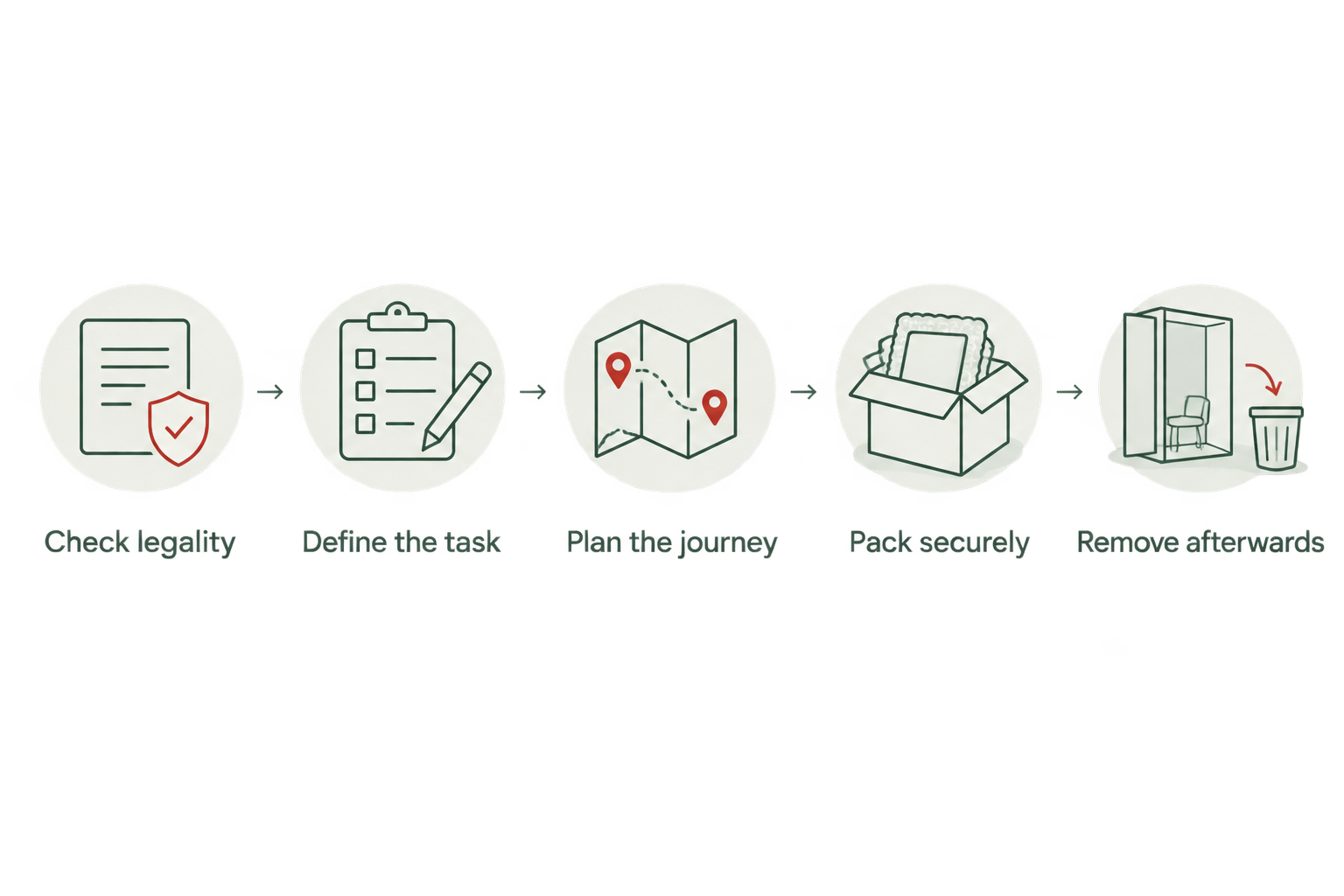
How should you transport a fixed blade for a lawful activity?
Safe packing reduces injury risk; it does not supply your legal justification. Start by deciding whether the activity actually needs a knife, then consider the journey and storage arrangements.
- Check legality. Establish that the knife itself is lawful to possess and that your destination permits it.
- Define the task. Identify the work, course or other lawful activity that explains taking the knife.
- Plan the journey. Keep travel connected to that activity rather than treating the knife as permanent personal kit.
- Pack securely. Protect the edge in a suitable sheath and secure the tool within your equipment.
- Remove afterwards. Unpack the knife when the relevant activity and journey are finished.
The practical approach for a 2026 bushcraft trip is straightforward: take only the tool needed for the session, follow the organiser's rules and remove it from your everyday bag afterwards. Do not leave a fixed blade in a daysack that you later use for shopping, commuting or a night out.
There is no general rule that a locked boot or sealed bag makes knife possession lawful. Those arrangements do not answer why the knife is there, and a vehicle is not a dependable exemption from public-possession rules.
Avoid treating a direct journey as another automatic defence. The connection between the knife and the activity remains the central issue; route planning is practical risk reduction, not a legal guarantee.
Can I carry a fixed blade in my car?
A fixed blade in your car still needs a good reason or lawful authority when the public-possession offence applies. Keeping it out of sight does not create an exemption, and leaving it there permanently makes the explanation different from transporting a tool for a particular task.
A knife packed for a specific work shift or outdoor activity has a purpose you can explain. A fixed blade kept indefinitely in a glovebox for unspecified emergencies does not gain permission simply because you call it emergency equipment.
For your 2026 vehicle kit, separate general supplies from task-specific tools. Unpack the latter when their job is finished rather than allowing them to become forgotten contents.
Can I take a fixed blade camping or on a bushcraft course?
Camping or bushcraft can support a good-reason defence, but neither is an automatic exemption. The knife, activity, destination and journey must fit the explanation.
Check the organiser's equipment list before packing. Some activities provide tools or set their own restrictions, and taking a knife that the session does not require adds an issue rather than solving one.
For a wild camp, consider whether you need a cutting tool at all. Preparing food and cordage at home can remove the task you otherwise intended to use it for; permission to camp or light a fire is a separate question.
Do not confuse practical suitability with public-carry legality. A fixed blade can suit a controlled outdoor task while still requiring justification throughout the relevant public part of your journey.
Can I carry a fixed blade for self-defence?
Self-defence is not a good reason to carry a fixed blade in public. Carrying a knife in anticipation of using it against another person creates serious criminal-law issues.
The distinction is between a tool carried for a lawful task and an item carried as a weapon. A camping explanation does not cancel an intention to use the knife to threaten or injure someone.
If you face a threat, contact the police rather than adding a knife to your kit. Call 999 in an emergency involving immediate danger.
What should you check before buying a knife?
Choose for the lawful task, not for an everyday-carry claim. Product wording such as outdoor, survival or EDC describes positioning; it does not decide whether public possession is lawful.
Military Mart's knife listings specify sales to customers aged 18 years or over and age verification at checkout. Passing that check addresses the purchase process, not your reason for carrying the knife later.
For a purchase in 2026, check these details before deciding:
- Whether the knife is fixed, locking or non-locking.
- The cutting-edge length, rather than relying on a model name.
- The stated condition and any included sheath or cover.
- The organiser's or employer's tool requirements.
- Whether a knife is necessary for the activity at all.
For bushcraft buyers, Military Mart supplies task-specific kit, not permission for unrestricted public carry. That is the buying distinction to keep: a suitable tool still needs a lawful context.
FAQ
Can I carry a fixed blade if its blade is under 3 inches?
A fixed blade under 3 inches still requires a good reason or lawful authority for public carry. The small-knife exception concerns qualifying folding pocketknives, not short fixed blades.
Does a locking pocketknife count as a folding pocketknife for the exception?
A locking pocketknife does not qualify for the small folding pocketknife exception. You need a good reason or lawful authority to carry it in public, even when its cutting edge is within the length limit.
Is a knife legal to carry if it is inside a rucksack?
Putting a knife inside a rucksack does not remove the public-carry rules. Secure packing protects people from the edge, but it does not establish a good reason for possession.
Can I carry a fixed blade on private land?
Private land is not automatically outside public-possession law because some privately owned places are accessible to the public. Permission from the landowner also does not override prohibited-weapon laws or cover your public journey there.
Does being over 18 mean I can carry a fixed blade?
Being aged 18 or over does not give you permission to carry a fixed blade in public without a good reason or lawful authority. Purchase restrictions and public-possession rules are separate.
Will a bushcraft course booking prove that carrying my knife is legal?
A bushcraft course booking supports your explanation but does not guarantee lawful possession. The knife, journey and surrounding circumstances still matter, and a court decides whether a disputed defence succeeds.
Can a legal pocketknife still be treated as an offensive weapon?
A pocketknife that qualifies for the folding-pocketknife exception can still create an offensive-weapon offence if carried with the intention of causing injury. The exception is not permission to threaten anyone or carry a weapon for protection.
One last thing
Check the bag you actually leave the house with. A knife packed for a legitimate weekend activity can become forgotten kit on an unrelated weekday journey, when the original explanation no longer fits.
Make unpacking part of your 2026 trip routine. Remove the knife, inspect its sheath and store it securely before the daysack goes back into everyday use.


Leave a comment