

Yes, an adult can generally own an ordinary bayonet at home in the UK in 2026, provided the item is not a prohibited weapon and no personal restriction prevents possession. Lawful ownership does not give you permission to carry it in public: public possession requires a lawful basis under the rules applying where you are. Check the actual item and your UK jurisdiction, not just the seller’s description of it as militaria.
- Is it legal to own a bayonet in the UK? Generally yes for adults, unless the item is prohibited.
- Home ownership and public carrying are separate legal questions; a sheath does not provide a defence.
- Military Mart requires bayonet buyers to be aged 18 or over and complete age verification at checkout.
- Check GOV.UK, the relevant legislation and your jurisdiction before buying, importing or transporting a bayonet.
Why this matters
A collector buying an issue bayonet for a cabinet faces a different question from someone wearing one on webbing outside. Both involve the same object, but the location, purpose and circumstances change the legal position.
Authenticity is a separate check. The guide to identifying genuine military surplus rather than replicas helps with buying decisions, but neither an original item nor a reproduction gets an automatic exemption from weapons law.
This is general information for a 2026 buying decision, not individual legal advice. For an uncertain item, a proposed import or a police enquiry, get advice from a solicitor familiar with weapons law in the relevant UK jurisdiction.
Is it legal to own a bayonet in the UK?
An ordinary bayonet is not automatically prohibited simply because it is a bayonet. An adult can generally keep a lawful example as part of a private militaria collection. That answer changes if the item falls within a prohibited category or possession is otherwise unlawful.
The distinction below is the starting point, not permission for every example or journey.
| Situation | General position | What you must check |
|---|---|---|
| Keeping an ordinary, non-prohibited bayonet at home | Generally lawful for an adult | The item’s classification and any personal restrictions |
| Buying from a retailer | Subject to age and sales controls | Age verification and applicable delivery requirements |
| Taking it through a public place | Requires a lawful basis | The relevant jurisdiction, purpose and circumstances |
| Taking it to a reenactment or exhibition | Not automatically exempt | Applicable defences, organiser rules and transport arrangements |
| Importing it from abroad | Separate import restrictions apply | UK classification and border rules before ordering |
| Keeping an item within a prohibited category | Private ownership can itself be unlawful | Whether a specific statutory exemption or defence applies |
A receipt proves a transaction. It does not prove that every later use, journey or method of display is lawful.
What laws should you check in 2026?
For England and Wales, section 139 of the Criminal Justice Act covers having an article with a blade or point in a public place. Separate offensive-weapon legislation also matters, including rules covering weapons prohibited in private.
Scotland has its own public-carry provisions, including section 49 of the Criminal Law (Consolidation) (Scotland) Act. Northern Ireland also has separate legislation. Do not treat an England-and-Wales summary as the complete law for the whole UK.
For a 2026 check, use these official sources according to their scope:
- GOV.UK: the guidance titled Buying, selling and carrying knives, including its overview of age restrictions and banned weapons.
- The official legislation database: the applicable statute and current orders defining prohibited weapons, with their territorial extent.
- Police Scotland: guidance relevant to possession and carrying in Scotland.
- nidirect and the Police Service of Northern Ireland: Northern Ireland guidance and local requirements.
Read the actual prohibited description where classification is uncertain. A familiar military name, old appearance or dealer’s label is not a substitute for that check.
Does the folding-pocketknife exception cover a bayonet?
No. An ordinary bayonet is a fixed-blade or pointed article, not a folding pocketknife.
In England and Wales, the limited folding-pocketknife exception concerns a cutting edge no longer than 3 inches, equivalent to 7.62 cm. A locking knife does not qualify for that exception, and neither does a fixed-blade bayonet.
The measurement is not a general allowance for all knives. A short fixed blade does not become exempt merely because its cutting edge is below that length.
Nor does the exception permit threatening behaviour or carrying an item as an offensive weapon. For a bayonet, forget the pocketknife shortcut and assess the actual reason for public possession.
Why the legal position varies
The word bayonet does not answer every legal question. These factors determine which checks you need:
- Jurisdiction: England and Wales, Scotland and Northern Ireland have different legislation and legal wording.
- Item classification: an ordinary military pattern and an item meeting a prohibited description need different treatment.
- Location: private possession and possession in a public place are separate issues.
- Purpose: a documented collection-related journey is different from carrying something for protection.
- Transaction: a domestic retail purchase, private transfer and overseas import raise different requirements.
- Personal circumstances: age and any applicable court order or other restriction can affect what is lawful.
Condition is another buying concern, but it is not a legal clearance. Rust, a missing sheath or a blunt edge does not by itself remove an article from weapons legislation.
How old must you be to buy a bayonet?
Military Mart requires bayonet customers to be aged 18 or over, with age verification at checkout. That requirement appears on its bayonet product descriptions; buying for a collection does not bypass it.
Retail knife sales are subject to age restrictions. Remote sales also involve verification and delivery controls, so expect the seller to check eligibility rather than accept an unsupported declaration.
An adult purchase and possession by a young person are not interchangeable legal questions. Do not buy a bayonet for a cadet or minor on the assumption that military interest, parental permission or supervised use settles the law.
For a gift, establish the recipient’s eligibility first. Keep the item out of children’s access while the transfer and storage arrangements are resolved.
Can you take a bayonet home after buying it?
A genuine purchase-related journey can provide a basis for explaining public possession, but the circumstances still matter. Buying it lawfully is not an unrestricted carrying permit. Keep evidence of what you bought and why you have it with you.
Use this sequence before collecting an item or taking it elsewhere:
- Check the item. Establish that possession is lawful and resolve any uncertainty about classification before travelling.
- Confirm the purpose. Know the specific reason for moving it, such as taking a purchase home or attending an agreed exhibition.
- Pack securely. Protect the blade or point and place the item inside a suitable closed container, rather than wearing it on your belt.
- Keep evidence. Retain the receipt, appointment details or event correspondence relevant to the journey.
- Check the route. Avoid unrelated stops and check any carrier or venue restrictions before setting off.
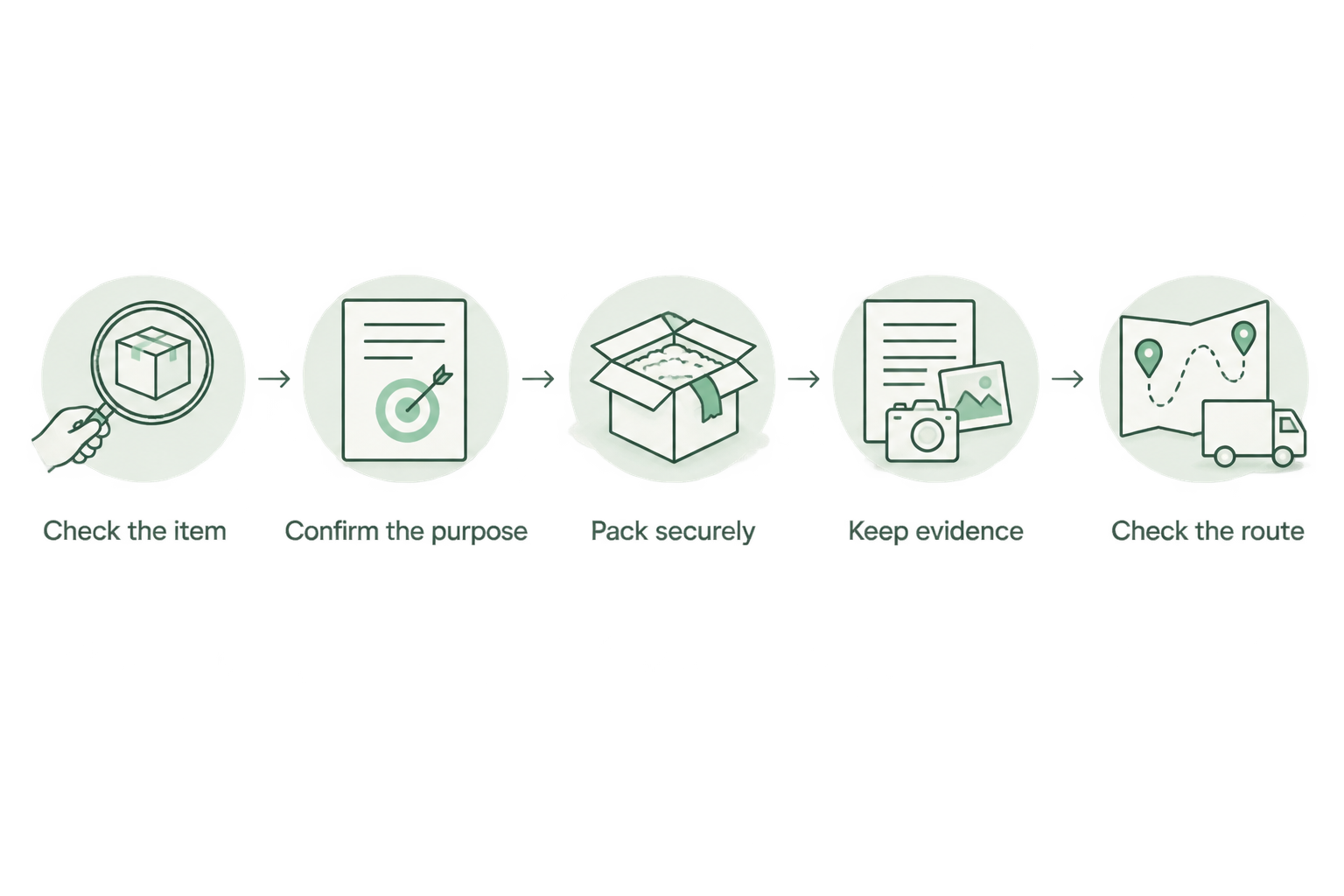
These steps reduce avoidable problems; they do not guarantee a defence. A sheath, closed bag or car boot is a packing arrangement, not an exemption from the law.
A privately owned vehicle is not a reliable escape from public-possession rules. Do not leave a bayonet in the car as permanent kit after the collection-related journey ends.
Can you carry a bayonet for self-defence?
No: do not carry a bayonet for self-defence. Carrying an article intending to use it to injure someone can engage offensive-weapon offences, even where owning that article at home would be lawful.
Calling it emergency kit or protection does not solve the problem. Neither does placing it beside camping equipment or keeping it out of sight.
A collector’s reason should explain the real activity and journey. Never invent an exhibition, repair appointment or reenactment explanation to justify carrying an item around.
Can you take a bayonet to a reenactment or militaria fair?
An organised event does not create blanket permission. Historical reenactment and exhibitions can be relevant to specific statutory defences, but the applicable legislation, item and circumstances determine whether a defence exists.
Ask the organiser about blade rules before attending. An event can refuse an item even if owning it privately is lawful, and permission inside the venue does not settle the journey there.
For a 2026 event, confirm:
- Whether the organiser permits the particular item.
- Whether it must remain secured or within a controlled display.
- How arrival, unloading and departure are handled.
- Whether written confirmation of your participation is available.
- Whether the activity involves any firearm requiring separate legal checks.
Do not turn up wearing a bayonet on webbing and expect a ticket to explain everything. Agree the arrangements first and follow the organiser’s instructions.
What should a collector check before buying?
Start with identification and condition, not just whether the listing says genuine. Ask for enough information to distinguish the pattern, assess alterations and understand what is included.
For an ordinary collectible, useful questions cover maker’s marks, blade condition, corrosion, grip damage and whether the sheath is included. Do not assume matching appearance proves matching provenance, or that a replacement sheath makes an item complete in a collector’s sense.
Military Mart is best suited to militaria collectors who want genuine surplus with stated condition grading. The limitation is that a retailer’s description or grade does not replace your own legal classification check or specialist authentication where provenance matters.
Military Mart sells genuine ex-military kit unless clearly labelled otherwise and grades condition openly. Treat the stated grade as a condition description, not proof of a particular service history or permission to carry the item.
Keep a record of the listing and transaction with your collection notes. That helps document what you bought without turning the receipt into something it is not: a certificate of legality.
How should you store a bayonet at home?
For lawful private possession in 2026, secure storage is the practical next step. Keep the item inaccessible to children, visitors and anyone who should not handle it.
A locked cabinet or secured display is a sensible precaution, not a claim that every ordinary bayonet has the same statutory storage requirement as a firearm. A sheath protects against contact with the blade, but does not prevent unauthorised handling.
Store the item dry and inspect it for corrosion. Avoid aggressive cleaning or sharpening before establishing its condition and collector significance; irreversible work can remove useful evidence of originality.
If you inherit an unidentified item, establish what it is before selling or moving it. Contact a suitable specialist or solicitor first, and do not walk into a police station carrying it unannounced.
FAQ
Is it legal to own a bayonet in the UK in 2026?
An adult can generally own an ordinary, non-prohibited bayonet privately in the UK in 2026. Check the item’s classification, your jurisdiction and any personal restrictions; public carrying is a separate legal question.
Do I need a licence just to own a bayonet?
An ordinary, non-prohibited bayonet does not generally require a licence merely for private ownership. That does not authorise possession of a prohibited weapon or cover a firearm associated with it.
How old do I have to be to buy a bayonet from Military Mart?
Military Mart requires bayonet buyers to be aged 18 or over and complete age verification at checkout. Collecting militaria does not bypass those checks.
Can I carry a bayonet if it stays in its sheath?
A sheath does not make public carrying lawful. You still need a lawful basis under the rules applying where you are, and secure packing does not create one.
Does a blunt bayonet count as harmless militaria?
A blunt edge does not automatically remove a bayonet from weapons law. A pointed article can still fall within public-possession legislation, and prohibited classification requires a separate check.
Can I order a collectible bayonet from another country?
Check UK import restrictions before ordering a bayonet from overseas. A foreign seller’s willingness to dispatch it does not establish that importing or possessing it is lawful.
Is an antique bayonet automatically exempt from knife laws?
An old bayonet is not automatically exempt from weapons law. Antique provisions depend on the particular prohibition and statutory wording, and age does not create general permission for public carrying.
One last thing
A sheath is not a legal certificate. It can make handling safer, but it does not change the item’s classification or supply a reason for carrying it.
Before buying, settle three separate questions: is this particular item lawful to possess, can you lawfully acquire it, and how will you get it home? Keeping those questions separate is more useful than relying on a broad claim that all militaria is exempt.


Leave a comment