

Buy a used army surplus sleeping bag only after checking its identity, insulation loft, zip, lining, fit and stated condition. Reject unexplained damp, mould, damaged insulation or a fastening that will not stay closed. For a 2026 camping trip, assess the complete sleep system too: a sound bag still needs suitable ground insulation and protection from wet weather.
- An army surplus sleeping bag needs sound insulation, working fastenings and enough room to sleep without compressing the filling.
- Military Mart suits buyers seeking genuine army surplus with clearly stated condition grades.
- A bivvy bag protects the sleeping bag; it does not replace its insulation or a suitable sleeping mat.
- Buy on condition and documented suitability, not camouflage, issue markings or an unsupported temperature claim.
Why this matters
A faded shell and flattened insulation are different problems. Fading affects appearance; damaged or uneven filling affects the bag's ability to hold insulating air around you.
Military Mart sells genuine ex-military kit with honest condition grading. Apply the same practical rule to any used sleeping bag: read the condition description, then check the parts that keep you warm and let you get out easily.
Used military sleeping bag: what should you check before you buy?
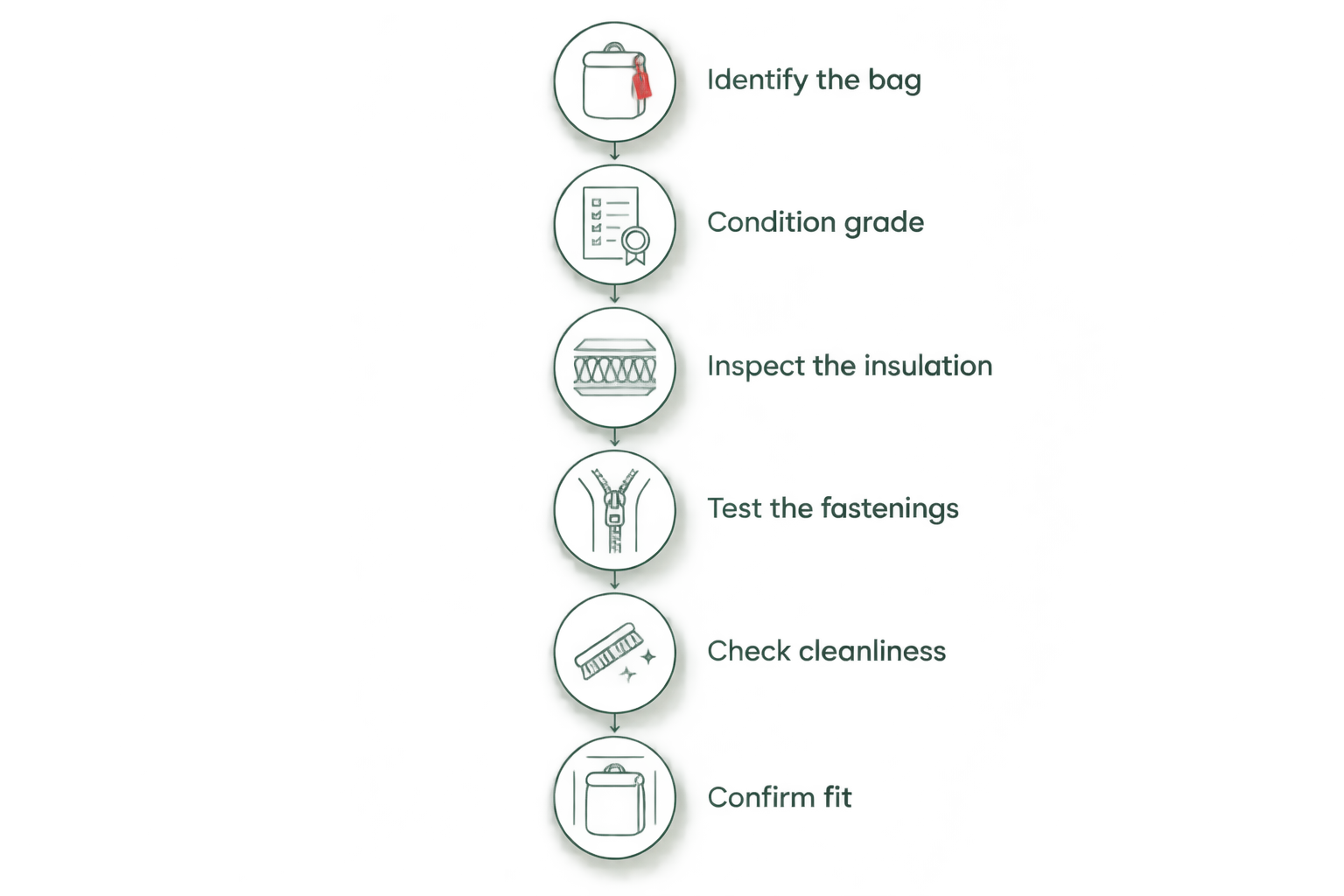
Work through this inspection in order. If you are buying online, ask for clarification or close-up photographs wherever the listing leaves a material question unanswered.
- Identify the bag. Check the label, model description, size and whether you are buying a complete sleeping bag or a separate component.
- Read the condition grade. Establish what wear, repairs, marks and missing parts the seller has disclosed.
- Inspect the insulation. Open the bag out and look for persistent flat patches, lumps or areas with little filling.
- Test the fastenings. Run the zip along its full length and check the hood adjustment and other fitted closures.
- Check cleanliness. Inspect the lining, seams and foot area for damp, mould, contamination and damage.
- Confirm fit and suitability. Check dimensions, documented temperature information, packed size and compatibility with your other sleep kit.
Do not let a tidy exterior end the inspection. Turn back the lining where possible and examine both sides of the zip, the foot box and the seams around the hood.
Is it actually a sleeping bag?
Separate sleeping bags from bivvy bags, liners and compression sacks before comparing listings. Similar names do not mean similar jobs.
| Item | Best for | Useful feature | Limitation |
|---|---|---|---|
| Insulated sleeping bag | Providing insulation around your body | Contains the filling that traps insulating air | Does not remove the need for ground insulation |
| Bivvy bag | Protecting a sleeping bag from external moisture | Adds an outer protective layer | Does not replace an insulated sleeping bag |
| Sleeping bag liner | Keeping the inside of the bag cleaner | Provides a removable inner layer | Does not establish the whole system's temperature suitability |
| Compression sack | Reducing packed bulk during transport | Helps contain the bag in your load | Provides no sleeping insulation |
For example, the British Army cold weather 90 pattern sleeping bag is identified as a sleeping bag. Still check its individual description for condition, size and included parts rather than treating the name as a complete specification.
How do you judge insulation and loft?
Loft is the thickness the insulation regains when the bag is unpacked. Filling traps air; persistent thin areas deserve closer inspection even when the outer fabric looks sound.
Open the bag out rather than judging it while tightly packed. Gently feel across the chest, back, sides and foot area, comparing adjacent sections for obvious gaps or hard clumps.
Look for:
- Persistent flat patches: ask whether the filling is compressed, displaced or damaged.
- Uneven distribution: check whether insulation has gathered away from an area that needs coverage.
- Damaged internal seams: inspect loose stitching where it holds the filling in place.
- Escaping filling: distinguish an isolated loose fibre from an opening that continues to shed insulation.
A photograph cannot prove thermal performance. In 2026, buy a used bag on its documented specification and disclosed condition, not on how thick it looks in a carefully arranged picture.
Do not assign a temperature rating by feel. A bag that seems substantial indoors has not thereby demonstrated suitability for an exposed winter camp.
What do surplus condition grades actually tell you?
Condition grades describe the seller's assessment of the item. Read the grading explanation and the product-specific notes together; a grade is not a temperature rating, cleaning record or promise that every example looks identical.
Used surplus can carry names, service marks, fading or repairs. Those details need separating from faults that affect insulation, closure or hygiene.
| Finding | What it means for your decision |
|---|---|
| Faded fabric or a previous owner's name | Assess as cosmetic wear unless accompanied by damage |
| Neatly repaired shell | Check the repair, surrounding fabric and insulation beneath it |
| Missing storage sack | Plan transport separately; check exactly what is included |
| Zip that separates after closing | Resolve the fault before relying on the bag outdoors |
| Mould, unexplained damp or contamination | Reject for sleeping use unless professionally assessed and resolved |
| Persistent thin insulation patches | Ask for a clear explanation; do not assume cleaning will restore them |
New old stock means unused older stock, not recently manufactured kit. Inspect storage condition, fabric and fastenings rather than treating an unused label as the end of the checks.
Which zip, hood and seam faults matter most?
Start with the main zip. Close it without forcing the slider, then apply gentle tension across the closed section to check that it stays joined.
Inspect the teeth or coil, slider, pull and end stops. Fabric repeatedly caught in the zip needs attention too, particularly if it has already torn the lining.
Check the hood adjustment and any fitted drawcord channels. They should operate without pulling stitching loose, and you should be able to release the opening easily from inside.
Pay particular attention to the foot box. Abrasion, split seams and flattened filling here are easy to overlook when a listing shows only the top half of the bag.
A working closure matters more than a clean-looking shell. Do not accept a zip fault as merely cosmetic when it prevents the bag staying closed.
How do you check whether the bag fits?
Ask for usable internal dimensions where available. Overall external length alone does not tell you how much space remains once the hood and shaped foot section are taken into account.
Try the bag wearing the dry layers you expect to sleep in. Check that your feet do not push hard against the end and your shoulders do not stretch the fabric tight.
Turn onto your side and operate the zip from inside. A bag that fits while you lie rigidly on your back can still restrict your normal sleeping position.
Avoid squeezing bulky clothing into a close-fitting bag. If the combination compresses the insulation, extra layers are not automatically an improvement.
For cadet camps in 2026, check the organiser's kit requirements before choosing a model. An issue label does not confirm that a particular bag meets the requirements of your activity.
Can you trust the temperature claim?
Trust a clearly identified rating for the exact model more than an unexplained statement that a bag is suitable for winter. Ask what the figure describes and whether it applies to the bag alone or a complete system.
Where a listing gives comfort, limit and extreme figures, do not treat them as interchangeable. An extreme rating is not a comfortable sleeping recommendation.
A used bag's condition matters alongside its original specification. Missing components, wet insulation and persistent loss of loft are reasons not to assume original performance remains unchanged.
For a 2026 winter trip, choose documented suitability for your expected conditions and allow for your own experience of sleeping cold. If the rating or condition remains unclear, choose a better-documented bag rather than filling the gaps with assumptions.
Why does used sleeping bag suitability vary?
The same model name does not settle every buying decision. These factors change whether a particular example suits your trip:
- Insulation condition: gaps, clumping and persistent flattening require investigation.
- Fit: a tight bag compresses filling; a restrictive cut also affects how you sleep.
- Completeness: a system component is not automatically a complete sleep system.
- Ground insulation: a sleeping mat handles a different part of the job from the bag above it.
- Moisture management: wet packing, damp storage and condensation need separate attention.
- Carrying requirements: check actual weight and packed dimensions against the space in your rucksack.
Military Mart's condition-led approach is relevant here: buy the described item, not an imagined perfect example of the pattern. Authenticity matters, but it does not cancel wear.
Do you need a bivvy bag as well?
A bivvy bag is relevant when your sleeping arrangement needs an outer protective cover. Check your shelter, expected weather and ventilation rather than adding one purely because it is military-style kit.
Keep the distinction clear when buying in 2026. The sleeping bag supplies insulation; the bivvy is a separate outer layer, and your mat provides insulation beneath you.
These examples show why the details matter:
| Bivvy bag | Best for | Stated feature | Buying limitation |
|---|---|---|---|
| Snugpak Bivvi Bag WGTE – Waterproof & Breathable Paratex Dry Shelter | Buyers seeking a cover with stated waterproofing information | Paratex Dry fabric; 5000mm hydrostatic head | The 5000mm figure is not a sleeping temperature rating |
| Dutch OD M80 Goretex® Bivi Bag | Buyers considering a graded surplus cover | Grade A; half-length front zip, attached hood and stuff bag | Check entry access and fit around your sleeping bag |
The Dutch cover's half-length front zip is a practical access detail, not evidence of greater warmth. Likewise, assess ventilation separately from the Snugpak cover's stated 5000mm hydrostatic head.


Can you wash a used military sleeping bag before using it?
Follow the bag's own care label. Do not transfer washing instructions from another military bag, and do not assume every synthetic or down-filled bag takes the same treatment.
Inspect and resolve damage before washing. If the care label is missing or unreadable, identify the model and filling before choosing a cleaning method.
Dry the bag completely before storage. Cleaning does not repair broken fastenings, replace missing insulation or establish a safe temperature rating.
Is an army surplus sleeping bag suitable for backpacking?
An army surplus sleeping bag suits backpacking only when its measured weight, packed size, fit and documented warmth match your route. Military origin alone does not make it the right load to carry.
Pack it with your actual shelter, mat, clothing and food before committing to the trip. Check that protecting the bag from water does not depend on leaving essential kit outside your rucksack.
FAQ
What's the most important check on a used army surplus sleeping bag?
Check the insulation and main closure before judging appearance. Persistent flat patches, displaced filling and a zip that will not stay closed need resolving before outdoor use.
Does Grade A mean a military sleeping bag is unused?
Grade A does not automatically mean unused. Read the seller's grading explanation and the individual product description for wear, repairs and included parts.
How can I tell whether a used sleeping bag is warm enough?
Use documented temperature information for the exact model alongside its current condition. Do not infer warmth from camouflage, thickness in a photograph or the words cold weather alone.
Is a bivvy bag the same as an army sleeping bag?
A bivvy bag is an outer cover, not an insulated sleeping bag. Check its fit and weather protection separately from the sleeping bag's insulation and your mat's ground insulation.
Should I reject a sleeping bag with a previous owner's name on it?
A previous owner's name is not by itself a functional fault. Inspect the lining, filling, seams and fastenings before deciding whether the bag suits sleeping use.
Can I machine wash any military sleeping bag?
Machine wash a military sleeping bag only when its care instructions permit it. Identify the model and filling first if the label is missing or unclear.
What should I ask Military Mart before buying a used sleeping bag?
Ask Military Mart to clarify the exact model, condition, size, included components and any documented temperature information that the listing does not explain. Request detail about repairs or functional faults before choosing.
One last thing
Test the complete setup somewhere you can stop easily before taking it on a remote trip. Use the same mat, dry sleeping layers and shelter you intend to carry, with a warm fallback close by.
That check exposes awkward zips, cramped fit and packing problems before they become field problems. Do not make the first night in an unfamiliar used bag the night you have no straightforward alternative.


Leave a comment