

Best overall for routine outdoor use: a rechargeable, balanced-beam torch. Best for trips without charging: a replaceable-cell torch. Best for hands-free camp jobs: the Wide-Beam LED Rechargeable Headlamp – 350 Lumens with Motion Sensor. This 2026 Military Mart guide ranks lighting options by their job, then explains how to compare lumens and battery life without confusing peak output with sustained light.
- For tactical torches lumens comparisons, match output to runtime on the same setting; peak brightness alone is not a verdict.
- A balanced-beam rechargeable torch is the default choice for regular outdoor use with access to charging.
- A replaceable-cell torch suits trips where you can carry compatible spare batteries but cannot recharge.
- Military Mart’s Wide-Beam LED Rechargeable Headlamp has a stated 350-lumen output and suits hands-free close work.
Why do lumens and battery life matter together?
A torch needs to light the right thing for long enough. A bright burst helps you check something briefly, but it does not describe the light available throughout a walk or a night in camp.
Lumens measure total light output. They do not tell you how tightly the beam is focused, how easily you can operate the switch with gloves, or whether the brightest setting steps down as the torch heats up.
Choose the working setting first, then compare its output and runtime. For a 2026 buying decision, a clear mode table is more useful than a large lumen figure printed beside an unrelated maximum runtime.
What makes the best tactical torch?
Use these criteria before choosing a model. They separate useful outdoor kit from a torch that simply looks the part.
- Sustained output: look for a runtime graph or an explanation of output changes, not just a peak lumen claim.
- Beam pattern: choose useful spill for nearby ground, or a concentrated beam for checking distant objects.
- Battery plan: match charging or replaceable cells to the facilities available on your trip.
- Controls: check access to low mode, switch operation with gloves, and protection against accidental activation.
- Weather protection: read the stated ingress rating and its conditions rather than treating the word waterproof as a specification.
- Condition: inspect contacts, seals, the lens and the battery compartment on used kit; appearance alone does not establish serviceability.
For surplus buyers, authenticity and condition are separate questions. Military Mart sells genuine ex-military kit unless it is clearly labelled otherwise, but an issue origin does not establish a torch’s current battery health or weather protection.
Tactical lighting options at a glance
The order below is a buying priority for different jobs, not a measured lumen leaderboard. A handheld torch and a broad-beam headlamp serve different purposes, so neither wins every comparison.
| Rank and option | Best for | Standout feature | Lumens and runtime check | Key limitation |
|---|---|---|---|---|
| 1. Balanced-beam rechargeable torch | Regular outdoor use | Forward beam with useful nearby spill | Compare sustained output and runtime on your walking setting | Depends on a charging plan |
| 2. Replaceable-cell torch | Trips without charging | Compatible spare cells restore power | Compare runtime using the specified battery type | Spare cells add kit and need safe storage |
| 3. Concentrated-beam torch | Checking distant objects | Focused central beam | Check candela and beam distance alongside lumens | Narrow illumination is less useful around your feet |
| 4. Compact backup torch | Emergency redundancy | Separate light source carried within reach | Check low-mode runtime and battery condition | Small controls and limited beam coverage need checking |
| 5. Wide-Beam LED Rechargeable Headlamp – 350 Lumens with Motion Sensor | Hands-free close work | Rechargeable headlamp with motion sensor | Stated 350 lumens; check runtime by mode | Broad coverage is not a distance-beam specification |
1. Balanced-beam rechargeable torch: best for regular outdoor use
A balanced-beam rechargeable torch is the default for dog walks, checking the garden and moving around a wild camp. Choose a model that combines a central beam with enough spill to see the ground beside it. Charging fits regular use when you can replenish the battery between outings.
Balanced-beam rechargeable torch pros:
- Useful central illumination without losing all nearby coverage.
- Recharging fits an established home kit routine.
- A selectable low mode supports close work without using maximum output.
Balanced-beam rechargeable torch cons:
- A flat battery needs a charger or a compatible replacement, depending on the design.
- Peak output does not establish sustained brightness.
- A proprietary charging connection adds another item to remember.
Best for: regular outdoor users with reliable access to charging.
Before buying in 2026, check the charging connection, battery replacement arrangements and mode sequence. You want to reach the useful setting directly, not work through a flashing mode every time you switch on.
Verdict: Buy a balanced-beam rechargeable torch as your default when its working-mode runtime covers your outing.
2. Replaceable-cell torch: best for trips without charging
A replaceable-cell torch lets you restore power by fitting compatible spare batteries. That is useful when the trip outlasts your access to a charging point. The battery type and safe spare-cell storage matter as much as the torch body.
Replaceable-cell torch pros:
- Compatible spare cells provide a practical power plan away from charging.
- Battery changes do not require waiting for a recharge.
- A clear battery specification makes trip preparation straightforward.
Replaceable-cell torch cons:
- Spare cells add weight and bulk.
- Different battery chemistries are not automatically interchangeable.
- Loose cells need protection from short circuits and damage.
Best for: campers and field users who can carry suitable spares but cannot recharge.
Follow the manufacturer’s battery instructions. Do not mix old and new cells, and do not assume a rechargeable cell is acceptable simply because it fits the compartment.
Verdict: Buy a replaceable-cell torch for off-grid trips when compatible spare batteries form part of your kit plan.
3. Concentrated-beam torch: best for checking distant objects
A concentrated-beam torch directs more of its light into a narrow area. Choose it for inspecting something beyond the immediate path, rather than lighting a tent or sorting kit. Beam intensity matters here.
Concentrated-beam torch pros:
- Focused illumination suits checks at a distance.
- A defined central spot helps you aim the beam.
- Candela and beam-distance specifications describe its purpose better than lumens alone.
Concentrated-beam torch cons:
- A narrow beam leaves less surrounding ground illuminated.
- Reflections from nearby objects can be distracting.
- Published beam distance is not a guarantee of identifying detail at that distance.
Best for: outdoor users who specifically need to check distant objects.
Keep the beam away from other people’s eyes, roads and vehicles. A distance torch complements general lighting; it does not remove the need to see where you are putting your feet.
Verdict: Buy a concentrated-beam torch for a defined distance task; skip it as your only camp light.
4. Compact backup torch: best for emergency redundancy
A compact backup torch gives you a separate light source if your main lamp fails, is lost or runs flat. Keep it accessible rather than buried beneath your sleeping kit. Check it before the trip.
Compact backup torch pros:
- Provides an independent light source.
- Fits into an accessible pocket or small kit pouch.
- A straightforward low mode supports basic close tasks.
Compact backup torch cons:
- Small switches need checking with gloves.
- Compact size does not guarantee adequate runtime.
- Forgotten batteries can leave the backup unusable.
Best for: anyone relying on a main light away from easy assistance.
Choose a backup you can operate without studying the controls. Battery compatibility with your main torch simplifies packing, but a shared battery type does not make either lamp immune to failure.
Verdict: Buy a compact backup torch for redundancy, not as an excuse to neglect the main lamp.
5. Wide-Beam LED Rechargeable Headlamp: best for hands-free close work
The Wide-Beam LED Rechargeable Headlamp – 350 Lumens with Motion Sensor has a stated output of 350 lumens and a 230° wide-beam design. It is rechargeable and includes a motion sensor. A head-mounted light leaves your hands free for sorting gear, handling tent fittings and checking kit.
Wide-Beam LED Rechargeable Headlamp pros:
- Head-mounted lighting leaves both hands free.
- Wide-beam coverage suits nearby tasks.
- Rechargeable design supports use between charging opportunities.
- Includes a motion sensor.
Wide-Beam LED Rechargeable Headlamp cons:
- Wide coverage does not establish long-distance performance.
- The 350-lumen figure does not establish runtime on each setting.
- Rechargeable lighting still needs a power plan.
Best for: campers who need hands-free illumination around their kit.
Military Mart’s Wide-Beam LED Rechargeable Headlamp is best for hands-free close work, not distance spotting. Check the operating instructions and runtime information before making it your sole light for an overnight trip.
Verdict: Buy the Wide-Beam LED Rechargeable Headlamp for close camp jobs; pair it with a forward-beam torch when the route demands one.
How should you compare tactical torches’ lumens and runtime?
Compare like with like. In 2026, the useful question remains the same: how much light does the torch maintain on the setting you intend to use?
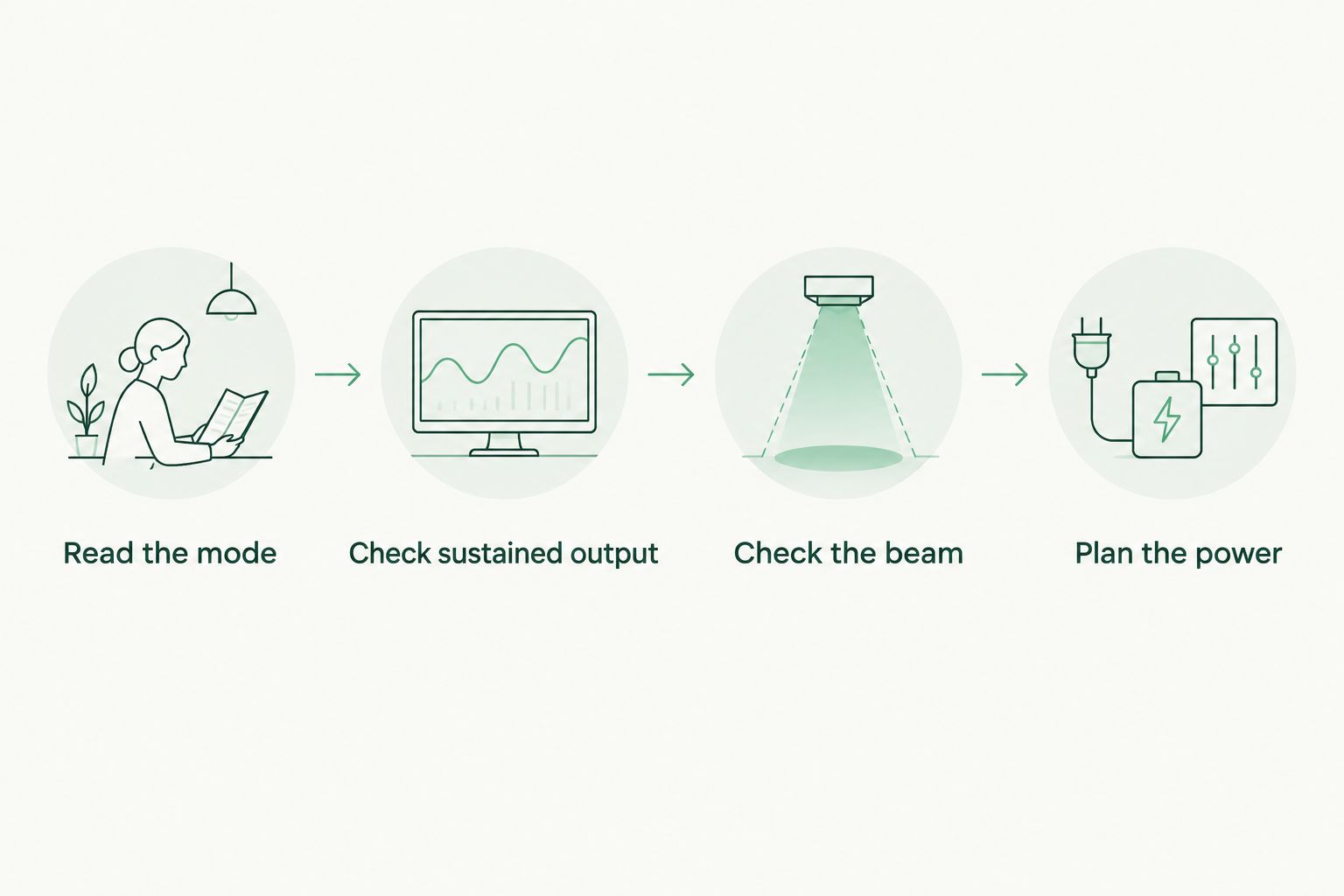
Read the mode table
Match each lumen figure to its own runtime. Do not pair the brightest setting with the longest endurance figure unless the specification explicitly does so.
Check sustained output
Look for a runtime graph showing how brightness changes after switching on. An early drop and a steady working level tell a different story from sustained operation near the initial output.
Check the beam
Lumens describe total light output; candela describes luminous intensity in a direction. Illuminance describes the light reaching a surface: 1 lux equals 1 lumen per square metre. These measurements answer different questions.
Plan the power
Check the specified battery type, charging method and replacement arrangements. Then decide how you will restore power if your main light runs flat.
Under the ANSI/PLATO FL 1 flashlight standard, runtime is measured until output falls to 10% of the initial measured output. That endpoint is not a promise that the torch maintains its starting brightness throughout the stated period.
A runtime graph is stronger buying evidence than a maximum-hours headline. Use it to judge whether the working light remains suitable for your task, not simply whether the lamp is still on.
How were these lighting options ranked?
The ranking puts a general-purpose handheld first, then separates off-grid power, distance checks, backup use and hands-free work. Beam suitability, sustained output, battery arrangements, controls and condition drive the decision.
This is a use-case ranking, not a claim of laboratory testing. A numerical model ranking requires comparable lumen and runtime measurements on equivalent settings; unrelated peak figures do not provide that comparison.
Which tactical lighting option should you choose?
Choose a balanced-beam rechargeable torch if you want one general-purpose handheld for regular outdoor use. Choose replaceable cells when charging is the constraint, and a concentrated beam when checking distant objects is the actual job.
For a 2026 wild-camping kit, separate route lighting from hands-free camp lighting. Add an accessible backup, and check every battery before leaving rather than relying on the last time the lamp worked.
FAQ
What’s the best lumen output for a tactical torch?
There is no single best lumen output for every tactical torch job. Choose a beam and working setting suited to the task, then compare sustained output and runtime on that setting.
Does a higher-lumen torch shine further?
A higher-lumen torch does not automatically shine further. Beam intensity and focus affect distance performance, so check candela and beam-distance information alongside total output.
Does the stated battery life mean full brightness throughout?
Stated battery life does not necessarily mean full brightness throughout. Under ANSI/PLATO FL 1, runtime ends when output reaches 10% of the initial measured output; check a runtime graph for brightness changes.
Is a rechargeable torch better than a replaceable-battery torch?
A rechargeable torch suits regular use with access to charging; a replaceable-cell torch suits a spare-battery plan away from charging. Neither arrangement removes the need to check battery condition and compatibility.
Is the Military Mart 350-lumen headlamp suitable for camping?
Military Mart’s Wide-Beam LED Rechargeable Headlamp suits hands-free close work around camp. Its stated 350-lumen output and 230° wide beam do not establish long-distance performance or runtime on each setting.
What should I check on a used surplus torch?
Check the battery compartment, contacts, seals, lens and switch on a used surplus torch. Confirm battery compatibility and condition separately; a genuine issue origin does not establish current electrical performance.
Should I carry a backup torch for a wild camp?
Carry an independent backup light when you depend on lighting away from easy assistance. Keep it accessible, protect spare batteries and check operation before leaving.
One last thing
Check the torch with the gloves you actually wear. Try switching on, reaching low mode and switching off without looking at the controls; impressive output is little use if the switch is awkward in the dark.
Repeat that check with the torch packed. Accidental activation can consume the battery before you need it, so use the manufacturer’s lockout method or another specified means of preventing the switch from being pressed.


Leave a comment