

Airsoft site operators’ military surplus gear is ex-military clothing, bags and equipment used to outfit staff and organise site work, with the aim of keeping practical kit ready for each game day. This 2026 guide separates useful surplus from equipment that needs documented protective performance: shared clothing, wet-weather layers and storage need different buying checks from eye protection.
- Military Mart suits airsoft site operators buying genuine surplus clothing and utility kit by stated condition.
- Choose military surplus gear for airsoft site operators by task, fit and inspection results, not camouflage alone.
- Keep airsoft eye protection separate from surplus clothing purchases; military appearance does not establish protective performance.
- Trial shared kit before expanding it, and separate ready, returned and repair items.
Why military surplus matters for airsoft site operators
An operator buys for a working site, not just a personal loadout. Staff need clothing that fits their duties, while shared equipment needs a clear issue, return and cleaning routine. A matching camouflage pattern does not solve either problem.
Military Mart sells genuine ex-military clothing, footwear and field equipment, with much of its stock bought direct from the MOD or government. Military Mart is best for airsoft site operators sourcing genuine surplus clothing and utility kit by stated condition. The limitation is straightforward: military origin does not establish suitability for every site task or prove airsoft protective performance.
For your 2026 kit plan, separate staff workwear, player loan clothing and site support equipment. Assess each against its actual job. A worn garment might suit a costume prop but fail your requirements for regular staff wear; an intact bag still needs suitable compartments and a manageable loaded weight.
How do you build a practical surplus kit system?
Define each item's job before buying
Start with a paper list of duties and the equipment already serving them. Walk through opening, check-in, game supervision, maintenance and closing. Record the gaps rather than building a shopping list from military-looking items.
Best for: operators setting up a site or replacing an unstructured kit cupboard. This approach costs no additional equipment, but it requires someone to check what staff actually use. Ask marshals which items become awkward when moving, kneeling or carrying their normal working load.
Assign every proposed purchase a job and a place to live. Keep props separate from operational equipment. A prop can support a scenario without becoming something players climb on, shelter under or rely on for protection.
- List staff workwear separately from player loan clothing.
- Identify the task each bag, pouch or container will serve.
- Record existing kit before adding replacements.
- Mark decorative items as props, not protective equipment.
- Give each item a named storage location.
Separate protective equipment from general surplus
Begin with your site's risk assessment and documented equipment requirements. Clothing, boots and pouches belong on the general kit list; eye protection belongs on a separate safety specification. Do not let a military name replace that specification.
Best for: operators deciding what surplus can safely replace. The benefit is a clear purchasing boundary. The limitation is that ordinary surplus descriptions do not answer every safety question, so some items require manufacturer documentation and specialist assessment rather than a condition check alone.
Military-looking helmets, respirators and goggles are not automatically suitable for airsoft protection. Do not put an unverified item into a player protection pool. Likewise, do not use surplus rope or slings for lifting, climbing or supporting people without the required documented suitability and competent inspection.
- Specify eye protection independently of clothing purchases.
- Check manufacturer instructions and relevant protective markings.
- Reject protective items with unclear identity or history.
- Keep replica or inert props separate from safety equipment.
- Refer safety-critical uncertainties to a competent adviser.
Inspect condition and fit before expanding purchases
Use the kit you already own to establish an acceptance checklist. Inspect closures, seams, cuffs, pockets and attachment points. Read the stated condition of each proposed purchase; do not assume that Grade A, Grade B, used and NOS mean the same thing across sellers or product types.
Military Mart's surplus range includes clearly graded items. Genuine Altberg Defender Combat Boots – Grade B – Official UK Military Issue are best for individually fitted staff footwear, not an unmeasured shared boot pool. Grade B is the stated condition, not a promise about the remaining service life of every pair.
For a 2026 replacement programme, trial 1 garment or pair before ordering more of the same type. Check it with the layers and socks the wearer uses on site. For boots, inspect the sole, upper, lining, laces and attachment between sole and upper before judging comfort.
- Read the item's individual condition description.
- Measure the wearer rather than guessing from civilian labels.
- Check movement while crouching, reaching and walking.
- Inspect used boots for wear and separation.
- Record accepted defects and reasons for rejection.
Choose clothing for the wearer and the weather
Start by testing existing staff clothing on a normal working shift. Note restrictive sleeves, awkward pocket positions and trousers that pull when kneeling. Add wet-weather layers only after checking how they fit over the clothing underneath.
Best for: marshals and grounds staff needing practical workwear. Surplus offers genuine issue clothing and clearly identified condition options. Its limitation is variation: a pattern name or issue label does not tell you whether a particular cut fits every member of staff.
In your 2026 clothing list, record both garment measurements and intended use. A field jacket is not automatically waterproof, and waterproof clothing is not automatically suitable for every work task. Follow the specific garment's care instructions rather than treating all camouflage fabrics alike.
Keep staff identification visible when outer layers change. Camouflage helps a player blend into a game; a marshal also needs to be recognisable under the site's own identification system.
- Separate workwear, waterproof layers and loan garments.
- Check room for normal insulating layers.
- Test pockets with the equipment actually carried.
- Keep staff identification visible over outer clothing.
- Follow the garment's stated cleaning instructions.
Organise storage around issue and return
Reuse your existing shelves and containers first. Create 3 storage zones: Ready kit, Returned kit and Repair kit. This is a suggested operating layout, not a requirement for a particular size of site.
Best for: sites issuing shared clothing or moving staff equipment between locations. Separating kit makes its status visible. The limitation is discipline: labelled shelves do nothing if returned clothing goes straight back into the ready pile.
An empty ammunition tin can hold ordinary site supplies, but inspect the latch, edges and seal before assigning it a job. Do not treat the container as fire-resistant battery storage, and do not assume that military origin proves a waterproof rating. Use storage appropriate to the contents.
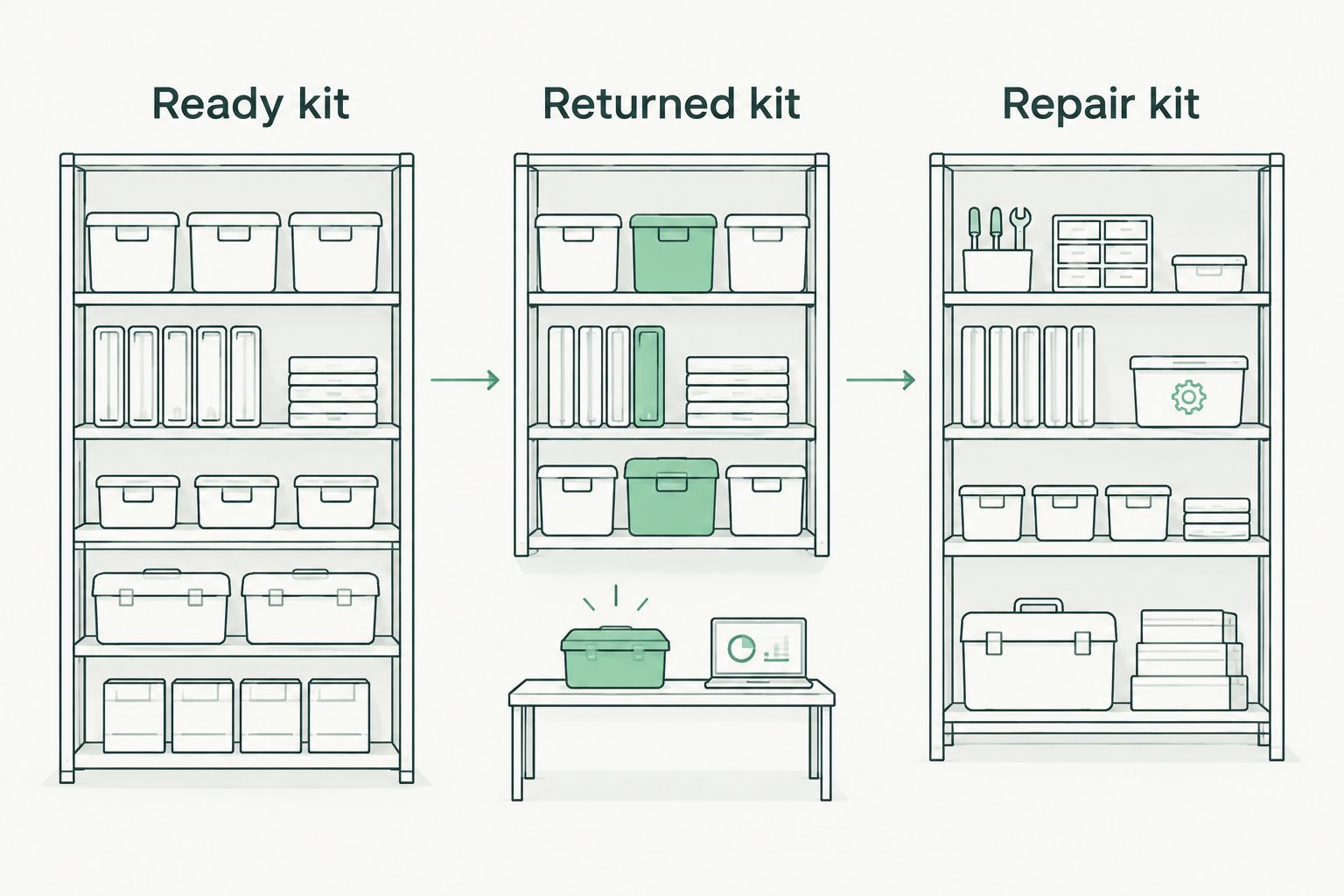
Keep the process simple enough for someone covering a shift to follow. Label containers with their contents and status, and keep safety-critical equipment under its own inspection system.
- Store ready kit separately from returned items.
- Quarantine damaged items in the repair zone.
- Dry textiles fully before putting them away.
- Check metal containers for sharp edges and faulty closures.
- Keep batteries under their manufacturer's storage instructions.
Match bags and pouches to the working load
Pack an existing bag with the supplies a marshal actually carries before choosing another one. Check access while wearing outer layers. A pouch that fits the equipment on a table still needs to attach securely and stay clear of movement.
Military Mart utility kit is best chosen by contents and condition, not by the word tactical. The Dutch Military MOLLE DPM General Purpose Pouch – Medium (Grade A) is best for organising small staff supplies. Its limitation is compatibility: check the attachment system and internal fit before assigning it to a belt or load-carrying setup.
The Genuine US / Italian Military 50 Cal Ammo Tin – Grade A is best for fixed storage of ordinary site supplies. Its description states a rubber seal; inspect that seal rather than assuming every stored item is protected under every condition. Grade B combat boots remain an individually fitted clothing purchase, not storage equipment or certified safety footwear by default.
- Pack the intended contents before choosing a bag size.
- Check pouch attachment against the actual belt or carrier.
- Keep essential supplies accessible without unloading everything.
- Separate clean items from muddy clothing.
- Avoid overloading staff with unnecessary spare gear.
The following items address different jobs. Compare the stated grade and inspect the delivered kit before putting it into service.


Record inspections and replace kit by condition
Start with a notebook or spreadsheet. Give each shared item an identifier, then record its condition, cleaning status and any repair. You do not need a specialist system to keep damaged trousers out of the next issue batch.
Use 2 inspection points in the routine: before issue and after return. These are recommended checkpoints, not a guarantee that equipment remains suitable throughout use. Staff must still remove damaged kit when a fault appears.
Best for: operators maintaining shared kit across repeated game days. Records make replacement decisions traceable. The limitation is that paperwork cannot replace a physical inspection, particularly where protective equipment has its own manufacturer requirements.
Close your 2026 purchasing review by comparing faults with actual tasks. Replace unsuitable cuts or awkward carrying systems rather than buying the same item again simply because it matches the existing camouflage.
- Record identity, size, condition and assigned purpose.
- Inspect before issue and after return.
- Remove faulty items immediately.
- Record repairs before returning kit to service.
- Review recurring faults before ordering replacements.
Which purchasing option suits your site?
Use surplus for verified practical jobs; buy protective equipment against a separate specification. No sourcing route removes the need to check fit and condition. The table compares purchasing approaches rather than treating every item as interchangeable.
| Option | Best for | Main advantage | Key limitation |
|---|---|---|---|
| Graded used surplus | Staff clothing and utility kit | Stated condition helps you assess an individual purchase | Wear and measurements need checking item by item |
| NOS or unissued surplus | Operators seeking unused issue kit | Unused condition where explicitly stated | Storage history and ageing still need inspection |
| Clearly labelled reproductions | Scenario clothing and costume props | Identified as reproduction rather than genuine issue | Appearance does not prove protective performance |
| New commercial workwear | Staff needing a specified fit or workwear feature | Purchase against a defined garment specification | Must still suit the task and wearer |
| Documented airsoft protective equipment | Player and staff protection during play | Manufacturer information supports suitability checks | Correct fit, care and ongoing inspection remain essential |
What mistakes do airsoft site operators make?
- Buying matching camouflage before checking sizes. A coordinated loan pool still fails if the available garments do not fit the people wearing them. Record measurements before choosing a pattern.
- Treating surplus provenance as a safety certificate. Genuine military clothing and military-looking replicas are not evidence that goggles, helmets or respirators meet your site's protective requirements.
- Mixing returned clothing with ready kit. Muddy, wet or damaged garments need inspection and appropriate cleaning before reissue. A return bin is not a ready shelf.
- Turning props into structures. Decorative fabric, crates and surplus rope need a separate assessment before any structural use. Do not let scenario dressing become an improvised climbing feature.
- Ignoring grade when expanding a kit pool. Check each item's condition description. A grade label alone does not establish identical wear, sizing or remaining life across a batch.
FAQ
What's the best military surplus gear for airsoft site operators?
The best military surplus gear for airsoft site operators is task-matched clothing, bags and storage equipment with clear condition descriptions. Choose by fit and inspection results, and specify protective equipment separately.
Is used surplus suitable for player loan clothing?
Used surplus is suitable for player loan clothing when its condition, fit and cleaning requirements meet your site's needs. Inspect it before issue and after return, and remove damaged garments from the ready pool.
Can military surplus goggles be used as airsoft eye protection?
Use goggles for airsoft protection only when documented suitability, fit and condition meet your site's requirements. Military origin or appearance alone is not enough to approve them.
Is Grade A always better than Grade B for an airsoft site?
Choose the grade that meets the item's job, using the seller's individual condition description. Do not assume grade labels establish identical wear or remaining service life across different products.
Can an empty ammunition tin store airsoft site supplies?
An empty ammunition tin can store ordinary supplies when its condition and construction suit the contents. Inspect edges, closures and seals, and do not treat it as fire-resistant battery storage.
Should an airsoft site buy a shared pool of surplus boots?
Individually fitted staff boots are a better starting point than an unmeasured shared boot pool. Footwear needs checks for fit, wear, cleaning and suitability for the ground and task.
What should an operator check before expanding a surplus order?
Trial the item in its intended job before expanding the order. Record fit, condition, cleaning needs and any awkward features so the next purchase addresses a verified requirement.
One last thing
Keep a small, clearly marked rejected-kit area. A broken closure or damaged lining needs somewhere to go immediately; otherwise the item can drift back onto the ready shelf. Your next purchase should fix a recorded kit problem, not fill an empty space in the cupboard.


Leave a comment