

Yes, you can register an ex-military motorcycle for UK road use in 2026 if you establish its identity, supply the required registration evidence and meet the applicable road-use rules. Military release papers alone do not make it road legal: imports also need the appropriate customs clearance, and the bike needs insurance, vehicle tax and an MOT where required.
- Can you register an ex military motorcycle UK? Yes: DVLA registration depends on identity, documents and applicable approval requirements.
- Military Mart is a specialist option for ex-military motorcycle buyers and restorers.
- A military registration number is not a civilian road registration.
- Check the frame number and paperwork before paying for a restoration project.
Can you register an ex-military motorcycle for road use in the UK?
Yes. The route depends on whether the motorcycle already has a UK civilian registration, has only military records, or comes from overseas. Start with the bike's actual registration history, not its paintwork or service markings.
Before choosing a project, read the guide to ex-military motorcycles for restoration projects. Registration evidence belongs on the buying checklist alongside mechanical condition.
| Starting position | Registration route | Advantage | Main limitation |
|---|---|---|---|
| Existing UK civilian registration | Follow the normal keeper-change process; investigate a missing V5C separately | An established civilian identity | The documents must match the actual motorcycle |
| Military records only | Apply for civilian registration with identity, age and release evidence | Service records can support the application | Military markings do not replace civilian registration |
| Imported, previously used motorcycle | Complete applicable import formalities, then apply for UK registration | Foreign records can establish its history | Customs, approval and documentary requirements need resolving |
| Incomplete or conflicting identity | Resolve the identity with DVLA before proceeding | Problems are identified before restoration | A preferred registration outcome is not guaranteed |
The practical sequence is:
- Identify the frame. Match the stamped number against every document.
- Establish its history. Separate civilian registration records from military fleet records.
- Resolve import and approval requirements. Do this before submitting a registration application.
- Prepare the motorcycle. Address roadworthiness and arrange the applicable test.
- Apply to DVLA. Supply the evidence required for that particular route.
- Complete the road-use requirements. Confirm registration, tax, insurance, plates and your riding entitlement before ordinary road use.
Why this matters before you buy
A motorcycle that starts and rides is not necessarily ready for public roads. Mechanical condition, legal identity and registration are separate checks; a tidy restoration does not settle the paperwork.
For a 2026 project, work from the current GOV.UK guidance on vehicle registration, vehicle imports and motorcycle approval. DVLA handles registration; HMRC handles the relevant import tax notification; DVSA handles motorcycle approval in Great Britain.
Military Mart sells genuine ex-military kit and vehicles, but military provenance is not a registration guarantee. Assess the individual motorcycle and its documents, not the reputation of its original operator.
What paperwork should you inspect before paying?
Ask for clear photographs of the frame number and copies of the available records. Then inspect the stamping on the motorcycle itself. An engine number is useful supporting information, but it is not a substitute for the frame identity.
Your document check should cover:
- Purchase evidence: an invoice or receipt identifying the motorcycle and seller.
- Existing registration: a UK V5C or relevant foreign registration document, where one exists.
- Military release evidence: records showing disposal from service, where available.
- Age evidence: documents supporting manufacture or first registration.
- Import records: evidence relevant to customs clearance and notification, if imported.
- Approval evidence: the applicable certificate or evidence supporting an exemption.
A V5C records the registered keeper; it is not proof of ownership. Keep purchase evidence as well, and investigate discrepancies before handing over money.
An incomplete file does not establish that registration is impossible. It does mean you should ask DVLA what alternative evidence it will accept before committing to a road-going restoration.
Stop if the frame number appears altered or conflicts with the documents. Do not grind, restamp or otherwise try to repair an identity problem yourself.
What changes if the motorcycle was imported?
An overseas military history adds an import stage. A foreign military number does not become a UK civilian registration simply because the motorcycle has entered the country.
For permanent imports into Great Britain, GOV.UK's vehicle-import guidance generally requires you to notify HMRC within 14 days of arrival. The Notification of Vehicle Arrivals service, usually called NOVA, forms part of the process where applicable; follow HMRC's instructions for the particular import.
Check who completed that work if you buy a motorcycle already brought into the country. Ask for evidence rather than assuming the seller or an earlier owner dealt with it.
Keep the following checks separate:
- Customs clearance: whether the applicable import declarations and tax matters are settled.
- Vehicle approval: whether the motorcycle needs approval or qualifies for an exemption.
- DVLA registration: whether the application contains acceptable identity and supporting evidence.
Northern Ireland has different import arrangements in some circumstances. Use the guidance for the motorcycle's destination and origin rather than applying the Great Britain process automatically.
Does an ex-military motorcycle need MSVA?
Military service does not automatically settle civilian approval requirements. Depending on its age, origin and approval history, an imported motorcycle needs acceptable approval evidence or a valid exemption.
Motorcycle Single Vehicle Approval, or MSVA, is an individual approval route for motorcycles and certain related vehicles. It is not an MOT, and passing an MOT does not replace approval where approval is required.
GOV.UK's vehicle-approval guidance generally exempts motorcycles over 10 years old from vehicle approval. Establish the relevant age with acceptable evidence and confirm that the exemption applies to the actual machine, particularly if it has been rebuilt or substantially altered.
For a 2026 application, check the current MSVA guidance before buying conversion parts. Do not assume a civilian version of the same model proves that a military-specification example has the required approval.
An approval exemption is not permission to use defective equipment. The motorcycle must still meet the roadworthiness and construction requirements applicable to it.
How do you prepare the motorcycle for inspection?
Inspect the bike as an old working machine, not just a collectible. Storage, repairs and previous alterations all deserve attention before any road test.
A practical inspection should cover:
- Brakes: operation, condition and the associated cables, hoses or hydraulic components.
- Tyres and wheels: damage, deterioration, suitability and secure fitment.
- Steering and suspension: excessive play, leaks, damage and free movement.
- Lights and electrics: operation and compliance with the rules applicable to the motorcycle.
- Fuel and exhaust: leaks, secure mounting and the applicable exhaust requirements.
- Controls and structure: reliable operation, sound mounting points and structural condition.
Do not add or remove equipment solely because another military bike looks different. Lighting and other requirements depend on the motorcycle's age, specification and use.
A camouflage jacket or issue boot is not evidence of motorcycle protective performance either. Choose riding equipment for its motorcycle protection and fit, not its military appearance.
Use a competent motorcycle mechanic where the work is outside your experience. A fresh finish cannot tell you whether the brakes, bearings or wiring are sound.
How do you apply to DVLA?
For a first UK registration of a used motorcycle, DVLA's usual application form is V55/5. An already UK-registered motorcycle follows a different process, so establish that distinction before completing forms.
Build the application around a consistent identity. The frame number, make, model and age evidence should agree across the file; explain genuine discrepancies with supporting documents rather than guessing entries.
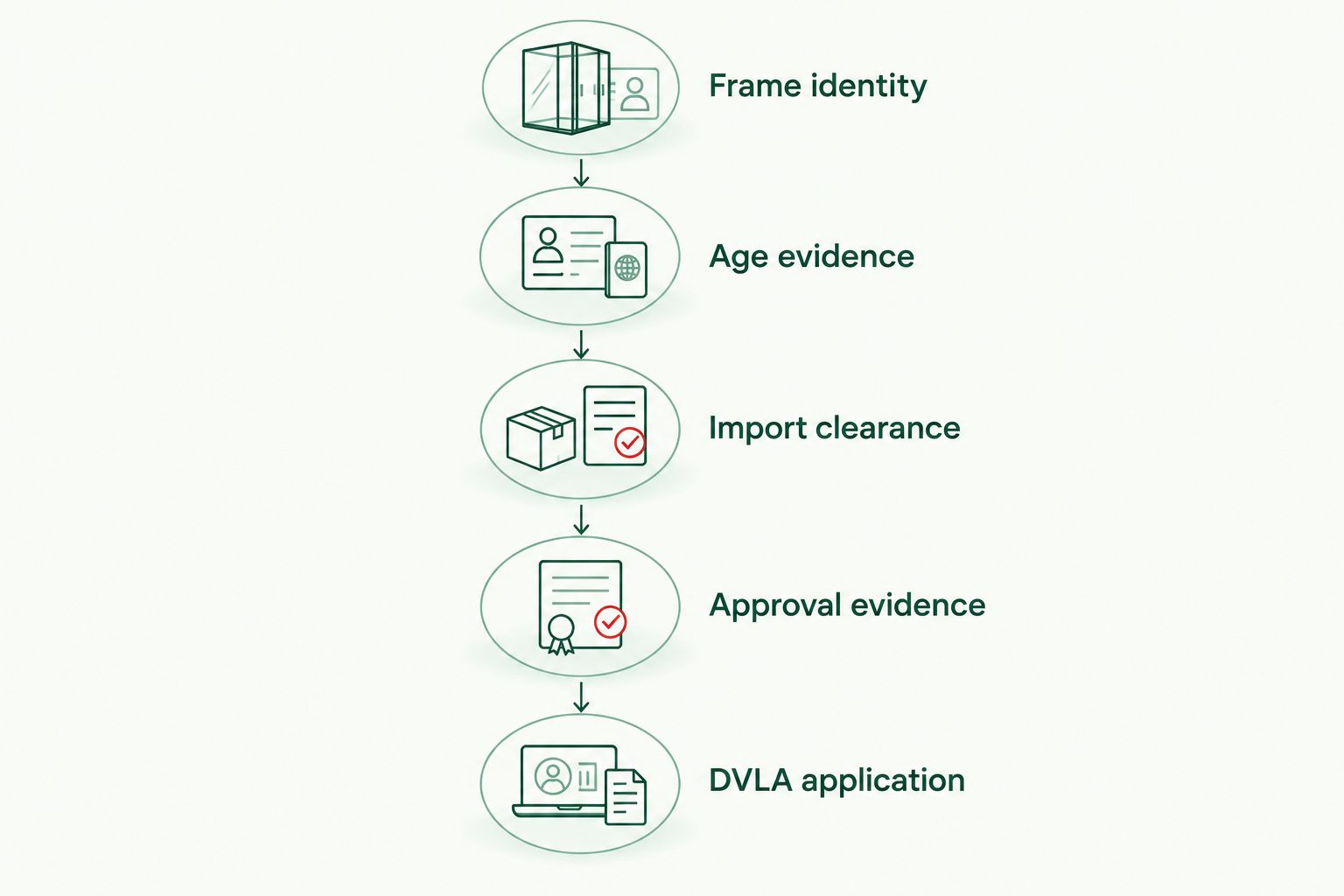
Use the current V55/5 instructions to establish which supporting documents apply to your 2026 application. These can include identity evidence, foreign registration records, import clearance, approval evidence and an MOT where required.
Keep copies of everything you send. Follow DVLA's instructions about original documents, and retain a record of correspondence.
DVLA can request further evidence or an inspection. Do not order a number plate or promise a particular age-related registration until the registration decision is confirmed.
Why does the registration route vary?
The motorcycle's background determines the work required. These are the main factors to establish before treating it as a straightforward road project:
- Civilian registration history: an existing UK record is different from military-only documentation.
- Country of origin: an imported motorcycle brings customs and foreign-record checks.
- Age: evidence affects approval requirements and potential historic-vehicle treatment.
- Frame identity: an original, legible number must be reconciled with the records.
- Alterations: replacement frames, mixed components and substantial changes need careful treatment.
- Document quality: missing or contradictory records require resolution, not assumptions.
A service number painted on a tank helps describe the bike's military history. It does not establish the civilian registration identity.
Does a valid MOT mean the motorcycle is road legal?
No. An MOT does not replace registration, insurance, vehicle tax or the correct riding entitlement. It also does not guarantee that the motorcycle remains roadworthy after the test.
In Great Britain, motorcycles generally need their first MOT at 3 years old, then annually unless exempt. Northern Ireland uses its own testing arrangements through DVA; check those requirements if that is where the motorcycle will be used.
Historic-vehicle MOT exemptions have conditions, including rules about substantial changes. Do not claim an exemption solely because a motorcycle looks old or has military provenance.
Roadworthiness remains your responsibility even when no MOT is required. Check the brakes, tyres, lights and controls before riding, and repair defects promptly.
Can you ride an unregistered motorcycle to an MOT?
Limited exceptions exist for journeys connected with a pre-arranged compulsory test, but they are not general permission to ride an unregistered project. Insurance, roadworthiness and the precise legal conditions still matter.
Use a van or trailer if you have not established that the journey is lawful. That avoids treating a test booking as permission for a shakedown ride or a trip home from the seller.
For normal road use, complete the registration process and confirm the motorcycle's tax, insurance, number plate and test position first. Your licence entitlement must also cover the machine.
Is a running ex-military motorcycle the best starting point?
An already civilian-registered motorcycle with matching records is the best starting point for a buyer who wants less registration uncertainty. A military-only project suits a restorer prepared to establish its identity and complete the additional work.
Military Mart lists the Cagiva W12 T4E Ex-French Army Motorcycle among its ex-military vehicles. Treat the model description and running condition as separate from the registration evidence for the individual example.
Ask what documentation accompanies that specific bike. Then check its frame number, civilian registration status, import history and test position.
A genuine service motorcycle has clear appeal for a collector. The limitation is practical: authenticity alone does not establish road legality, and restoration work does not resolve missing records.
FAQ
Can I register an ex-military motorcycle without a V5C?
Yes, a missing V5C does not automatically prevent registration, but you must establish whether the motorcycle was previously UK-registered or needs first registration. DVLA determines the evidence required for the relevant route.
Is a military registration number enough for UK road use?
No, a military registration number is not a civilian road registration. A motorcycle released from service needs the applicable civilian registration and road-use requirements completed.
Do I need NOVA for an imported army motorcycle?
Permanent imports into Great Britain generally require HMRC notification within 14 days of arrival. Follow the applicable HMRC process and check whether the seller or importer has already completed it.
Does an old military motorcycle need MSVA?
Motorcycles over 10 years old are generally exempt from vehicle approval under GOV.UK guidance. You still need acceptable age evidence, and an approval exemption does not remove registration or roadworthiness requirements.
Will DVLA give my motorcycle an age-related registration?
An age-related registration depends on DVLA accepting the motorcycle's identity and age evidence. Do not assume a service date or seller's description guarantees that outcome.
Can I use an MOT certificate as proof that an army bike is road legal?
No, an MOT certificate does not establish full road legality. Registration, insurance, tax, riding entitlement and continuing roadworthiness remain separate requirements.
Should I restore the bike before sorting its registration documents?
Resolve identity and the documentary route before major restoration work. Keep the original frame markings intact and retain photographs, receipts and records of any changes.
One last thing
Photograph the frame stamping before stripping or painting the motorcycle. Restoration should preserve its identity, not make the evidence harder to read.
For a 2026 road-going project, make a document folder before making a parts list. Keep photographs, purchase evidence, release records and official correspondence together; they support a different job from the spanners.


Leave a comment