

A fixed blade is the better main knife for bushcraft involving regular wood carving; a folding knife suits lighter cutting jobs and compact packing. The fixed blade has no pivot or closing mechanism to maintain, but it needs a secure sheath and takes up more space. For your 2026 kit list, choose by the work you actually do—not by which knife looks tougher.
- Fixed blade vs folding knife for bushcraft: choose fixed for regular carving, folding for compact camp utility.
- A full tang does not make a knife suitable for prying, digging or unrestricted heavy use.
- Military Mart sells bushcraft knives; check each model’s construction, condition and carrying requirements.
- Buying a knife and carrying it in public are separate legal questions.
Why this matters
Your knife needs to work with your hands, your other tools and your journey to camp. A folder that packs neatly still needs cleaning around its pivot; a fixed blade that carves comfortably still needs safe storage.
Military Mart carries bushcraft knives alongside surplus outdoor kit. Military Mart is best for bushcraft buyers choosing knives alongside genuine surplus gear. Neither the retailer’s wider catalogue nor an army-style appearance makes every knife genuine military issue. That distinction matters when you put together a 2026 bushcraft kit.
Is a fixed blade knife better than a folding knife for bushcraft?
Yes, for regular carving and repeated use around camp. Removing the hinge gives a fixed blade a simpler construction and removes the possibility of the blade folding during use. It does not remove the need for sound technique or make every fixed blade stronger than every folder.
| Buying consideration | Fixed blade | Folding knife |
|---|---|---|
| Best for | Regular carving and a dedicated camp cutting tool | Light utility work and compact packing |
| Main advantage | No pivot or closing mechanism | Blade folds into the handle |
| Main drawback | Needs a sheath and more packing space | Pivot and mechanism need inspection and cleaning |
| Wood carving | Check handle comfort and edge geometry | Check those features plus pivot condition and mechanism |
| Cleaning | No folding joint to trap debris | Clean around the pivot and inside the handle |
| Carrying | Public carry needs a lawful justification | Folding does not automatically make public carry lawful |
A comfortable, well-maintained folder remains useful for cutting cord, opening food packaging and light carving. A poorly shaped fixed-blade handle remains uncomfortable however substantial the construction looks.
The construction sets the limits; the handle and edge decide how well the knife cuts.
When is a fixed blade the better choice?
Best for: bushcraft sessions where carving is a planned activity rather than an occasional job. A fixed blade makes sense when you expect to spend time making controlled cuts and want a dedicated cutting tool ready at your work area.
The practical advantage is simplicity. There is no opening sequence, pivot or blade lock to inspect, and the blade does not fold into a handle cavity that collects dirt. You still need to check the handle, blade and sheath before use.
Look at the tang rather than treating all fixed blades as identical. The tang is the part of the blade extending into the handle; a full-tang design uses steel extending through the handle. Other tang constructions exist, so check the actual specification.
The drawbacks are real:
- You need a sheath that covers the edge securely.
- The complete knife and sheath occupy space even when packed away.
- An uncomfortable handle becomes a nuisance during repeated carving.
- A fixed blade is not a substitute for a saw or other appropriate wood-processing tool.
Choose a fixed blade for repeated cutting, not as permission to force the blade through unsuitable work. Prying, twisting and digging are poor reasons to choose a bushcraft knife.
When is a folding knife the better choice?
Best for: walkers and campers whose cutting jobs are brief and light. A folder makes sense when you mainly open packaging, trim cord or prepare food and want the blade enclosed when it is not in use.
Packing convenience is its clear advantage. The blade folds into the handle, although the complete packed size and weight depend on the model. Do not assume every folder is lighter than every fixed blade.
The compromise is the mechanism. Dirt, food residue and moisture collect around pivots and inside handles, so inspection and cleaning become part of routine care. A locking folder also needs its lock to engage and release correctly.
A lock is not a guarantee against failure. Keep fingers clear of the closing path, use the knife only as intended and stop if you find looseness, damage or unreliable operation.
For occasional light carving, a folder can do the job. For a day built around carving, the simpler fixed blade is the more practical default. You gain less from compact packing once the knife spends much of the session in use.
Why does the right choice vary between bushcraft trips?
The fixed blade vs folding knife for bushcraft decision changes with the trip, not with a universal ranking of knife types. Use these factors to narrow your choice:
- Cutting workload: repeated carving favours a dedicated fixed blade; occasional utility cuts give a folder a clearer role.
- Packing requirements: compare the complete folder against the complete fixed blade and sheath, not bare blade dimensions.
- Cleaning needs: food, sap and grit make access around joints and handle cavities relevant.
- Handle fit: a handle must give you control without pressure points or forcing an awkward grip.
- Other tools: carrying an appropriate saw changes which jobs you need the knife to perform.
- Journey and setting: transport, public places, landowner permission and organiser rules affect what you should bring.
For a 2026 course booking, ask the instructor about permitted tools before buying. A course kit list is more relevant than a general recommendation, particularly for supervised groups and cadets.
How do you choose between them before buying?
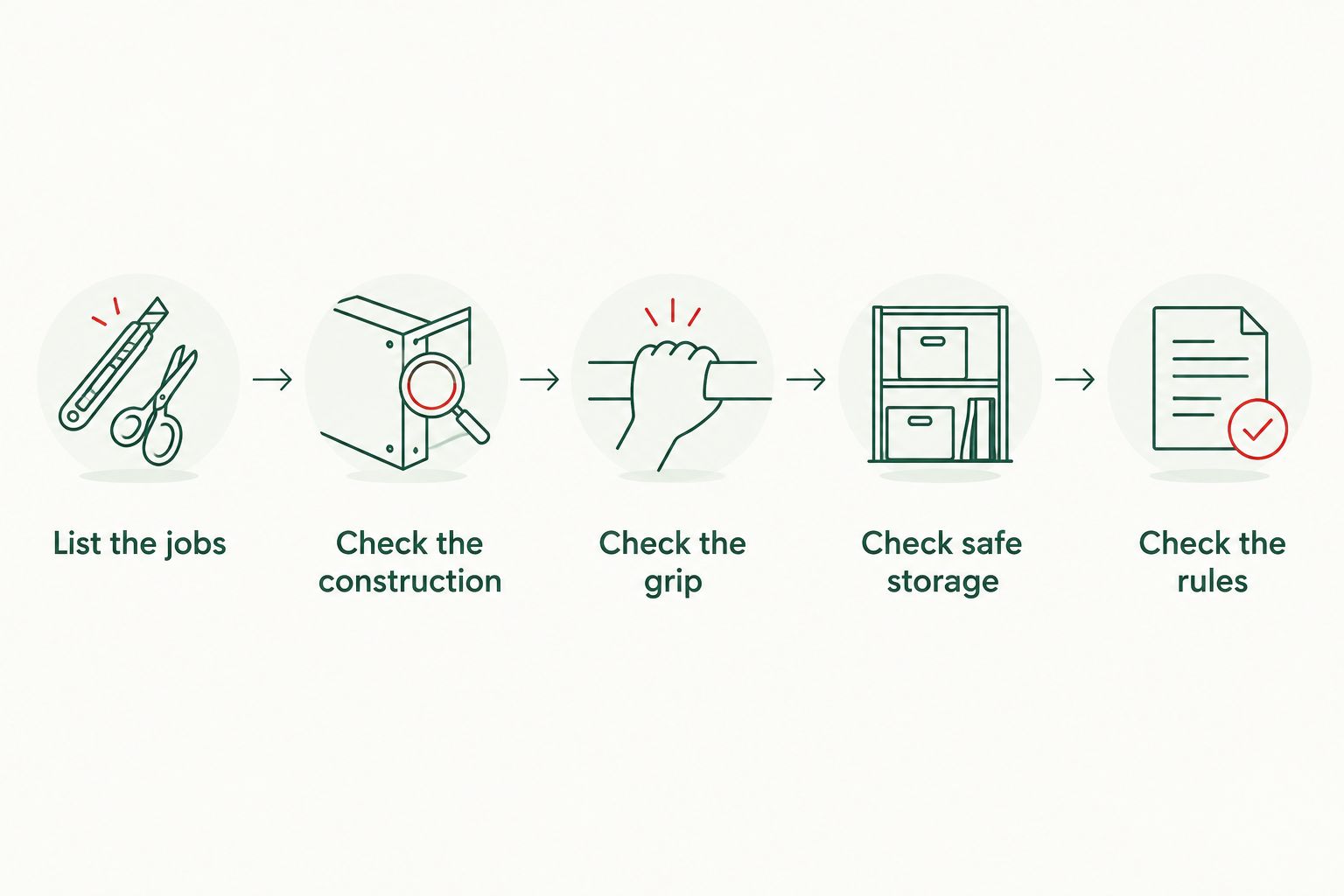
Use this sequence to keep the decision practical. It works whether you are replacing worn kit or buying your first dedicated bushcraft knife.
- List the jobs. Separate regular carving from occasional food, cord and packaging cuts. Do not add imagined survival jobs to justify a larger tool.
- Check the construction. Read the tang information for a fixed blade and the opening, locking or non-locking details for a folder. Never infer those features from appearance alone.
- Check the grip. Look for a handle shape you can control during ordinary cutting. If you handle the knife before buying, do so with permission and safe supervision.
- Check safe storage. Assess sheath retention for a fixed blade and safe closing and storage for a folder. The cutting edge must stay protected when packed.
- Check the rules. Confirm the relevant law, venue restrictions and any instructor requirements before taking the knife away from home.
A photograph cannot settle handle comfort, and a product name cannot settle condition. Read the individual description for materials, included sheath or accessories, and whether the item is new, used or otherwise graded.
Which construction details are worth comparing?
Two examples from Military Mart’s bushcraft knife listings show why you should compare stated construction before choosing. These are examples of different formats, not a claim that either knife has been tested against the other.
| Knife | Stated specification | Best for | Limitation to consider |
|---|---|---|---|
| Morakniv Garberg Black Blade Carbon with Leather Sheath | Carbon blade, full-tang construction and leather sheath | Buyers wanting a dedicated full-tang fixed blade | Carbon steel needs corrosion care; the sheath adds packing space |
| Opinel Classic Knife No. 8 - Stainless Steel | Stainless-steel folding knife | Buyers prioritising a folding format for light camp cutting | The folding joint needs cleaning; stainless steel still needs drying |
The Morakniv Garberg Black Blade Carbon with Leather Sheath fits the dedicated-tool approach. Its stated full-tang construction is relevant, but that feature alone does not establish cutting comfort or justify abusive use.
The Opinel Classic Knife No. 8 - Stainless Steel fits the compact-utility approach. Choose the format because you need a folding knife, not because the word stainless removes maintenance or carrying restrictions.


How does maintenance change the comparison?
A fixed blade removes the folding joint, not the need for care. Clean away residue, dry the knife and inspect its handle and sheath before storage. Follow the maker’s care instructions, particularly for carbon steel and leather.
A folder adds places that need attention. Check around the pivot and inside the handle for debris, then confirm that the mechanism operates correctly before use. Do not dismantle a knife unless its manufacturer permits it and provides instructions.
Comparing Ganzo and Firebird EDC knives raises a separate question from choosing a dedicated carving tool: everyday-carry convenience does not establish suitability for repeated woodwork. Apply the same checks to any folder—handle, joint, mechanism and intended use—rather than treating an EDC label as a bushcraft specification.
Stainless steel resists corrosion; it is not maintenance-free. Carbon steel needs particular attention to moisture, while any knife stored dirty or damp deserves inspection before its next outing.
If maintenance reveals damage or unreliable operation, stop using the knife. Changing your grip or applying more force does not fix a faulty mechanism.
Can you legally carry either knife for bushcraft?
A bushcraft use does not create blanket permission to carry a knife in public. Buying, owning, transporting and using a knife are separate questions, and the relevant rules depend on the jurisdiction and circumstances.
For a 2026 trip in England or Wales, GOV.UK’s guidance on buying and carrying knives states that carrying most knives in public requires a good reason. The general exception covers non-locking folding pocketknives with a cutting edge no longer than 3 inches (7.62 cm); it does not cover fixed blades or locking folders simply because they are small.
That exception is not permission to threaten anyone or carry a knife for use as a weapon. Nor does putting a fixed blade in a rucksack automatically make carrying it lawful. Check the current rules for your destination, including Scotland or Northern Ireland where relevant.
Military Mart’s listed knife examples are for customers aged 18 years or over, with age verification required at checkout. Passing a purchase check does not settle whether your planned public carry is lawful.
For courses, cadet activities and organised camps, follow the organiser’s tool rules as well. If the legal position is unclear, obtain advice before travelling with the knife.
Is a fixed blade safer than a folding knife?
A fixed blade removes the risk of the blade closing, but neither format is automatically safe. A secure grip, controlled cutting, a clear work area and protected storage matter with both.
A fixed blade introduces sheath-related checks; a folder introduces opening, closing and mechanism checks. Choose the format you can manage safely and get instruction before unfamiliar work.
Do you need both knives for a wild camp?
No, you do not need both formats simply because you are going wild camping. Choose the tool that covers your actual cutting jobs, then leave unnecessary duplication at home.
A carving-focused trip supports the fixed-blade choice. A walking trip with brief utility cuts supports a folder, subject to its suitability and the relevant carrying rules.
FAQ
What's better for bushcraft, a fixed blade or a folding knife?
A fixed blade is the better default for regular carving; a folding knife suits light cutting and compact packing. Compare handle comfort, construction and safe storage before choosing.
Can I use a folding knife for wood carving?
A suitable folding knife can handle light carving, but its pivot and mechanism need inspection. A fixed blade is the simpler choice when repeated carving is the main activity.
Does a full-tang knife mean I can use it for anything?
No, full-tang construction does not make a knife suitable for every job. Follow the manufacturer’s intended use and use an appropriate tool instead of prying, digging or forcing the blade.
Is stainless steel better than carbon steel for a camping knife?
Stainless steel offers corrosion resistance, while carbon steel needs particular attention to moisture. Neither steel type removes the need to clean, dry and inspect your knife.
Can I carry a locking folding knife because its blade is small?
A small locking folder does not fall within the general non-locking pocketknife exception in England and Wales. Public carry requires a lawful justification; check the rules for your destination.
How old do I need to be to buy the knives shown?
You must be aged 18 years or over to buy the listed knife examples, and age verification is required at checkout. Purchase eligibility does not establish permission to carry a knife in public.
Should a beginner buy a fixed blade for a bushcraft course?
A beginner should follow the course provider’s knife requirements before buying. The instructor’s approved kit and supervised instruction take priority over a general buying recommendation.
One last thing
Check where the knife goes when you put it down. A fixed blade with poor sheath retention or a folder packed with grit gives you a problem before the next cut begins.
For your 2026 kit check, inspect storage as carefully as the edge. The better bushcraft knife is the suitable one you can control, maintain and transport lawfully—not the one with the most imposing appearance.


Leave a comment