

British Army ration packs do not have one storage life that applies to every pack: follow the dates and storage instructions on the individual food items. For your 2026 camping kit, the deciding factors are the type of date, the storage history and the condition of each sealed pouch—not simply whether the outer box remains unopened.
- How long do ration packs last? British Army ration packs need individual date, storage and seal checks.
- A best-before date concerns quality; a use-by date concerns safety. Do not treat them as interchangeable.
- Reject swollen, leaking or punctured food pouches. Heating does not make suspect food safe.
- Military Mart serves bushcraft enthusiasts looking for genuine army surplus; assess ration food separately from clothing grades.
How long do British Army ration packs last in storage?
Use the food manufacturer's stated shelf life, not a blanket lifespan for military rations. A date on the outer packaging needs context: it might identify packing or production rather than the final date for eating every component.
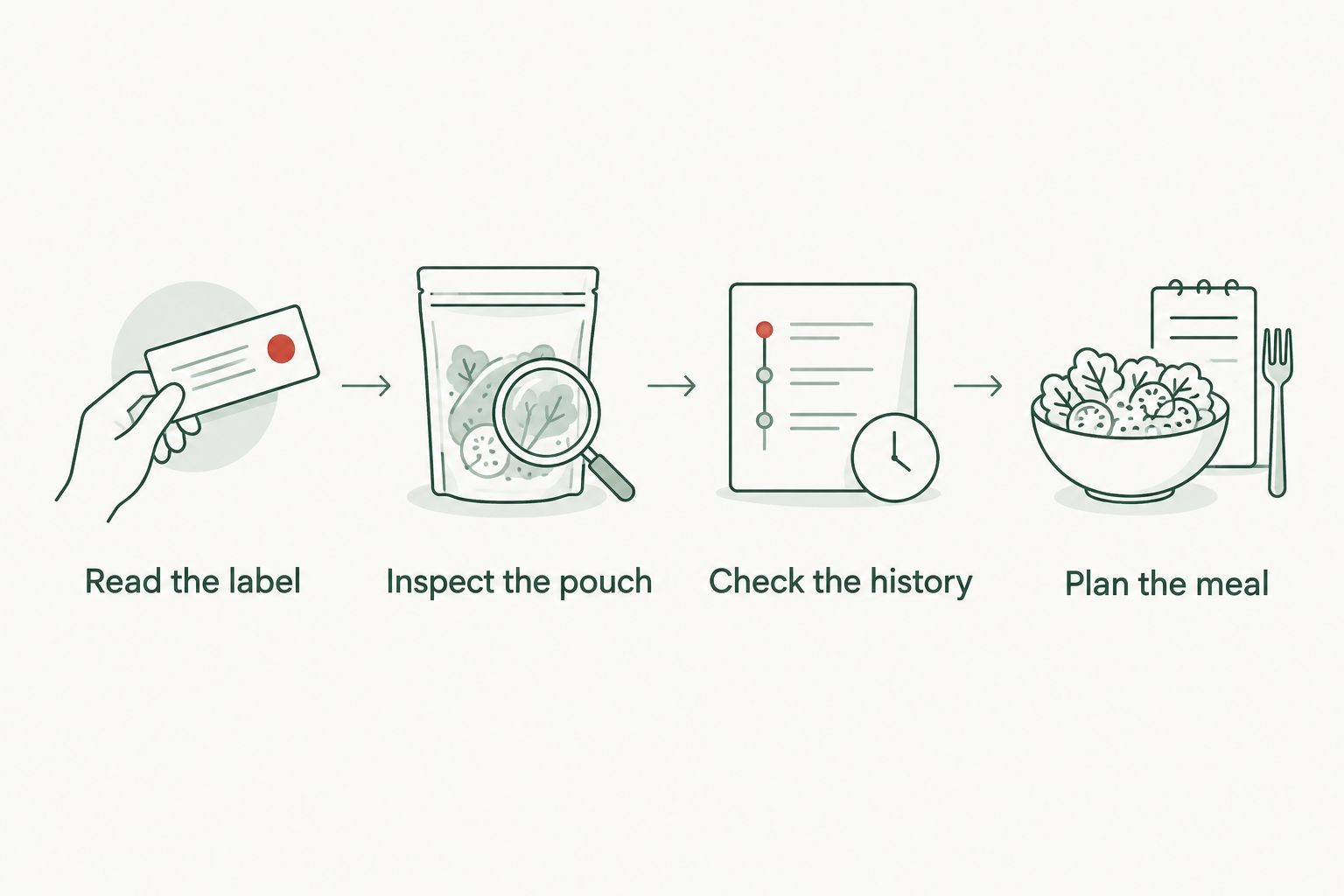
Work through these checks before putting a pack into long-term storage or taking it on a wild camp:
- Read the date. Establish whether it is a best-before date, a use-by date or a production code.
- Check the instructions. Find the storage requirements and any directions that apply after opening.
- Inspect the seals. Look at individual food wrappers and pouches, not just the outer bag or carton.
- Check the history. Establish where the pack has been kept and whether it has suffered heat, damp or physical damage.
- Record the details. Keep the original labels and put the next relevant date somewhere visible.
For preparation and handling beyond storage, read the guide to using military ration packs safely.
A pack bought in 2026 is not necessarily a pack manufactured in 2026. Your purchase date is useful for stock records, but it does not replace the manufacturer's information.
Why this matters
A ration pack is a collection of food items, not a single sealed meal with one guaranteed lifespan. Assessing only the outside risks missing a damaged wrapper or a different date inside.
That matters when your evening meal is already in a bergen halfway up a hill. Check food before departure, while replacing it is straightforward. Carrying an unverified pack as your only food turns a storage question into a trip-planning problem.
Military origin does not remove ordinary food-safety rules. Genuine issue kit still needs readable instructions, sound packaging and suitable storage.
What do the dates on a ration pack mean?
The Food Standards Agency distinguishes between best-before dates, which concern quality, and use-by dates, which concern safety. Both depend on following the stated storage instructions.
| Marking or condition | What it tells you | What it does not tell you | Your next move |
|---|---|---|---|
| Best-before date | The period for which the manufacturer expects the stated quality under the specified conditions | That damaged or badly stored food is safe | Check storage instructions and packaging before assessing the food |
| Use-by date | The safety deadline when the stated storage instructions have been followed | That smell or appearance can override the deadline | Do not eat food after its use-by date |
| Production or packing date | When a manufacturing or packing event took place | The final date for eating the contents | Find the manufacturer's shelf-life instructions |
| Batch or lot code | Information used to identify a production batch | A date you can reliably decode without the correct system | Ask the supplier or manufacturer to identify it |
| Unreadable date | That you cannot verify the marking from the label | Permission to assign a new lifespan | Resolve the uncertainty before relying on the food |
Is a best-before date an expiry date?
A best-before date is about quality, not an automatic safety cut-off. Food past that date still needs suitable storage, intact packaging and an assessment appropriate to the food.
Do not turn that distinction into a promise that every old ration pouch is edible. A best-before marking does not excuse a puncture, a failed seal or an unknown storage history.
Can I eat food after its use-by date?
Do not eat food after its use-by date, even if it looks and smells normal. Harmful bacteria are not reliably detected by your senses.
That rule applies in 2026 just as it does to the rest of your food cupboard. Boiling a pouch is not a way to extend a use-by date or rescue suspect contents.
Why ration-pack storage life varies
The label gives you the manufacturer's conditions. What happens to the pack afterwards determines whether those conditions have actually been met.
- Temperature: heat accelerates deterioration. A cupboard away from heat sources is a different environment from a vehicle parked in the sun.
- Moisture: damp damages outer packaging and makes storage harder to inspect. Keep food packaging dry and protected.
- Packaging condition: punctures, leaks and failed seals compromise the barrier protecting the food. An intact carton does not prove every pouch inside is intact.
- Food type: different foods have different formulations and packaging. Do not transfer the date from a main meal to every other component.
- Opening: breaking a food seal changes the storage requirements. Follow the instructions for the opened item rather than its unopened shelf life.
- Storage history: a readable date cannot prove that a pack has always been stored correctly. Ask about the history rather than filling the gap with an assumption.
Avoid applying a shelf-life chart for another country's rations to British Army packs. Different products need their own manufacturer's information, even when their packaging looks similar.
Where should I store unopened ration packs?
Choose a cool, dry place that meets the food label's instructions. Keep packs away from direct sunlight, radiators, household chemicals and anything likely to puncture the wrappers.
For your 2026 food reserve, choose somewhere you can inspect easily. A shelf you can reach and read is more useful than a forgotten box behind damp camping gear.
| Storage option | Best for | Practical advantage | Limitation |
|---|---|---|---|
| Indoor cupboard meeting label instructions | Routine home storage | Easy to inspect and rotate | Nearby appliances or pipework can introduce heat or moisture |
| Clean protective container indoors | Keeping packs organised | Helps protect wrappers from knocks and clutter | Does not control temperature or extend food dates |
| Vehicle kit | Carrying food for a planned trip | Keeps food with your outdoor gear | Vehicle interiors experience temperature extremes |
| Shed or loft | Non-food kit that suits those conditions | Keeps bulky equipment out of living space | Variable temperature and damp make food-storage conditions harder to control |
A protective box is useful for organisation. It is not refrigeration, insulation or evidence that the contents remain edible.
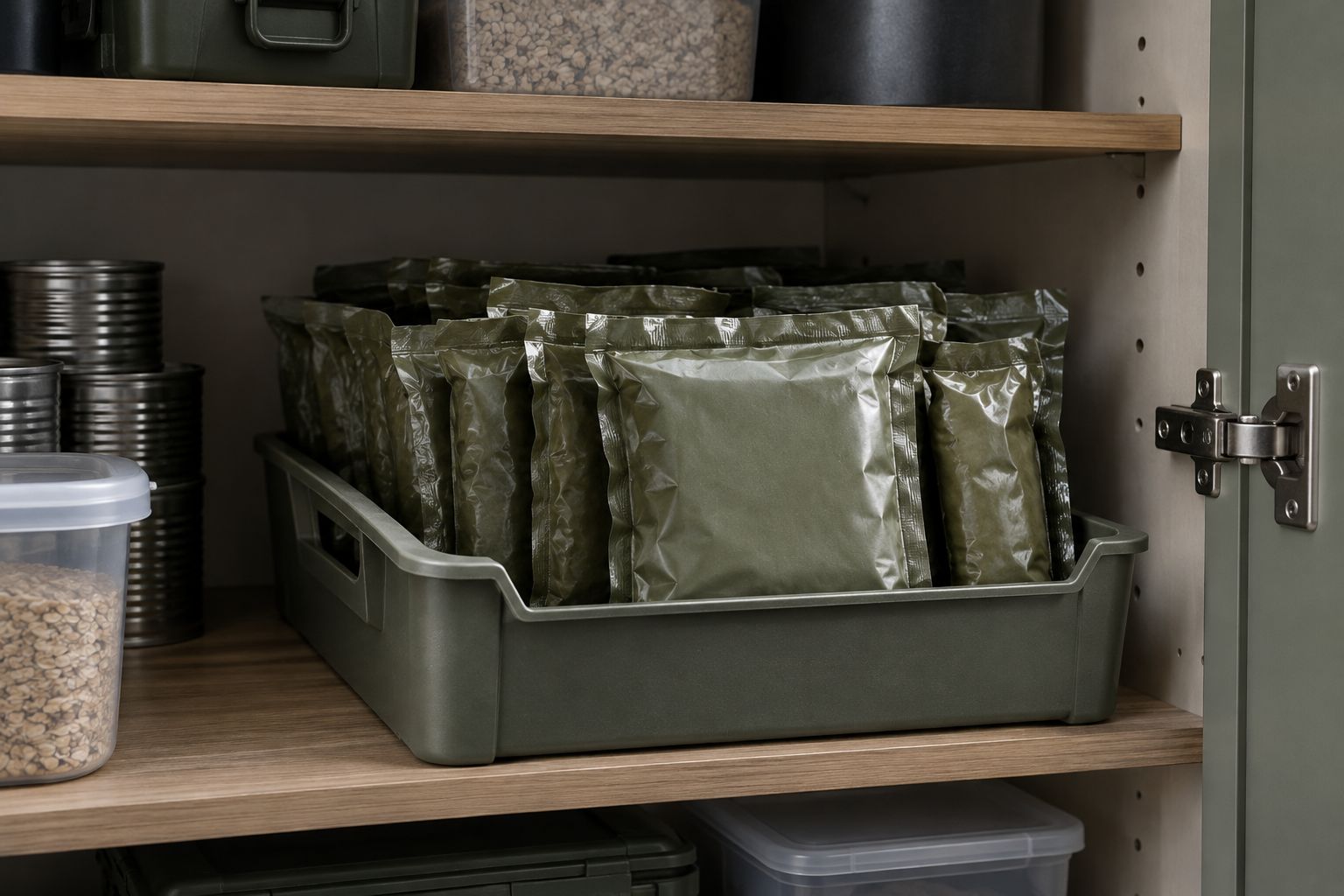
Leave labels accessible rather than hiding everything under tape. If you add an inventory label, put it on the storage container without covering the original food information.
How do I check an old ration pack before a trip?
Inspect the pack at home in good light. Keep the food separate from dirty field kit while you work through it.
Read the label
Read each food item's date and instructions. Do not assume an unfamiliar string of digits is a day, month and year; production codes need the correct explanation.
If the outer packaging and an inner item show different markings, establish what each marking means. Neither should be ignored simply because the other looks more favourable.
Inspect the pouch
Check seams, folds and corners for damage. Reject food in packaging that is swollen, leaking, punctured or otherwise compromised.
A stain on the outside needs investigation, not a quick wipe followed by packing it away. Do not taste suspect food to decide whether a damaged pouch is acceptable.
Check the history
Consider where the pack has actually been stored. A long spell in a hot vehicle or a damp outbuilding is relevant even when the printed date has not passed.
If you cannot establish suitable storage, do not rely on the pack as your expedition food. Replace uncertain food before you leave.
Plan the meal
Check that the remaining acceptable contents cover your intended meals and dietary needs. Removing a suspect item changes what you have available to eat.
Do not put a rejected pouch back into the carton for someone else to discover. Separate it immediately and dispose of it appropriately.
Does opening the outer pack shorten its shelf life?
Opening the outer carton or bag is different from opening a sealed food pouch. If an inner food package remains intact, its own storage instructions still govern it.
The trade-off is protection and traceability. Loose items are easier to inspect and organise, but separating them from the original packaging risks losing batch details, instructions or allergen information.
Opening a food pouch ends its unopened storage life. Follow the manufacturer's directions for consumption and storage after opening; do not put leftovers back into long-term ambient storage.
How should I rotate ration packs in storage?
Put food needing attention soonest where you will see it first. Record the product, batch details, relevant date and storage instructions without replacing or obscuring the original label.
For a 2026 stock check, separate food you intend to eat from historic packs kept as militaria. A sealed collectible and a dependable camping meal serve different purposes.
Check your reserve before trips and when reorganising your kit. Do not leave the first proper inspection until departure morning, when an unreadable date becomes an avoidable scramble.
What should I check when buying surplus ration packs?
Ask for readable date information, packaging condition and storage details. A general description such as genuine, unissued or surplus does not answer those food-specific questions.
Military Mart is an army surplus specialist serving campers, bushcraft enthusiasts and collectors. Its wider condition grading helps describe surplus kit, but a clothing grade is not a food-safety assessment.
For ration food, assess the actual listing and labels. Authenticity matters; it does not establish the remaining shelf life of an individual meal.
FAQ
How long do ration packs last if I keep them in a cupboard?
Follow the individual food dates and storage instructions; a cupboard does not give every ration pack the same lifespan. Choose a cool, dry location that meets the label's requirements and inspect the packaging.
Can I eat a British Army ration pack after its best-before date?
A best-before date concerns quality rather than being an automatic safety cut-off. Check the food's storage history and packaging, and do not eat anything suspect or damaged.
Can I eat ration food after its use-by date if I boil it?
Do not eat ration food after its use-by date. Heating does not override that deadline or make suspect food safe.
Does a sealed outer ration bag mean the food is safe?
A sealed outer bag does not establish that every food item inside is safe. Check individual dates, seals and storage instructions before relying on the contents.
Can I keep ration packs in my car for emergencies?
A car is not a reliable default for long-term ration storage because its interior experiences temperature extremes. Follow the food manufacturer's storage requirements rather than assuming military packaging solves the problem.
How do I read a ration-pack batch code?
Ask the supplier or manufacturer to explain an unfamiliar batch code. Do not guess a date format or calculate remaining shelf life from an unverified interpretation.
Does genuine military surplus mean ration food is still edible?
Genuine military origin does not prove that food remains edible. Military Mart surplus buyers should check food dates, storage history and individual packaging separately from authenticity or kit grading.
One last thing
Write down the next action, not just the purchase date. A useful storage label tells you which food needs checking or using next; a receipt only tells you when money changed hands.
Before your next wild camp, check the food itself. The strongest-looking outer packaging cannot answer for the pouch inside.


Leave a comment