

Austin Champ restoration cost depends on the vehicle’s condition, completeness and the work you do yourself; a useful 2026 budget starts with an inspection and itemised quotations, not a blanket average. Include transport, storage, tools, specialist work and testing alongside replacement parts. Budget for a safe, mechanically sound vehicle before paint, markings and finishing details.
- Austin Champ restoration cost needs an inspected vehicle and defined scope, not a generic average.
- Separate recommissioning, mechanical restoration and full restoration before comparing quotations.
- Check part numbers, completeness and condition before buying Austin Champ spares.
- Military Mart suits military vehicle restorers sourcing surplus kit; confirm each part’s identity and condition before buying.
Why this matters
A vehicle that starts is not necessarily ready for the road. Equally, tired paint does not establish that the engine or driveline needs rebuilding. Treat appearance, mechanical condition and structural condition as separate inspection tasks.
Before committing to a project, read the guide to sourcing parts for an Austin Champ restoration. Build a missing-parts list against the vehicle itself, rather than assuming that loose boxes contain everything needed to finish it.
The useful question is not simply what another owner spent. It is what your Champ needs, which jobs you can complete properly, and what remains uncertain after inspection.
How much does it cost to restore an Austin Champ?
An Austin Champ restoration needs a vehicle-specific budget covering acquisition, repairs, labour and completion costs. For a 2026 project, ask for dated quotations against a written scope so you can distinguish agreed work from allowances and exclusions.
Use the following breakdown as a quotation checklist. It is a way to account for the work, not a claim that every Champ needs every operation.
| Budget heading | What to include | What to establish first |
|---|---|---|
| Vehicle and collection | Purchase, loading and transport | Whether the vehicle rolls, steers and can be loaded safely |
| Inspection and strip-down | Assessment, dismantling and documentation | Which faults need further investigation |
| Structure and body | Corrosion repairs, fabrication and preparation | Extent of deterioration and previous repairs |
| Engine and cooling | Diagnosis, servicing or rebuilding as required | Actual condition rather than starting behaviour alone |
| Transmission and driveline | Inspection, repairs, seals and associated labour | Faults, leaks and component identity |
| Brakes and steering | Inspection and necessary repair | Condition of safety-critical components |
| Electrical equipment | Wiring, connections and component testing | Existing specification and alterations |
| Finishing and trim | Paint, fittings, upholstery and markings | Intended finish and missing items |
| Completion | Reassembly, adjustment and testing | Written acceptance checks and outstanding faults |
| Project overheads | Storage, tools, consumables and outside services | What the workshop quotation excludes |
Keep the purchase decision separate from the restoration decision. A vehicle is not a suitable project merely because the initial outlay fits your budget. Establish whether the work, workspace and unresolved faults fit as well.
If you already own the Champ, record what you have spent separately from the work still required. That gives you a clear remaining commitment instead of a running total that mixes completed repairs with guesses.
Recommissioning: return an assessed vehicle to use
Recommissioning is the right scope when inspection establishes that the vehicle does not need a wider rebuild. The work centres on checking systems, addressing deterioration and correcting identified faults after storage or inactivity.
Do not choose this scope from the seller’s description alone. Ask a competent inspector to assess the structure, brakes, steering, tyres, fuel system, cooling system and electrical equipment before you settle the job list.
- Best for: an owner whose inspected Champ needs defined repairs rather than wholesale dismantling.
- Advantage: keeps work focused on demonstrated needs and preserves serviceable components.
- Limitation: recommissioning does not resolve faults outside its agreed inspection and repair scope.
Request a written list of checks and repairs. A vague instruction to get it running leaves too much room for disagreement about what completion means.
Mechanical restoration: repair the systems that need it
Mechanical restoration addresses faults that servicing and adjustment will not put right. Define the work by system: engine, cooling, transmission, driveline, brakes, steering and electrics, with inspection findings attached to each job.
For your 2026 quotations, separate diagnostic work from the repair authorised afterwards. Ask the workshop to explain what it can establish externally and what requires dismantling before it can quote accurately.
- Best for: an owner keeping sound bodywork while addressing identified mechanical defects.
- Advantage: directs effort towards function rather than replacing everything for appearance’s sake.
- Limitation: dismantling can expose additional work, so the initial scope needs an approval process.
Ask what happens to removed components. Keep identifiable original parts until you have confirmed whether they are repairable, needed as patterns or required for an exchange arrangement.
Full restoration: define the finish before dismantling
A full restoration needs a detailed specification. Write down what will be dismantled, repaired, replaced and refinished, and what evidence will support decisions about originality.
Separate a presentable working vehicle from a historically researched restoration. The latter needs decisions about specification, fittings, finish and markings before purchases begin; a smart appearance alone does not establish historical accuracy.
- Best for: an owner who wants extensive work and has suitable space, time and specialist support.
- Advantage: allows connected repairs and finishing work to be planned together.
- Limitation: the wider scope requires more decisions, documentation and control over additional work.
Do not start a full strip-down without a storage and identification system. Photograph assemblies, label fixings and record component locations as you work. Dismantling should produce an organised inventory, not an unidentified collection of parts.
Which restoration approach fits your Champ?
Choose the scope from inspection findings and your intended use. This comparison describes project approaches, not condition grades or promises about the work any particular vehicle needs.
| Approach | Best for | Main advantage | Main limitation |
|---|---|---|---|
| Recommissioning | An inspected vehicle needing defined repairs | Retains serviceable assemblies | Does not cover a wider rebuild |
| Mechanical restoration | A vehicle with identified system faults | Focuses on function | Internal condition needs investigation |
| Full restoration | An owner seeking extensive repair and refinishing | Coordinates work across the vehicle | Requires detailed scope and project control |
An owner-led project and a workshop-led project also need different budgets. Doing work yourself removes the workshop charge for those tasks, but you still need suitable tools, space, knowledge and a way to check the result.
Do not treat your own time as proof that a job is economical. Record what you can complete competently and obtain outside help for work beyond that boundary, particularly safety-critical repairs.
Why Austin Champ restoration cost varies
The scope of work changes with the vehicle in front of you. Use these factors to question an estimate rather than accepting a single total without explanation.
- Starting condition: distinguish structural deterioration, mechanical defects and cosmetic wear. Each needs a different inspection and repair plan.
- Completeness: inventory missing fittings and assemblies before purchase. A box of loose spares needs identification, not just counting.
- Repair or replacement: ask whether a component needs replacement, can be repaired or requires further assessment first.
- Labour split: specify which jobs you will do and which belong with a workshop or specialist subcontractor.
- Restoration standard: agree whether the aim is dependable use, a tidy finish or documented historical detail.
- Project logistics: include collection, storage, outside services and movement between workshops in the plan.
For a 2026 budget, keep the date and scope beside every quotation. An old invoice from another restoration is useful background, but it is not a current quotation for your vehicle.
How do you build a usable restoration budget?
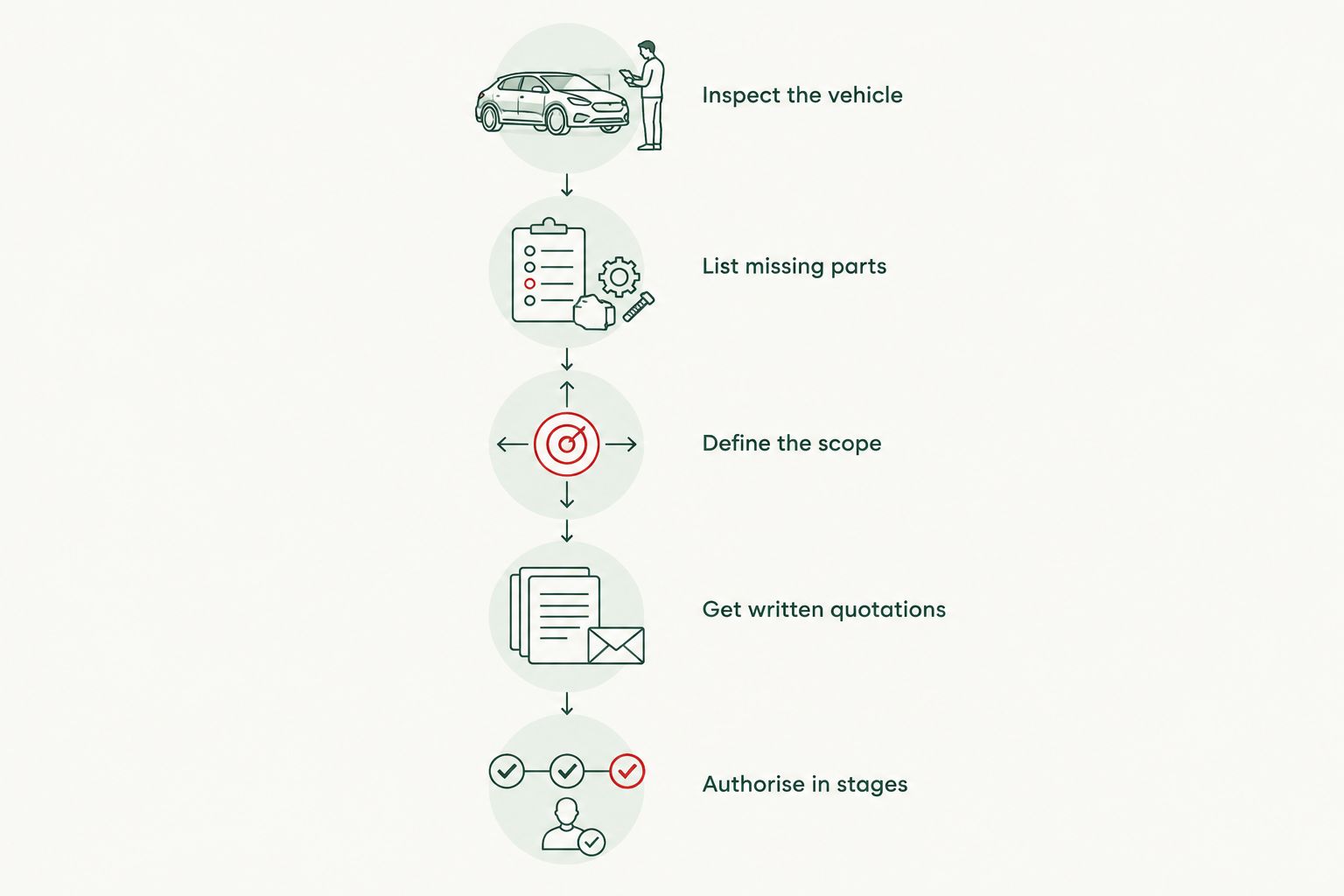
Start with evidence, then authorise work in stages. The aim is to identify expensive decisions before dismantling makes them unavoidable.
- Inspect the vehicle. Record condition, identity, previous alterations and faults. Use a competent specialist where your own knowledge stops.
- List missing parts. Match loose components to the vehicle and mark anything that still needs identification or condition checks.
- Define the scope. Write down the intended use, finish and division between owner work and paid work.
- Get written quotations. Request itemised work, exclusions, tax treatment and the process for approving additional jobs.
- Authorise in stages. Review findings after inspection or strip-down before agreeing to the next phase.
Keep a separate register of unresolved items. An uninspected assembly should remain an open decision, not disappear into the budget as though it has passed assessment.
Ask your workshop to stop and seek approval when findings change the agreed scope. A written approval trail keeps both parties clear about what was requested, what was discovered and what happens next.
How should you assess surplus spares?
Identify the part before judging its condition. A shared manufacturer’s name or a similar appearance does not establish compatibility with an Austin Champ; check the relevant parts information and the actual component.
Military Mart lists a Large Lot of Austin champ parts. Treat a mixed lot as an inventory exercise: establish what is included, which pieces match your requirements and what inspection each needs. Do not count the whole lot as usable replacement stock without checking it.
For restoration spares, record:
- The part number or identifying marks, where present.
- The assembly and vehicle specification it belongs to.
- Whether it is used, repaired, reproduction or NOS.
- Visible damage, corrosion and missing fittings.
- Any testing or refurbishment required before fitting.
NOS means new old stock, not a substitute for inspection. Storage history and material condition still matter, particularly where a component performs a safety-critical job.
Preserve labels and packaging until identification is complete. Photograph parts alongside their markings so your workshop can assess the same item you are discussing.
Can I save money by doing the restoration myself?
Owner labour reduces the paid labour attached to jobs you complete yourself, but it does not remove tools, materials, workspace or specialist services from the project. Choose tasks by competence, not enthusiasm alone.
Cleaning, photography and careful inventory work are useful starting points. Agree the division of work with your workshop before dismantling, especially if the workshop needs to inspect assemblies intact.
Should I buy a complete Champ or an unfinished project?
A complete Champ is easier to inventory, but completeness does not prove condition. An unfinished project needs a documented handover showing what was removed, what was repaired and what remains unresolved.
Inspect both against the same requirements. For a 2026 purchase, request current evidence of the vehicle’s condition rather than relying only on photographs taken during earlier work.
Should I paint the Champ before repairing the mechanical faults?
Finish structural and mechanical work before final paint wherever the repair sequence allows. Agree the order with the people doing the work so later access does not undo completed finishing.
Choose the finish against your restoration specification. A military colour description alone does not establish that a paint matches the vehicle’s intended historical appearance.
FAQ
What's included in an Austin Champ restoration budget?
An Austin Champ restoration budget includes inspection, required repairs, parts, labour and completion testing. Account separately for collection, storage, tools, consumables and outside services so they are not overlooked.
Can I get an accurate restoration quote from photographs?
Photographs support an initial discussion, but they do not replace a physical inspection. Ask the workshop which parts of its estimate remain subject to inspection or dismantling.
Does a running Austin Champ need less restoration work?
A running engine does not establish the condition of the whole Austin Champ. Inspect the structure, brakes, steering and other systems before deciding the scope.
Is restoring an Austin Champ cheaper than buying a finished one?
Compare an inspected project and its itemised work against an inspected finished vehicle. The description restored does not replace evidence of the work or a condition assessment.
Are new old stock parts ready to fit?
New old stock parts still need identification and condition checks before fitting. Confirm compatibility and assess deterioration rather than treating unused as proof of serviceability.
How do I stop the restoration budget expanding without approval?
Use a written scope and require approval for additional work. Review inspection and strip-down findings before authorising repairs that were not included initially.
Can Military Mart help with an Austin Champ restoration?
Military Mart sells military vehicle spares and lists a Large Lot of Austin champ parts. Confirm the contents, condition and suitability of individual components against your restoration requirements.
One last thing
Before authorising work in 2026, write down what will make the next stage complete. That means agreed checks, recorded results and a list of unresolved faults—not simply a vehicle that looks further along.
The most useful budget is one you can stop and review. Keep each stage understandable before committing to the next, and retain the photographs, invoices and parts records with the vehicle.


Leave a comment