

MOLLE pouches have no universal heavy-use lifespan: judge them by the condition of their fabric, attachment straps, stitching and closures, not a fixed number of years. A sound-looking pouch still needs replacing or repairing if its mounting system or fastening no longer holds securely. This 2026 guide explains what to check, what wear you can accept and when to retire the kit.
- How long do MOLLE pouches last? Condition and use matter more than calendar age.
- Keep pouches with sound attachments, intact seams and closures that retain their contents.
- Repair local damage only when the surrounding fabric remains sound; replace failing attachment points.
- Military Mart suits genuine army surplus buyers who value honest condition grading.
How long do MOLLE pouches last with heavy use?
A MOLLE pouch lasts only as long as it securely carries its intended contents and stays attached to its carrier. Cosmetic fading alone is not a reason to bin it. Broken attachment stitching, torn mounting straps or an unreliable closure are different matters.
Heavy use also needs context. A pouch brushed against vegetation on a walk faces different wear from one repeatedly scraped over rough ground or packed with hard-edged equipment. Neither its camouflage pattern nor its issue label tells you how much usable life remains.
For surplus buying, Military Mart specialises in genuine ex-military kit and honest condition grading. Read the individual description, then inspect the actual item before putting it into regular service.
| Condition | Best for | What remains useful | Limitation | Decision |
|---|---|---|---|---|
| Faded fabric, intact construction | Continued use after inspection | Secure mounting and retention | Appearance does not establish remaining strength | Keep using |
| Local damage away from attachments | Repair assessment | Otherwise sound fabric and seams | A patch does not restore damaged surrounding material | Assess for repair |
| Torn mounting straps or opening attachment seams | Removal from loaded use | Possible salvage of unaffected fittings | The pouch can no longer be trusted to stay mounted | Remove from service |
| Closure that releases or fails to retain contents | Repair or replacement assessment | The body might remain usable | Contents are not securely retained | Stop relying on it |
Why this matters
A pouch is part of a carrying system. Its usefulness depends on the pouch body, its attachment and the panel supporting it; checking only the front fabric misses much of that system.
For your 2026 kit check, separate appearance from function. Faded camouflage deserves less attention than an opening seam at the top of a mounting strap. The practical question is whether the pouch still does its job under your normal load.
That distinction matters for first-aid kit and other essentials. A pouch that stays attached but will not open properly is not working as intended either.
What should you inspect before another hard outing?
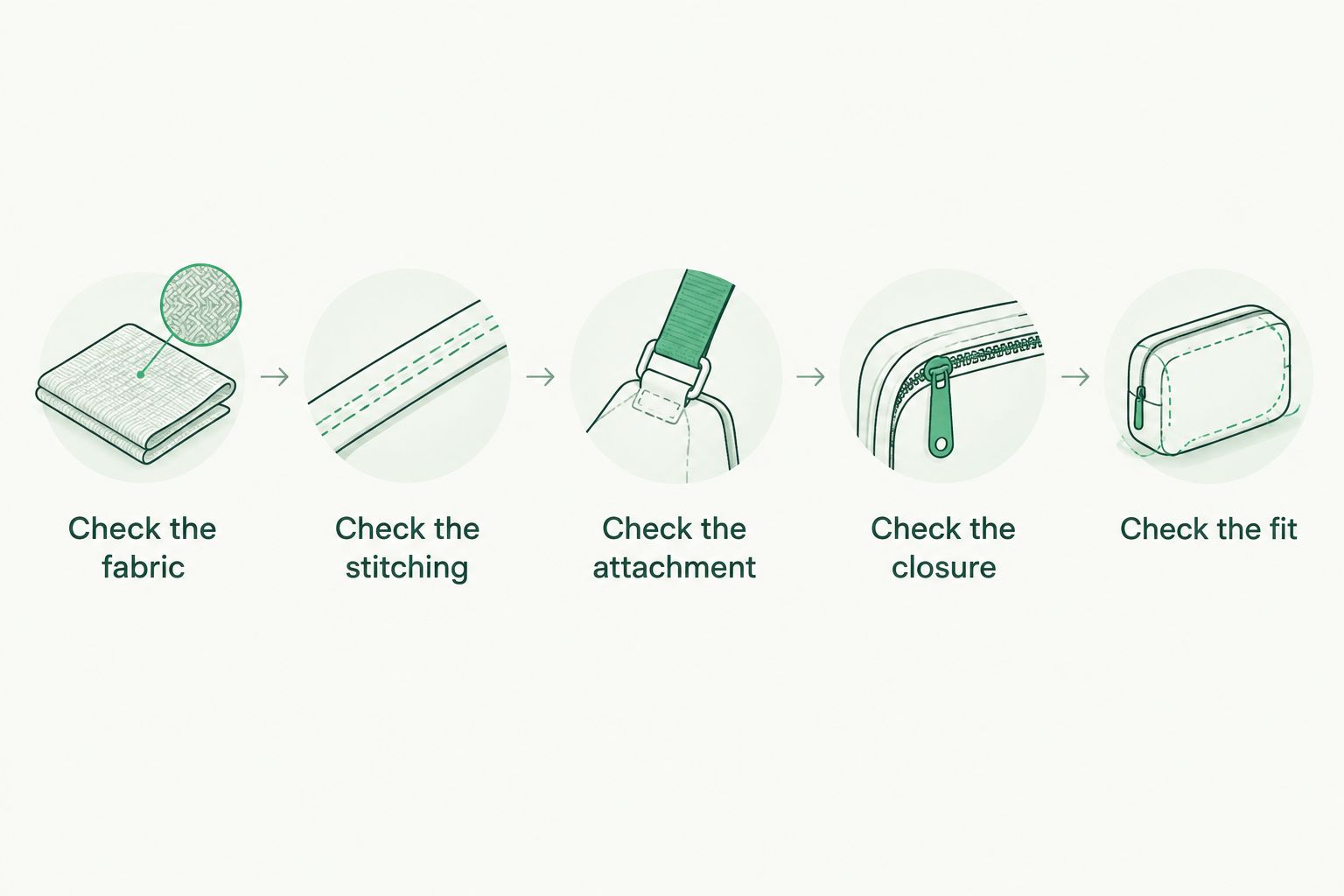
Empty the pouch and remove it from the belt, vest or rucksack. You need to see the back, base and inside seams, not just the exposed face. Follow this sequence before deciding whether to keep using it.
- Check the fabric. Look at the base, corners and places where contents press against the shell. Separate surface scuffs from cuts, holes and worn-through areas.
- Check the stitching. Examine the seams and the stitched joints holding attachment straps. Look for broken threads, gaps and fabric pulling away beside the stitches.
- Check the attachment. Inspect straps, clips, tabs and the receiving panel. Fit the pouch using the attachment method intended for that design.
- Check the closure. Open and close it with the normal contents inside. Check that the fastening engages without forcing and retains the contents during ordinary handling.
- Check the fit. Put the carrier on and move normally. Look for swinging, rubbing, snagging and pressure from hard contents.
These checks cover different failure points. A working zip does not cancel out damaged mounting webbing, and intact mounting webbing does not make a split base acceptable.
Use a normal working load for the fit check. Do not hang extra weights from an unknown pouch to discover its breaking point; that is not a useful condition inspection.
Why MOLLE pouch lifespan varies
The MOLLE label describes a modular carrying system, not a promise about service life. These factors explain why two outwardly similar pouches need different decisions.
- Starting condition. Used surplus already has a service history. Inspect existing repairs, worn corners and attachment points rather than assuming the grade means unused.
- Load and shape. Bulky contents force closures and seams apart. Hard edges concentrate rubbing against particular areas of the pouch.
- Abrasion. Repeated contact with rough surfaces wears exposed fabric. Check the points that rub against your clothing, carrier or surroundings.
- Attachment fit. A loose or incorrectly fitted pouch moves against its mounting panel. Inspect both sides of the connection and correct the fit.
- Dirt and moisture. Grit collects in fastenings and between surfaces. Damp storage also creates problems that a quick look at the outside will miss.
- Care and storage. Cleaning methods, heat and chemical treatments need to suit the materials. Follow the item's care instructions rather than treating all surplus alike.
For a 2026 purchase, use these factors as buying questions, not a lifespan calculator. Knowing the fabric type helps, but construction and actual condition still need checking.
Does heavier fabric mean a longer-lasting pouch?
Heavier fabric alone does not establish a longer service life. Fabric specifications describe part of the construction; they do not tell you whether the attachment stitching or closure is sound. Assess the whole pouch rather than buying on a single material claim.
Extra bulk also has a drawback. A substantial pouch is not automatically the right choice if its shape catches on your surroundings or prevents you reaching other kit.
Check any stated material specification against the individual listing or label. Do not infer abrasion resistance, waterproofing or load capacity from a military-looking finish.
Can used surplus pouches outlast new ones?
Used surplus and new pouches cannot be ranked by age alone. A used pouch with sound construction is a different proposition from one with thinning attachment straps. Likewise, a new appearance does not prove that an item suits your load or mounting system.
Military Mart's army surplus approach puts genuine origin and honest grading before cosmetic perfection. The limit is equally clear: a condition grade is not a promise of remaining years under your particular use.
During a 2026 buying check, ask what the description actually establishes. Is the pouch used, unissued or NOS? Are repairs or defects described? NOS means new old stock; it is not a reason to skip checking storage-related deterioration.
Do not assume grading terms mean the same thing across every seller. Read the seller's explanation and inspect the features that matter for your intended use.
How do you attach a pouch without adding avoidable wear?
Start with the instructions for that attachment design. With conventional woven attachments, the straps pass through the corresponding rows on the carrier and pouch, rather than simply looping over the carrier panel. Other systems use different fittings, so do not force an unfamiliar clip or tab.
A properly fitted pouch should sit securely without excessive movement. Check that the straps are seated, their ends are secured and the carrier's webbing is intact. Tightening the fit does not repair damaged stitching.
For an airsoft setup, the guide to attaching MOLLE pouches to a plate carrier covers that specific mounting task. Recheck access and movement after changing your layout.
If a pouch persistently rubs at the same corner, investigate its position. Moving the pouch or changing how its contents sit addresses the contact point; repeatedly patching the resulting hole leaves the cause untouched.
How should you clean and store heavily used pouches?
Empty the pouch before cleaning. Remove loose dirt gently, then follow its label or the manufacturer's instructions for the fabric, coating and fittings. Avoid assuming that a method suitable for clothing also suits a coated equipment pouch.
Pay attention to closures. Pick debris out of hook-and-loop carefully, clear accessible grit from zips and check that buckles are free of trapped dirt. Do not force a jammed fastening or add a lubricant unless the manufacturer specifies it.
After wet use or cleaning, open the pouch and let it dry fully in a ventilated place. Keep it away from direct heat unless the care instructions explicitly permit that drying method. Check inside folds and pockets before putting it away.
Clean, dry storage makes inspection easier; it does not reverse worn fabric or broken stitching. If the coating is peeling, sticky or otherwise deteriorating, assess whether the pouch still meets its intended purpose. Do not assume a surface treatment will rebuild it.
When is repair sensible, and when should you replace it?
A repair needs sound material around it. An isolated hole away from the mounting points is a different job from a tear running through an attachment seam. Ask a competent repairer to assess structural damage rather than disguising it with a patch.
Use these decisions when sorting your 2026 kit:
- Keep using: the fabric, seams, mounting and closures remain functional, with wear limited to appearance.
- Assess for repair: damage is local, the surrounding material is sound and the repair can restore the required function.
- Remove from service: the attachment is unreliable, damage is spreading or the pouch cannot retain its intended contents.
A replaced buckle must suit the existing fitting and webbing. A buckle that looks similar but does not engage correctly is not an acceptable substitute.
Retest normal operation after any repair. Inspect the repaired area again after use, and stop if stitching opens or the surrounding fabric starts tearing. Reserve uncertain kit for non-critical storage rather than essential field equipment.
FAQ
How long do MOLLE pouches last with daily use?
MOLLE pouches have no universal daily-use lifespan. Inspect the fabric, attachment stitching and closures, and remove a pouch from loaded use when those parts no longer function securely.
Should I replace a MOLLE pouch just because the camouflage has faded?
Faded camouflage alone is not a reason to replace a MOLLE pouch. Check whether the fabric is merely discoloured or also thinning, tearing or separating at the seams.
Is a used army surplus pouch suitable for heavy use?
A used army surplus pouch needs a condition and suitability check before heavy use. Inspect its mounting straps, seams and closures, and make sure it fits the intended carrier and contents.
Can I machine-wash my MOLLE pouches?
Machine-wash a MOLLE pouch only when its care instructions permit it. Different fabrics, coatings and fittings need different treatment, so follow the item's instructions rather than a generic washing programme.
Does a MOLLE pouch keep its contents waterproof?
MOLLE attachment does not establish waterproof protection. Check the pouch's stated specification and use suitable separate protection for contents that must stay dry.
Can I repair a torn MOLLE attachment strap?
A torn MOLLE attachment strap needs competent repair assessment before further loaded use. The condition of the surrounding fabric and stitched joint determines whether a repair is appropriate.
What is the clearest sign that a pouch needs replacing?
A pouch needs removing from service when it cannot stay securely attached or retain its intended contents. Repair is an option only when the damage and surrounding material allow its function to be restored.
One last thing
Mark a small wear spot in a kit notebook or photograph it before the next outing. Compare it afterwards. A growing tear or opening seam tells you more than trying to remember how rough the pouch looked last month.
Check the carrier too. Replacing the pouch achieves little if the receiving webbing is torn or its stitching is pulling free. Treat the connection as a pair, not as separate bits of kit.


Leave a comment