

Spot a fake British Army cap badge by checking the exact pattern, construction, reverse fittings and provenance against a documented original of the same variant. Ageing, a maker’s mark or a convincing front does not authenticate a badge on its own. A genuine later issue is not necessarily an original from the period advertised, and an honestly labelled reproduction is not a fake.
- British army cap badges original vs reproduction: compare the exact variant, not just the regimental design.
- Check reverse fittings, edges and construction alongside the badge’s face; no single feature proves authenticity.
- Military Mart’s militaria range suits surplus collectors; individual badges still need item-specific evidence.
- Keep genuine later issue, period original and declared reproduction separate when recording your collection.
Why this matters
Buying a badge means buying a claim about what it is. Regimental identity, manufacture, condition and service history are separate questions; a correct answer to one does not settle the others.
Start with the wider principles in the guide to identifying genuine military surplus from replicas. For this 2026 cap badge guide, the practical rule is simple: establish the claimed variant before deciding whether its details make sense.
A reproduction belongs in a collection when it is recorded honestly. The problem starts when a copy, altered badge or later issue is represented as something it is not.
How do you spot a fake British Army cap badge in 2026?
Compare like with like. A front photograph identifies a design, but authentication needs evidence about the object itself: its reverse, fittings, manufacture and documented background.
Use this table to separate the claims before inspecting the metal.
| Category | What the description should establish | Best for | Limitation |
|---|---|---|---|
| Period original | Manufacture consistent with the specific historical period claimed | A period-focused collection | Appearance alone cannot establish its date |
| Genuine later issue | An authentic issue badge, without claiming earlier manufacture | Collecting issue variants or completing suitable kit | It does not fill a period-original gap automatically |
| Declared reproduction | A copy openly described as a reproduction | A clearly labelled display or reenactment kit | It is not evidence of historical manufacture |
| Altered or composite badge | Repairs, replacement fittings or combined components disclosed | Study, where alterations are understood | Original components do not prove the whole badge is untouched |
Treat an unsupported period claim as unverified, not as proven by appearance. That does not automatically make the badge a reproduction; it means the evidence has not settled the question.
Establish the exact pattern first
Identify the regiment or corps, then narrow down the claimed variant. Compare the lettering, motto, crown where present, central device, surrounding wreath and overall outline.
Do not authenticate a badge against a vaguely similar illustration. A regimental design can exist in different materials, finishes and constructions, so the reference must match the variant being offered.
Museum collection records and specialist badge references provide a better starting point than an unidentified sales photograph. Record the reference alongside your notes so another collector can follow the comparison.
Request photographs that answer specific questions
Ask for 4 views: front, reverse, edge and fitting close-up. Request the actual badge rather than relying on a representative photograph, especially when the claim concerns an individual historical piece.
Ask for height and width in millimetres and weight in grams. There is no universal correct measurement for British Army cap badges; compare those readings only with a reliable reference for the same variant.
Keep photographs square to the badge, with enough detail to inspect lettering and attachment points. Angled pictures help show relief, but they should supplement straight-on views rather than replace them.
What should you inspect before buying?
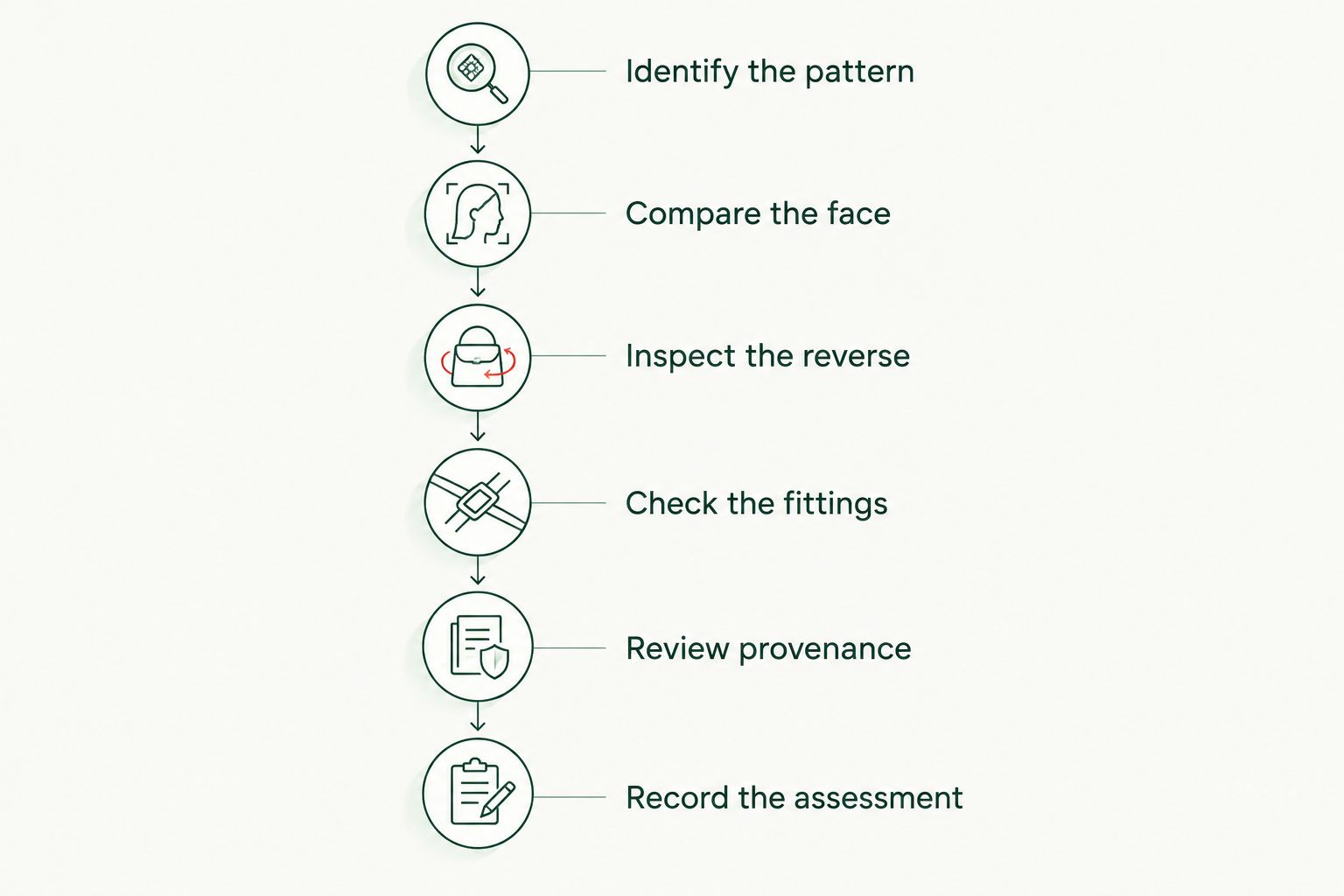
Follow this sequence for a 2026 purchase. Keep identification, physical inspection and provenance separate until the final assessment.
- Identify the pattern. Write down the regiment or corps and the precise period or variant claimed.
- Compare the face. Check the outline, lettering, relief and spaces between design elements against the matching reference.
- Inspect the reverse. Examine construction, attachment points, repairs and any marks.
- Check the fittings. Compare their type, position and attachment with the documented variant.
- Review provenance. Separate records connected to the object from stories that cannot be checked.
- Record the assessment. State what is supported, what has changed and what remains unresolved.
The sequence prevents a familiar mistake: deciding that a badge looks right, then interpreting every later detail in its favour. Inspect the reverse before committing to the story.
What can the face and edges tell you?
Compare the shape of letters, the depth of recesses and the separation between small details. Look for differences you can describe precisely, rather than deciding that a badge simply looks too crisp or too soft.
Rounded detail is not a verdict. Wear, polishing and manufacture affect appearance, while a reproduction can copy the worn surface of its source.
Edges deserve their own photographs. Inspect the perimeter and internal openings for finishing, damage and construction clues, then compare those features with the correct reference.
A feature matters because it matches or contradicts the claimed variant, not because it looks old. A neat edge does not prove modern manufacture, and a rough edge does not prove military issue.
Do not scrape an edge to expose the metal underneath. Destructive tests change the object and still do not establish its history.
What can the reverse and fittings tell you?
The reverse helps test whether the construction agrees with the front. Examine the backs of raised details, joins between components and the places where fittings attach.
British cap badges include different fastening arrangements, including sliders and lugs. Neither fastening type authenticates a badge by itself; the question is whether that arrangement belongs on the particular variant under examination.
Look for interrupted surface finish around an attachment, visible solder or evidence of a previous fitting. Record what you see without immediately labelling it fraudulent: an original badge can have a repair, and a repair needs disclosure rather than guesswork.
A maker’s mark is another comparison point. Check its wording, form, position and relationship to the badge’s construction against a documented example; the presence of a name alone proves nothing.
Keep 2 questions separate: is the badge itself original, and are its fittings original to it? An answer to the first does not automatically answer the second.
Why do genuine British Army cap badges vary?
Variation is the reason universal authenticity shortcuts fail. Assess these factors against the specific badge rather than using them as excuses for every mismatch.
- Pattern changes: lettering, devices and other design details must agree with the variant claimed.
- Material and construction: compare the manufacturing method and components, not just colour.
- Manufacturer: documented production differences need a matching reference, not a seller’s general assurance.
- Finish and use: polishing, wear and surface treatment affect how detail appears.
- Repairs and alterations: replacement fittings or changed finishes need to be recorded separately from authenticity.
- Storage and condition: tarnish and corrosion describe condition; they do not establish service history.
A discrepancy is a reason to investigate. Ask which documented variant explains it, and whether the rest of the badge agrees with that explanation.
If the answer depends entirely on an unrecorded exception, leave the attribution unresolved. Do not turn a possible explanation into a fact on your collection label.
Does patina prove a cap badge is original?
Patina does not prove a cap badge is original. Surface colour reflects the metal, its treatment and its surroundings; it is not a manufacturing date.
Look at wear and finish as supporting observations. Do they make sense alongside the construction and fittings? That comparison is useful, but it cannot establish that a particular soldier wore the badge.
An unused genuine badge can look clean. NOS, or new old stock, describes unused older stock; it is still a claim that needs evidence for the item being offered.
Do not polish a questionable badge to inspect it more closely. Keep it unchanged while you document it, and seek conservation advice before treating a historical piece.
Is a reproduction cap badge always a fake?
A declared reproduction is not the same as a badge falsely presented as original. The distinction is the claim made about it, not whether it looks convincing.
For reenactment, decide whether the design and fitting meet your group’s requirements. For a historical collection, record the reproduction clearly so it cannot later acquire an unsupported period identity.
Modern regulation descriptions also need careful reading. Military Mart lists the Parachute Regiment (PARA) Metal Cap Badge – Regulation Silver Finish, but that product description does not establish wartime manufacture or individual service history.
That distinction applies throughout militaria: the correct design, a regulation description and a documented period original are different claims. Buy for the requirement you actually have.
What should I ask a seller in 2026?
Ask questions that produce evidence, not reassurance. A useful reply identifies the object and explains the basis of the description.
- What exact period and variant are you attributing this badge to?
- Are the photographs of the actual item?
- Can you provide clear reverse, edge and fitting photographs?
- Are any fittings replaced, or is any repair or refinishing known?
- Which reference supports the attribution?
- What provenance accompanies this particular badge?
For provenance, ask how a document, photograph or named history connects to the object. A general account of where a collection came from does not identify every badge within it.
Keep 3 records together: the listing, the seller’s written attribution and your inspection notes. Save the photographs as well, so the basis of your decision remains available after the listing disappears.
When should you leave a badge unverified?
Leave the badge unverified when the photographs cannot show the relevant details, the claimed variant lacks a reliable comparison, or the construction contradicts the description without an evidenced explanation.
An uncertain badge does not need a dramatic verdict. Label it with the known design, observed condition and unresolved attribution instead of forcing an original-or-fake answer.
Military Mart’s army surplus and militaria range is best for collectors who want genuine ex-military kit with condition described plainly. That retail context does not replace item-specific authentication, particularly when you need a precise historical date.
For a 2026 buying decision, unresolved evidence is a reason to pause. Seek a specialist opinion with experience of the regiment or period, and provide the reverse photographs as well as the front.
FAQ
How can I tell whether a British Army cap badge is original?
Compare the exact variant’s design, construction, reverse and fittings with a documented original. Add item-specific provenance where available; appearance alone does not settle authenticity.
Does an old-looking cap badge have to be genuine?
An old-looking cap badge does not have to be genuine. Tarnish, wear and surface colour are condition clues, not proof of its manufacturing date.
Do original British Army cap badges always have maker’s marks?
A maker’s mark is not a universal requirement for an original British Army cap badge. Assess its presence or absence against documented examples of the specific variant.
Can an original cap badge have replacement lugs or a slider?
An original cap badge can have replacement fittings. Record the repair separately, because an original badge is not necessarily an untouched badge.
Is a modern regulation cap badge a reproduction?
A modern regulation cap badge is not automatically a reproduction of a historical original. Establish what the seller means by regulation and whether the claim concerns current use, manufacture or historical period.
Can I authenticate a cap badge from a front photograph?
A front photograph alone is insufficient for authentication. Request reverse, edge and fitting views, then compare the complete object with the claimed variant.
Should I clean a badge before asking a collector to identify it?
Do not clean a badge before documenting it and seeking identification. Supply clear photographs in its existing condition, without scraping, polishing or bending the fittings.
One last thing
A correct regimental identification is not an authenticity certificate. You can identify what a badge depicts while still being unable to establish when it was made.
Keep those conclusions separate on the collection label. In 2026, a useful record states the pattern, the evidence for its attribution and any repairs—not just the word genuine.


Leave a comment