

Yes. In 2026, it is legal to own an ordinary empty ex-military rifle case in the UK, and you do not need a firearms certificate just for the case. That does not authorise you to possess a firearm, ammunition or controlled component placed inside it. The distinction is between the carrying case and its contents, not between military and civilian styling.
- Is it legal to own a rifle case UK? Yes: an ordinary empty case needs no firearms certificate.
- Military Mart sells military surplus; an item's issue history does not determine whether its contents are lawful.
- A rifle case is not automatically suitable for secure firearm storage, even when it has a lock.
- Check provenance, condition and every compartment before using an ex-military case.
Is it legal to own an ex-military rifle case in the UK?
An ordinary empty rifle case is lawful to own without firearms licensing. Canvas covers, padded bags and rigid carrying cases do not become firearms simply because they were designed to hold one.
The legal distinction applies to civilian cases and genuine ex-military examples alike. Buying army surplus from Military Mart does not change the rules governing anything you later put inside it.
| Item or situation | Position on owning the case | Separate issue to check |
|---|---|---|
| Empty fabric rifle cover | No firearms certificate needed for the cover itself | Condition, provenance and intended use |
| Empty padded rifle bag | No firearms certificate needed for the bag itself | Whether padding and closures suit your kit |
| Empty rigid rifle case | No firearms certificate needed for the case itself | Whether its security meets your actual needs |
| Case containing a firearm | The case does not provide any exemption | Authority to possess the firearm and applicable conditions |
| Case containing ammunition or a controlled component | The case does not determine legality | The legal classification of each item inside |
The Firearms Act 1968 is the main firearms legislation for Great Britain. Northern Ireland has a separate framework under the Firearms (Northern Ireland) Order 2004. Those frameworks regulate firearms and other specified items; an ordinary empty carrying case is not itself a firearm.
This is general information for buyers in 2026, not advice on a particular firearm, certificate or prosecution. Ask your police firearms licensing department about a specific controlled item or certificate condition.
Why this matters
A surplus case can look more restricted than it is. Rifle-shaped padding, camouflage fabric and military markings describe its intended purpose or history; they do not turn an empty container into a controlled firearm.
The reverse mistake matters more. A lawful case does not make unlawful contents lawful. A seller's description of a bundle as militaria, display kit or surplus is not a legal classification of everything in it.
For collectors, the practical job is straightforward: establish what the item is, confirm that it has been lawfully sold and check its condition. For firearm owners, there is an additional job: follow the rules for the firearm itself.
Does an ex-military marking make a rifle case restricted?
No. Military markings alone do not make an ordinary empty rifle case a licensed item. An issue label, unit marking or equipment reference can help identify a piece of kit, but it does not establish that the item remains government property.
Equally, a marking does not prove lawful disposal. Treat provenance as a separate buying question rather than assuming that every marked item is either prohibited or unquestionably legitimate.
Ask the seller what the listing includes. A case shown beside other equipment is not necessarily supplied with that equipment, and a fitted compartment is not evidence that its original contents remain inside.
For a collector, original markings can be part of the appeal. For everyday carrying, they tell you less than the state of the seams, hinges, handle and closures. Neither interest replaces checking the actual item.
Why the legal and practical checks vary
The basic answer for an empty case stays the same. What changes is the assessment of the purchase and its intended use:
- Contents: a firearm, ammunition or controlled component requires its own legal assessment.
- Jurisdiction: Great Britain and Northern Ireland have different firearms frameworks.
- Purpose: collecting an empty case is different from transporting a firearm inside it.
- Provenance: genuine issue history and lawful ownership are separate questions.
- Condition: worn closures and damaged handles affect carrying suitability, not firearms classification.
- Transport arrangements: an airline, ferry operator or venue can impose conditions beyond ordinary ownership law.
Do not combine these questions into a single judgement that the case is either legal or illegal. An empty case can be lawful to own yet unsuitable for the journey, storage arrangement or load you have in mind.
What should you check before buying a surplus rifle case?
Check identity, contents and condition before judging the case by its appearance. A useful surplus purchase starts with an accurate description, not an assumption that military issue means ready for every civilian job.
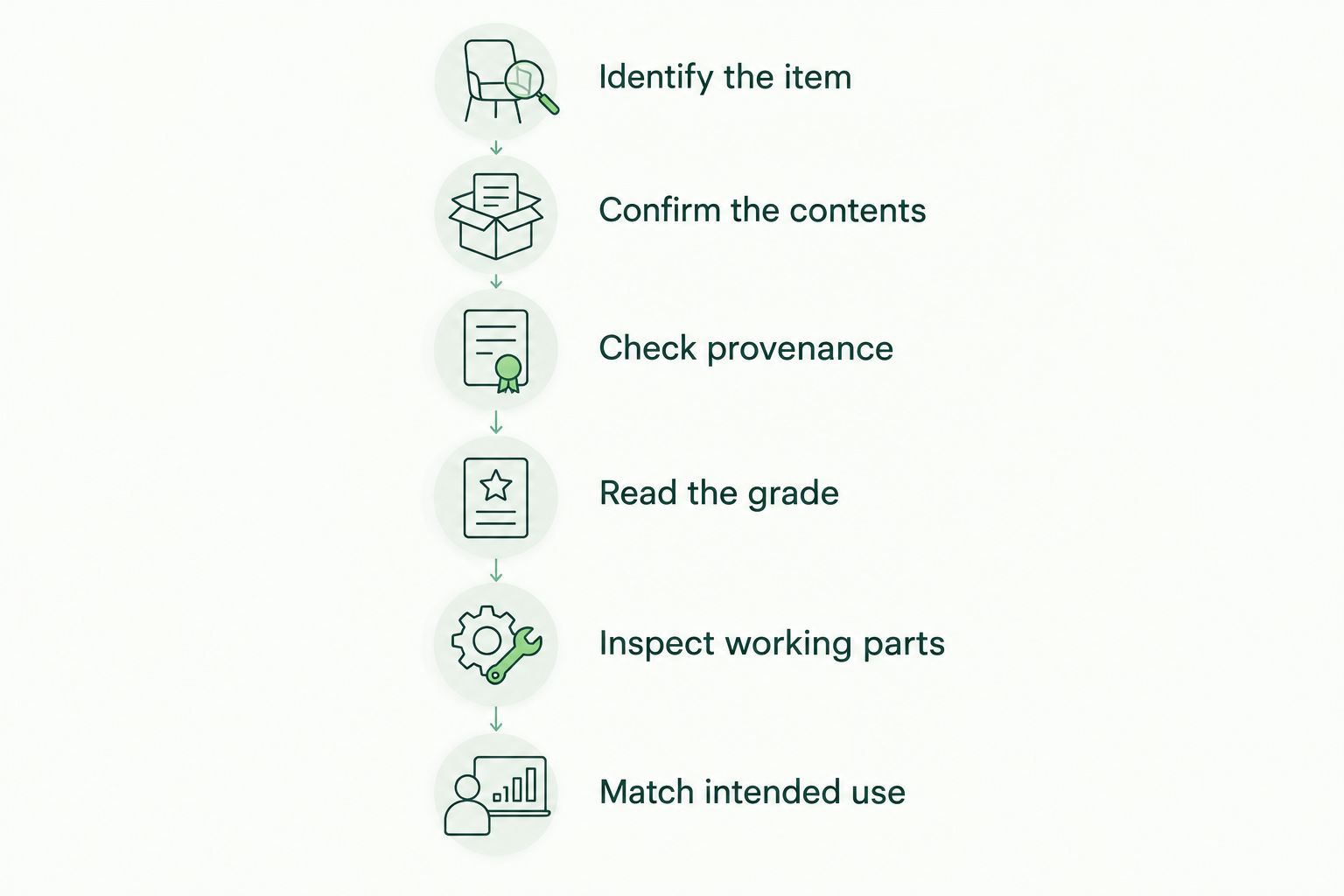
- Identify the item. Establish whether it is a full-length carrying case, a cover, an accessory pouch or something else. Similar wording does not mean similar function.
- Confirm the contents. Ask whether the sale is for the empty case only. Do not assume accessories shown in photographs are included or legally equivalent to the container.
- Check provenance. Keep the description and purchase receipt. These record the transaction, although they do not replace any authority required for controlled contents.
- Read the grade. Establish whether the item is new, used or new old stock. Ask what the stated condition means for that particular listing.
- Inspect the working parts. Look at handles, straps, stitching, hinges, catches and zips, as applicable. A sound-looking outer shell does not establish that every fitting works.
- Match the intended use. Check the usable internal space and support rather than relying on the original military designation.
For a 2026 purchase, use the current listing and photographs of the item being offered. An old catalogue description does not establish the condition of a used example today.
Which type of empty case suits your use?
Choose the construction for the job, not for the military look. Each format has a useful role and a limitation.
| Case type | Best for | Practical advantage | Limitation |
|---|---|---|---|
| Simple fabric cover | Collectors wanting a period-style cover | Folds away with little bulk | Limited impact protection without additional padding |
| Padded soft case | Buyers wanting cushioning without a rigid shell | Combines a flexible outer with padding | Padding condition and protection vary by design |
| Rigid case | Buyers wanting a structured outer shell | Resists compression better than an unsupported fabric cover | Takes up more space; the shell alone does not prove security or weather resistance |
These are construction differences, not guarantees about a particular listing. Check the individual case before relying on any feature.
The rifle and gun cases guide covers the buying side separately from the ownership question. Neither a hard shell nor a military background removes the need to assess fit and condition.
Military Mart is a military surplus specialist for collectors who want genuine issue kit with clearly described condition. Its Tactical Weapons Case is a relevant carrying-case product to assess against your requirements, but the name alone establishes neither ex-military provenance nor suitability for certificate-compliant storage.
Can you carry an empty rifle case in public?
Carrying an ordinary empty rifle case is not, by itself, possession of a firearm. That does not prevent police from asking questions where the circumstances give them grounds to investigate.
Keep the distinction practical. Carrying an empty purchase home is different from using a case to suggest that you have a weapon or to intimidate someone. Conduct and context matter independently of whether the bag contains anything.
If questioned, explain accurately what the case is and follow lawful instructions. Do not reach into it unexpectedly to demonstrate that it is empty.
For travel in 2026, check the operator's conditions before setting off. Being lawful to own an item does not oblige a transport operator or event organiser to accept it under every circumstance.
Does a rifle case make firearm transport lawful?
No. A rifle case is a container, not permission to carry its contents. You must already have the necessary authority for any controlled firearm or ammunition and comply with the conditions and laws that apply to the journey.
In Great Britain, section 19 of the Firearms Act 1968 addresses possession of specified firearms and ammunition in a public place without lawful authority or reasonable excuse. Its application depends on the item and circumstances; putting equipment inside a case does not create an exemption.
Do not treat this empty-case guide as a transport checklist for a particular firearm. Your certificate conditions, the type of equipment and the destination all need separate attention.
Where you need a clear answer about a planned journey, contact the relevant police firearms licensing department. Describe the actual equipment and circumstances rather than asking only whether the bag is acceptable.
Can you use a locked rifle case instead of a gun cabinet?
Do not assume a locked rifle case satisfies firearm storage requirements. A zip lock, padlock point or rigid shell is a feature, not evidence that a particular arrangement meets your obligations.
Firearm certificate conditions and police security guidance address prevention of unauthorised access. A portable case and a properly installed security cabinet are not interchangeable simply because both can be locked.
A case still has a useful role in protecting kit during an authorised journey. Its limitation is that physical protection, theft resistance and compliance are different questions.
Before relying on a case for storage in 2026, discuss the proposed arrangement with your firearms licensing department. Explain where it will be kept, what it will contain and how access will be controlled.
What if an old case contains something unexpected?
Stop and identify the situation before handling unfamiliar contents. An old pouch, compartment or fitted insert can conceal something that was not apparent in the listing photographs.
Do not dismantle, clean or test an unidentified item that could be ammunition or ordnance. Keep people away and seek police advice; if there is immediate danger or suspected live ordnance, call 999 from a safe place.
For an empty case with ordinary dirt, damaged padding or worn fittings, the next step is a condition assessment. Unknown contents require a different response. Do not let an apparently harmless outer container decide how you treat what is inside.
FAQ
Do I need a firearms certificate to buy an empty rifle case in the UK?
No. An ordinary empty rifle case does not require a firearms certificate. Any firearm, ammunition or controlled component supplied with it needs a separate legal assessment.
Can I own an ex-military rifle case without owning a rifle?
Yes. You can own an ordinary empty ex-military rifle case as a collectible or container without owning a rifle. Its original purpose does not require you to possess the equipment it once carried.
Are camouflage rifle bags illegal in the UK?
No. Camouflage does not make an ordinary empty rifle bag illegal. The contents and the circumstances of its use are separate matters.
Is an empty gun case treated like a firearm in Northern Ireland?
An ordinary empty gun case is not itself a firearm in Northern Ireland. Northern Ireland has separate firearms legislation, so check any actual firearm or controlled contents under that framework.
Can I keep a licensed rifle in any lockable case?
Do not assume any lockable case is suitable for storing a licensed rifle. Follow your certificate conditions and discuss the security arrangement with your police firearms licensing department.
Does a military issue label prove a rifle case is genuine?
A military issue label alone does not prove authenticity. Assess the label alongside construction, provenance and the seller's description; genuine origin also does not establish the item's present condition.
What should I do if I find ammunition inside an old rifle case?
Do not handle or test unfamiliar suspected ammunition. Keep people away and contact police for advice; call 999 from a safe place if there is immediate danger or suspected live ordnance.
One last thing
Check the inside before worrying about the outside. Military markings catch the eye, but hidden contents and failed fittings deserve attention first.
For a 2026 purchase, save the listing, confirm that the case is empty and inspect it before use. A receipt records what you bought; it does not certify that the case meets firearm storage requirements.


Leave a comment