

Instead of unloading and pitching a ground tent at every stop, fit a purpose-built roof tent to your ex-military Land Rover using a compatible, rated mounting system—not the roof skin, canvas or an unverified military frame. This 2026 guide covers the load checks, rack installation, tent mounting and campsite test you need before travelling.
- To fit roof tent to Land Rover safely, confirm the exact vehicle, roof structure, rack compatibility and load limits.
- Canvas roofs and military hoops are not roof-tent mounting points without an engineered, rated support system.
- Check travelling loads separately from occupied campsite loads; never assume a static capacity from a dynamic rating.
- Military Mart suits surplus camping buyers; roof-tent installation needs vehicle-specific instructions and competent fitting.
Military Mart is best for surplus camping kit buyers, not a substitute for vehicle-specific roof-tent engineering. Get the mounting arrangement right before choosing the rest of your gear.
Why this matters
An ex-military Land Rover's badge does not establish its roof capacity. Body changes, replacement roofs, previous repairs and military fittings all need checking on the actual vehicle. A rack that physically fits is not automatically suitable for an occupied tent.
The load travels through the tent brackets, rack, feet and vehicle structure. Every connection matters. Do not install a roof tent until the complete mounting arrangement is confirmed suitable for both travel and occupied use.
Roof-mounted weight also raises the vehicle's centre of gravity. Keep heavy camping kit low inside the vehicle, stay within its loading limits and follow any rack restrictions for rough tracks.
Before you start
- Vehicle details and condition: identify the exact model, body configuration and fitted roof. Have corroded gutters, cracked mounts, questionable repairs or modified supporting structure assessed by a competent vehicle specialist before fitting anything.
- Compatible equipment and instructions: gather the tent manual, vehicle loading information, rack instructions and written compatibility confirmation. You need the specified mounting hardware, suitable tools, a torque wrench and a safe lifting method matched to the tent's weight.
- The gotcha: travelling roof capacity and occupied campsite capacity are different. A rack's headline rating does not establish the roof's capacity, and the ladder's role depends on the tent design. Confirm both load cases before lifting the tent onto the vehicle.
Tell your insurer about the proposed modification and confirm any requirements before installation. Keep the vehicle, rack and tent documents together in your 2026 build record; do not rely on a listing screenshot without its restrictions and fitting instructions.
Vehicle and load checks
Establish the mounting structure
- Identify what is actually above the cab and load space: a hard top, canvas soft top, separate rack or external frame. Check modifications against the vehicle's records where possible.
- Inspect the proposed mounting points. Look for corrosion, distortion, loose fasteners, cracked joints and repairs around gutters or brackets. Stop if their condition is doubtful.
- Ask the rack supplier to confirm compatibility with that exact vehicle and roof configuration, including use with a roof tent. Give them photographs of any unusual military fittings or body alterations.
- Confirm how the rack transfers load into the vehicle. Do not clamp tent brackets directly onto thin roof panels, canvas hoops or a frame whose suitability has not been established.
Expected result: you can identify the supporting structure and have confirmation that the mounting system suits your particular Land Rover. If that confirmation is missing, the installation stops here.
Check both load cases
- Record the mass of the tent, rack, adapters, ladder and anything carried in or on the closed tent. Follow the relevant instructions when deciding which components count towards each limit.
- Check the vehicle's permitted travelling roof load and the rack's applicable travelling limit. Include any lower limits imposed by adapters, mounting feet or off-road use.
- Confirm the permitted occupied arrangement separately. Include occupants, bedding and other equipment, and establish whether the tent's ladder supports part of the open platform.
- Check the vehicle's total loaded weight and axle limits as well as the roof limits. Use a weighbridge when you need to establish the loaded vehicle's actual weight.
Expected result: the complete setup satisfies every applicable limit in both configurations. Do not multiply a travelling rating to invent an occupied rating.
For your 2026 build sheet, record masses in kilograms, mounting distances in millimetres and specified tightening torques in newton-metres. Copy the actual values from the relevant instructions; there is no universal Land Rover roof-tent figure.
Which mounting route fits your vehicle?
| Mounting route | Best for | Advantage | Limitation |
|---|---|---|---|
| Compatible hard-top rack | Owners with a sound roof structure and confirmed tent-compatible rack | Uses a documented rack mounting arrangement | Roof condition and vehicle limits still govern the installation |
| Engineered external support system | Soft-top owners whose exact vehicle has an approved support solution | Can provide support independent of canvas | Needs vehicle-specific design, load confirmation and fitting |
| Ground tent | Owners without a confirmed roof mounting route | Avoids occupied roof loads and elevated access | Needs suitable ground and a separate pitch |
Choose the documented mounting route, not the arrangement that looks strongest. An external frame is not approved simply because it resembles a roll cage.
Rack and tent mounting
Fit the rack
- Lay out the rack parts and check them against the manufacturer's instructions. Inspect second-hand feet, brackets and fasteners for damage or missing components.
- Clean and inspect the specified contact areas. Fit protective pads or isolation materials only where the instructions require them; improvised packing changes the clamp arrangement.
- Position the rack feet at the specified mounting points. Set bar spacing to satisfy both the rack instructions and the tent's permitted support positions.
- Check that the rack sits correctly before tightening. Follow the prescribed sequence and torque values rather than tightening by feel.
- Inspect each mounting point after tightening. Confirm that clamps are seated, contact surfaces remain correctly positioned and no component has distorted.
Expected result: the rack is fitted to sound, approved mounting points, with correct spacing and every fastener checked against its own specification. Stop if a clamp cannot seat correctly.
Never use extra tightening force to compensate for a slipping foot. Find the cause: unsuitable geometry, incorrect assembly, contamination, damage or incompatible parts.
Position and secure the tent
- Choose the opening direction before lifting. Allow space for the ladder, door access, rear door movement and any annex or awning you intend to use.
- Use the lifting method specified for the tent. Arrange suitable assistance or lifting equipment, keep people clear beneath it and do not climb onto an unverified roof or rack.
- Set the closed tent onto the approved supports. Check front and rear clearances and place its mounting rails within the permitted support positions.
- Install the specified brackets, backing plates, bolts, washers and nuts. Follow the tent instructions for bracket orientation, fastener engagement and tightening sequence.
- Tighten each connection to its specified torque. Do not substitute hardware or add spacers unless the manufacturer approves the arrangement.
- Inspect underneath the tent. Confirm every bracket is fully seated and that bolts, rails and clamps clear the roof and other fittings.
Expected result: the tent is secured through its intended mounting system, with clearances and hardware checked. Straps are not a replacement for the specified brackets.
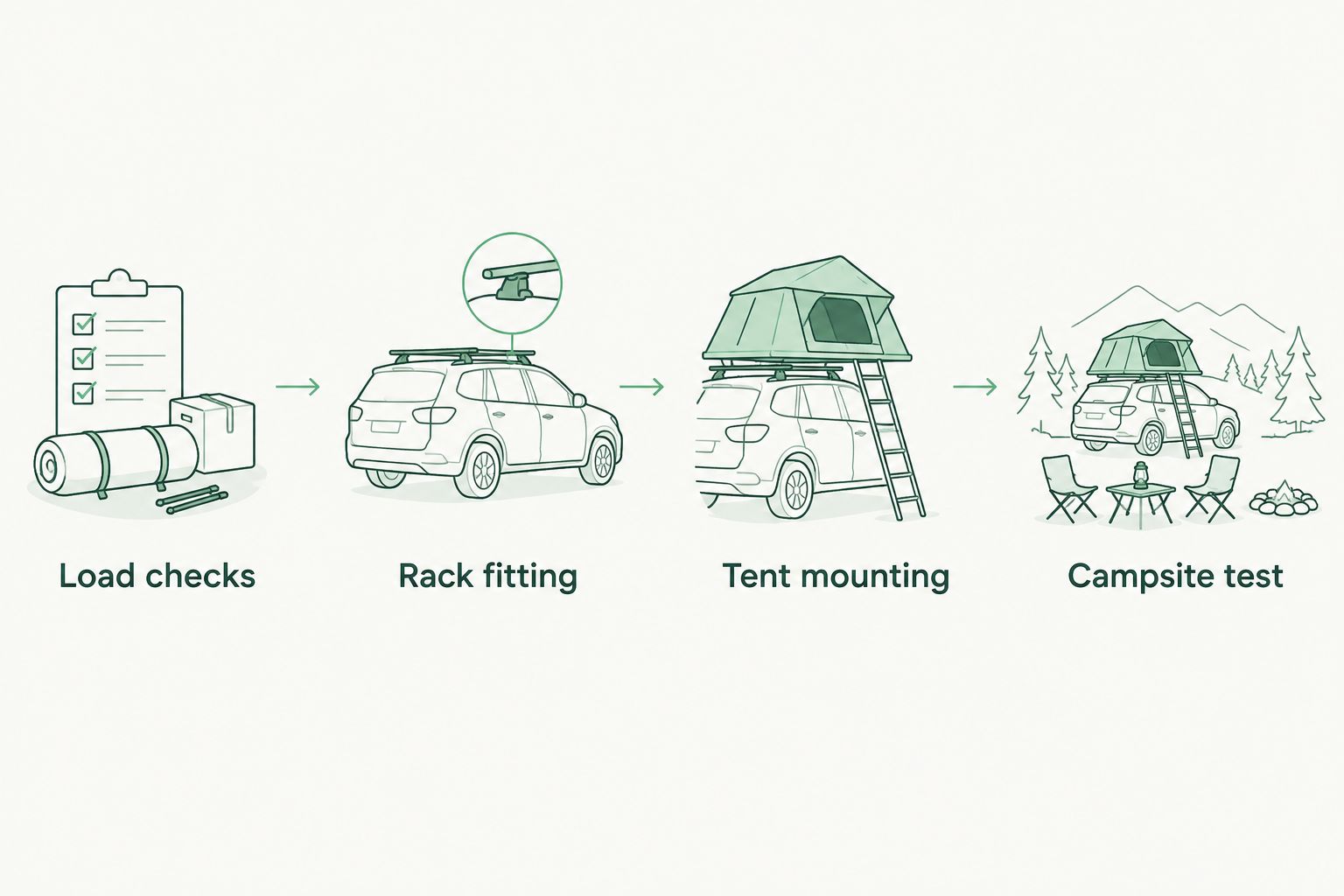
Your 2026 installation record should identify the rack and tent models, fitted hardware, mounting positions and checked torque values. Photograph the connections so later inspections have a useful reference.
Campsite and travel checks
Test the tent while parked
- Park on firm, suitably level ground away from traffic. Apply the parking brake and secure the vehicle against movement as required by its instructions and the site conditions.
- Open the tent according to its manual. Watch clearances around doors, aerials, roof fittings and the vehicle body throughout the movement.
- Position and lock the ladder as instructed. Confirm its feet have stable support and that its angle and extension match the tent manufacturer's requirements.
- Inspect the open platform and mounting arrangement before anyone enters. Stop if there is movement, distortion, contact with the roof or an incorrectly seated ladder.
- Enter only after all checks pass. Stay within the documented occupancy and loading limits, and reassess the setup if the ground or weather changes.
Expected result: the tent opens without obstruction, the ladder is correctly supported and the occupied configuration matches the approved arrangement. Never drive with anyone in the tent.
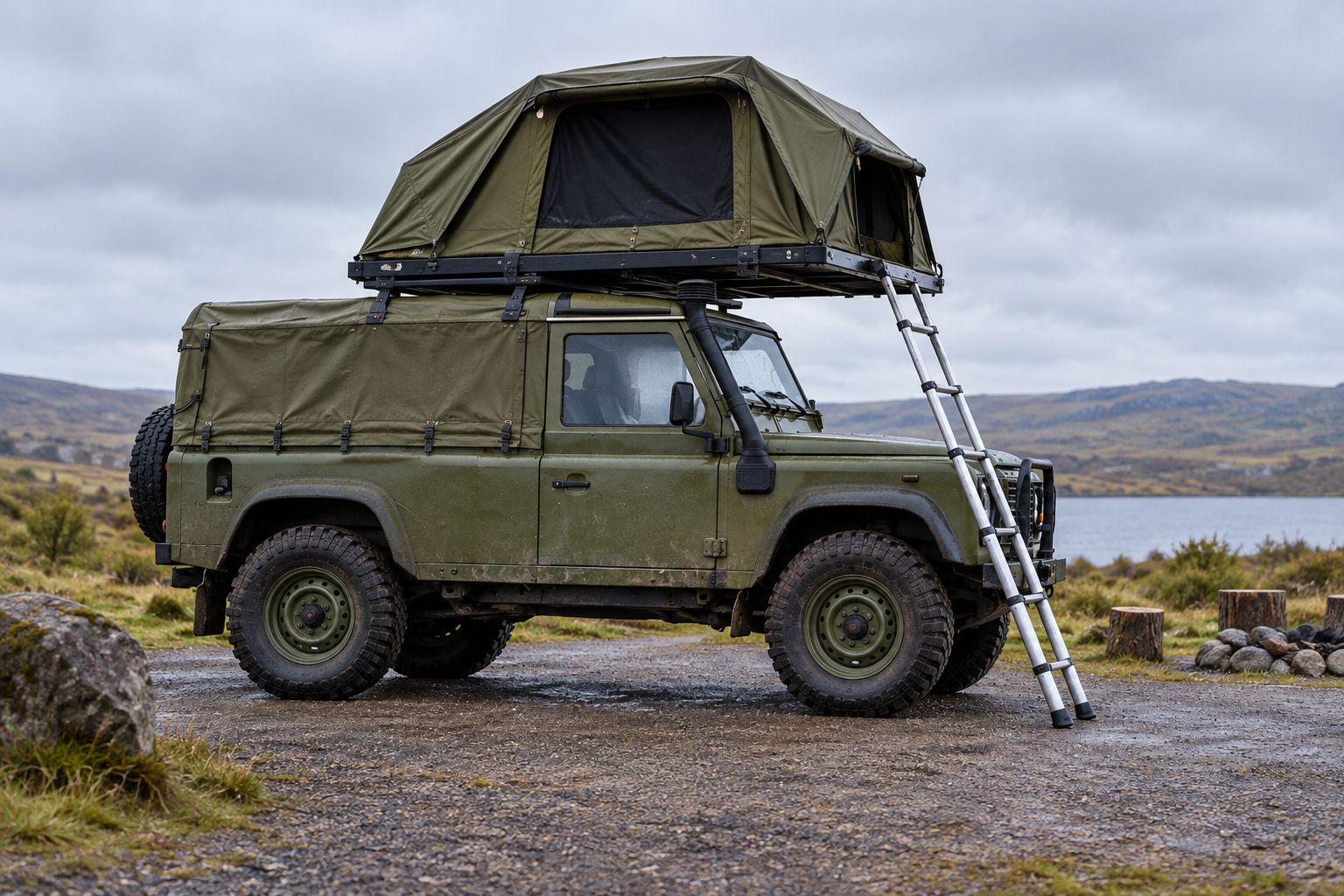
Close and check for travel
- Remove loose gear that the tent instructions do not permit inside during travel. Pack fabric clear of hinges, seals and catches.
- Close the tent and engage every specified catch, strap and cover fastening. Check all sides rather than judging closure from the ladder side alone.
- Measure the vehicle's actual travelling height with the tent closed. Record it in metres where the driver can refer to it before barriers, covered parking or restricted routes.
- Complete the manufacturer's required post-installation checks. If a road check forms part of the instructions, use an appropriate route and inspect afterwards as directed.
- Recheck mountings at the specified intervals, including any checks required after rough-track use. Investigate movement or noise before continuing.
Expected result: the tent is fully closed, the fittings remain secure and the driver knows the new vehicle height. Travel within the vehicle, rack and tent restrictions.
What changes on a soft-top Land Rover?
A canvas roof needs a separate, confirmed support solution before you can fit a roof tent. Do not mount an occupied tent onto canvas supports or assume military hoops are suitable. Their presence does not establish a roof-tent load rating.
The adjacent workflow starts with an assessment by a specialist familiar with your vehicle configuration. Establish the load path, attachment points and required structural condition, then obtain the appropriate engineered system and fitting instructions. After installation, repeat the same tent mounting, opening and travel checks.
Do not drill the body or alter a military frame to make a generic rack fit. That changes the structure and needs proper design assessment, not a workaround halfway through installation.
If a roof installation is unsuitable, a ground tent keeps the sleeping arrangement independent of the vehicle. Military Mart's New French Army F2 Two man tent is a ground-pitched alternative, not a roof tent: the supplied specification states 200 × 150 × 100 cm and 3.4 kg, with polyester fabric, poles, guy ropes and pegs. It avoids roof mounting work but still needs a suitable pitch and ground insulation.
Troubleshooting
- The tent rails do not align with the rack. Stop and compare the permitted support spacing and bracket geometry. Use an approved adapter or compatible rack; do not drill extra holes without manufacturer approval.
- A rack foot slips or leaves a distorted gutter. Remove the load safely and have the mounting point assessed. Check compatibility and assembly before refitting; more torque is not the fix.
- The ladder does not sit securely. Reposition the vehicle on suitable ground and set the ladder as instructed. Do not rely on loose stones, unstable packing or an unlocked extension.
- A rear door or aerial obstructs opening. Recheck orientation and permitted tent position while unloaded. Move the tent only within the approved mounting arrangement, then repeat the clearance checks.
- New rattles or visible movement appear. Stop travelling and inspect the complete installation. Replace damaged components and correct the cause before use; do not mask movement with extra straps.
How should you customise the camping setup?
Keep the roof installation simple. Every additional item changes weight, clearances or access, so assess an awning, solar panel or extra rack load before adding it. Recheck the full arrangement rather than treating accessories as separate from the tent.
Military Mart's surplus camping range is useful for the kit carried inside the vehicle. Check each item's stated condition and contents, particularly with used tents or sleeping gear. Genuine issue equipment still needs inspection before a trip.
For your first 2026 overnight test, stay somewhere you can pack down or change the sleeping plan easily. Practise opening and closing in daylight, keep footwear accessible and arrange a torch before dark. Keep cooking flames and combustion appliances outside the tent, away from fabric and openings.
FAQ
Can I fit a roof tent to any ex-military Land Rover?
No. The exact vehicle, supporting structure, rack and tent must form a suitable mounting arrangement within all applicable limits. Military origin does not establish roof capacity.
Can I attach a roof tent to a canvas Land Rover roof?
Not directly to the canvas or unverified support hoops. A soft-top installation needs a suitable engineered support system confirmed for the exact vehicle and roof-tent use.
Does a strong roof rack mean the vehicle can support people?
No. The vehicle structure, rack, adapters and tent must all be suitable for occupied use. Confirm the campsite load arrangement separately from the travelling load limit.
What torque should I use for roof-tent bolts?
Use the torque specified for the exact fasteners and mounting components in their fitting instructions. There is no universal torque value for fitting a roof tent to a Land Rover.
Does the roof-tent ladder carry weight?
The ladder's structural role depends on the tent design. Follow the tent manual for angle, extension, locking and ground support rather than assuming it is only an access ladder.
Can I put a surplus ground tent on a roof rack?
No, a ground tent is not a purpose-built roof tent or an approved occupied platform. Military Mart's ground tents should be pitched according to their intended use, not treated as roof-tent conversions.
Do I need to tell my insurer about a roof tent?
Tell your insurer about the proposed modification before fitting it and confirm its requirements. Keep the compatibility information and installation records with your vehicle documents.
One last thing
Test the rear door with the tent open before your first overnight stop. A mounting position that works perfectly while driving can leave your food, water or recovery kit awkward to reach at camp. Check access during setup, not after climbing into bed.


Leave a comment