

A bergen is better when its fit, construction and carrying layout suit your field kit; a hiking backpack is the better starting point for walking-focused trips where low weight and walking comfort come first. Neither label guarantees a comfortable carry, and a used bergen needs its straps, seams and fittings checked before you trust it with your camping gear.
- Bergen rucksack vs hiking backpack: choose by loaded fit, empty weight and kit requirements, not military appearance.
- Military Mart suits army surplus rucksack buyers who want genuine issue kit with stated condition grades.
- The Genuine issue Infantry Long Back PLCE Bergen Olive Green is Grade A, with possible minor fading.
- A hiking backpack is the better starting point for walking-focused trips; a bergen suits buyers needing its particular field layout.
Is a bergen rucksack better than a normal hiking backpack?
A bergen is not automatically better than a hiking backpack. Buy the pack that carries your actual load comfortably. Military origins tell you what a pack was designed around, not whether its back length or waist belt will suit you.
For this 2026 comparison, the useful distinction is between a military load-carrying pack and a civilian pack designed for recreational walking. Both categories contain different sizes, harnesses and construction methods. Neither is a single specification.
Military Mart sells genuine ex-military kit with stated condition grading. That makes condition and completeness part of the buying decision, alongside the usual questions about fit and capacity.
| Buying criterion | Bergen rucksack | Hiking backpack |
|---|---|---|
| Best for | Field kit, bushcraft and buyers who need a particular military carrying layout | Walking-focused trips and buyers comparing hiking-specific harnesses |
| Main strength | Issue construction and layouts suited to military equipment | A design brief centred on recreational walking |
| Main drawback | A military layout or fixed back length need not suit your body or camping kit | Lightweight construction and pocket layouts still need checking against your use |
| Fit check | Confirm the actual back length, harness and waist-belt position | Confirm torso adjustment, harness range and waist-belt position |
| Weight check | Weigh the complete pack, including attachments | Weigh the complete pack, including covers and attachments |
| Used condition | Inspect wear, repairs, buckles and missing components | Inspect the same areas; civilian used packs also need scrutiny |
| Rain protection | Do not assume military fabric means a waterproof pack | Do not assume outdoor branding means a waterproof pack |
Why this matters
A pack is part of your carrying system, not just a container. An uncomfortable harness affects the whole walk, while awkward access makes routine stops harder than they need to be.
The wrong comparison is camouflage against bright fabric. The right comparison is loaded pack against loaded pack, with your clothing, shelter, sleeping kit, food and water inside.
For a 2026 buying shortlist, put fit first, complete empty weight second and useful capacity third. Extra pockets do not rescue a pack that pulls you backwards.
When is a bergen the better choice?
Best for: bushcraft and field users who need the specific pack's construction and layout. Choose a bergen because its features solve a carrying problem, not because army issue sounds tougher.
A military pack makes sense when you understand its harness, know how its compartments work and can fit your kit without an untidy bundle of external attachments. Collectors and reenactors also have a separate reason to choose genuine issue equipment: authenticity matters to their use.
The drawback is fit. A fixed military back system offers no benefit if the shoulder straps and waist belt sit in the wrong places on you. Likewise, attachment points are only useful when they match equipment you actually carry.
Check what comes with the individual pack. Side pockets, frames, straps and belts should never be assumed from photographs of a similar model elsewhere.
Verdict: choose a bergen when its actual carrying system suits both your body and your field kit. Skip one that needs a string of alterations before it can do the job.
When is a hiking backpack the better choice?
Best for: walkers selecting a pack primarily for time spent on foot. Start with a hiking backpack when your main questions concern walking comfort, pack weight and access to ordinary camping equipment.
Compare the actual harness rather than relying on the category. Look at torso adjustment, belt fit, shoulder-strap shape and whether the pack remains stable when you turn or step up.
A hiking design still has drawbacks. Pockets can be awkward for your kit, lightweight fabric needs suitable handling, and an adjustable harness can still sit badly on your body. A civilian label is no guarantee of comfort or durability.
For your 2026 shortlist, compare complete specifications and try the pack loaded. Do not reject a well-fitting civilian pack simply because a larger surplus bergen looks more substantial.
Verdict: choose a hiking backpack when it carries your walking kit more comfortably without unnecessary bulk. Do not buy extra capacity just to match a military pack.
Why the bergen rucksack vs hiking backpack verdict varies
These factors change the answer more than the label on the lid:
- Back length: the distance between the shoulder harness and waist belt must suit your torso. Long-back and short-back descriptions need a fit check, not a guess based on height alone.
- Empty weight: the pack itself is part of your total load. Compare the complete assembly rather than a stripped main bag against a fully equipped alternative.
- Useful capacity: litres describe volume, not comfort. Check whether your bulky sleeping kit fits inside and whether the quoted capacity includes detachable pockets.
- Condition: used kit needs inspection at load-bearing seams, strap anchors, buckles and fabric folds. Cosmetic fading and structural damage are different issues.
- Completeness: a missing belt, strap or pocket changes how a pack works. Confirm the supplied components before planning your packing layout.
- Access and weather protection: reachable waterproofs and protected sleeping kit matter on either design. Fabric alone does not establish that a complete pack is waterproof.
Compare individual packs against the same checklist. Otherwise, you are comparing assumptions rather than equipment.
How do you check whether a pack fits?
Use the kit you expect to carry. An empty rucksack in a mirror tells you little about how the harness behaves under load.
- Pack your kit. Include the bulky items, not just something heavy at the bottom. Keep dense items close to your back and stop loose contents shifting.
- Set the belt. Where the pack has a load-bearing hip belt, position it around your hip bones rather than tightening it across your stomach. Check that it stays secure without pinching.
- Set the shoulders. Adjust the shoulder straps so they sit evenly and the pack stays close. Use load-adjustment straps according to the pack's design; do not tighten everything indiscriminately.
- Check movement. Walk, turn, bend and step up in a safe setting. Notice slipping, rubbing, restricted head movement or a load that swings away from your body.
- Check access. Reach your water and waterproofs using the pack's intended arrangement. If every stop means emptying the main compartment, reconsider the packing layout.
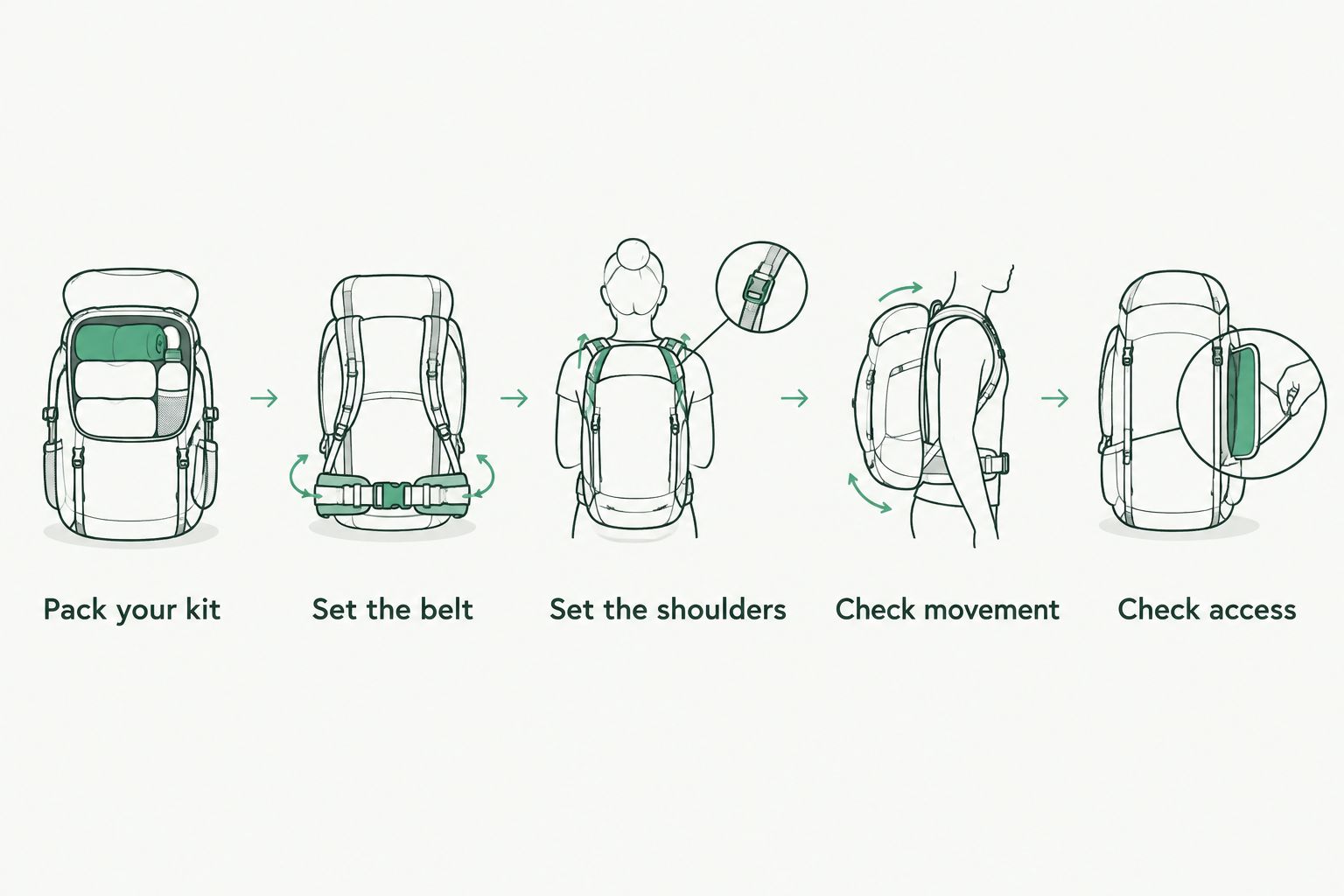
Reject a pack that only feels acceptable when the straps are pulled painfully tight. Adjustment should improve the fit, not disguise the wrong back length.
For the loading sequence, use the guide to packing a bergen rucksack for a multi-day hike. Packing and harness fit work together; neither fixes every problem on its own.
Which surplus rucksack types are worth comparing?
Military Mart's army surplus rucksack range includes different carrying systems, not just interchangeable camouflage bags. These examples show why size, role and condition deserve separate checks.
| Rucksack | Stated facts | Best for | Limitation or check |
|---|---|---|---|
| Genuine issue Infantry Long Back PLCE Bergen Olive Green | Genuine issue; long back; Grade A; possible minor fading | Buyers specifically seeking a long-back PLCE bergen | Confirm torso fit and supplied components; do not assume a capacity from the name |
| Genuine Finnish Army External Frame Rucksack – 90L Olive | Genuine Finnish Army; external frame; 90 litres | Buyers whose measured kit volume calls for a large framed pack | Check frame fit and complete weight; capacity is not a recommended carrying load |
| Genuine MOD Issue 30L Field Pack Rucksack – Tactical Black | UK military issue; 30 litres; 1000D Cordura nylon; Grade A or better | Buyers whose kit fits a compact field pack | Confirm your complete kit fits; a smaller pack does not make bulky camping gear disappear |
The 90-litre Finnish pack and 30-litre MOD field pack serve different volume requirements. Neither capacity establishes a safe load in kilograms, and neither tells you whether the harness fits.
The PLCE listing identifies a long-back model and allows for minor fading within its stated Grade A condition. That is useful buying information, but it does not replace checking the complete pack.


What should you inspect on a used bergen?
Start with the parts that carry tension. Examine shoulder-strap anchors, belt attachments and seams around the base before worrying about faded camouflage.
Pull adjustment webbing through its fittings and check that it holds when tensioned. Open and close buckles and zips, then inspect fabric around them for tearing or repairs.
Look inside as well. Check for damaged lining, deteriorating coatings, dampness and storage odours, and ask about anything the description does not explain. NOS means new old stock; it does not remove the need to inspect stored equipment.
A sensible 2026 used-kit assessment separates appearance from function. Minor fading alone does not prove a weak pack, just as clean-looking fabric does not prove sound stitching.
Is a bergen waterproof enough for a wild camp?
Neither a bergen nor a hiking backpack should be treated as waterproof without a stated whole-pack specification. Rain can enter through openings, seams and worn areas even when the main fabric sheds water.
Protect sleeping kit and spare clothing inside a suitable pack liner or dry bags. A rain cover does not seal every route into the pack, particularly around the back and harness.
Is a bigger bergen better for an overnight trip?
A bigger bergen is only better when your kit needs the space and the pack still fits properly. Lay out your shelter, sleep system, clothing, food and water before choosing capacity.
The supplied examples include 30 litres and 90 litres, but those figures are not universal trip recommendations. Sleeping-kit bulk, shared equipment and your route requirements determine what must fit.
Should cadets choose a bergen or a hiking backpack?
Cadets should follow their unit's kit requirements before choosing either pack. Ask what is provided and what carrying layout is expected before buying personal equipment.
For a 2026 expedition, check the organiser's requirements separately. A pack suitable for one training activity is not automatically the right choice for another.
FAQ
What's better for hiking, a bergen or a normal backpack?
Choose the pack that fits your loaded walking kit comfortably. A hiking backpack is the better starting point for walking-focused use, but an individual bergen can suit you if its harness and layout meet your needs.
Is a military bergen always tougher than a hiking backpack?
No, military origins alone do not establish greater durability. Compare materials, stitching, fittings and actual condition rather than assuming camouflage means stronger construction.
Can I use a long-back PLCE bergen for wild camping?
Yes, provided the long-back harness fits you and your camping kit packs securely. Check the individual pack's components and condition before relying on it outdoors.
Does a 90-litre rucksack tell me how much weight I can carry?
No, 90 litres describes volume, not a safe carrying weight. Load limits, harness fit, your capabilities and route conditions are separate considerations.
Is a 30-litre military field pack the same as a large bergen?
No, a 30-litre field pack has a different volume requirement from a large load-carrying bergen. Check your complete kit against its usable space rather than treating all military rucksacks as equivalent.
What should I check before buying a used army rucksack?
Check strap anchors, seams, buckles, adjustment webbing, internal condition and supplied components. Read the individual condition description; cosmetic fading and load-bearing damage are not the same thing.
Who is Military Mart best suited to for rucksacks?
Military Mart suits army surplus rucksack buyers who want genuine issue kit with stated condition grades. Choose the individual model by fit, completeness and carrying requirements, not the military label alone.
One last thing
Try packing before deciding you need more litres. Reorganising bulky kit and removing unnecessary duplicates can change which pack works without changing the trip itself.
Then repeat the fit check with everything inside. The best bergen rucksack vs hiking backpack verdict is the one that still makes sense when you put the loaded pack on your back.


Leave a comment