

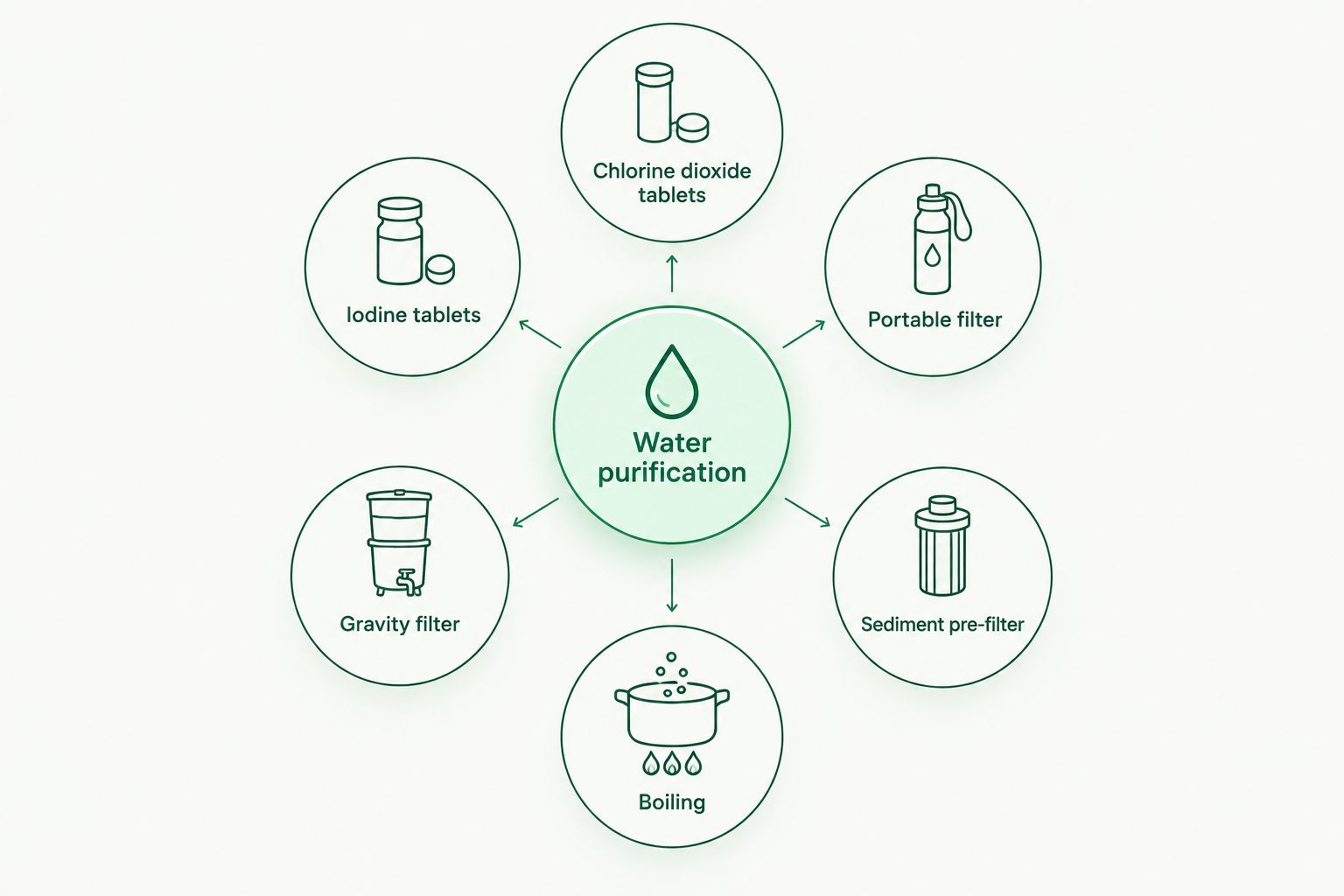
Chlorine dioxide tablets, iodine tablets, portable filters and gravity systems all turn dubious stream or tap water into something safe to drink, but each does it on a different timescale and with a different kit weight. This guide ranks the six main water purification tablets and filters worth carrying on a UK wild camp, bushcraft trip or cadet exercise in 2026, and tells you which one to pack for your specific trip.
- Chlorine dioxide water purification tablets win overall for wild camping: light kit, no pump, proven against giardia and cryptosporidium.
- Iodine tablets work faster but leave a metallic taste and aren't safe for thyroid conditions or pregnancy.
- The Lifesaver 4000uf portable filter suits group camps and repeat trips with zero chemical taste.
- A Millbank sediment bag pre-filters murky streams before you treat the water at all.
- Boiling for 1 minute, 3 minutes above 2,000 metres, stays the free backup when kit runs out.
Why this matters
MilitaryMart gets asked which water purification tablets and filters actually work for a UK wild camp, so here's the straight ranking rather than a shopping list. Untreated water from a British stream or river can carry Giardia and Cryptosporidium even when it looks clear, and both cause days of gut trouble that end a trip early. Cadets on a Duke of Edinburgh expedition, bushcraft students at a static camp, and anyone filling a bottle from a Highland burn in 2026 face the same risk. See how to use water purification tablets for camping and travel for the contact-time table before you buy.
The method you pick changes how long you wait before drinking, how much your kit weighs, and whether the water tastes of anything afterward. Get it wrong and you're either drinking risky water or carrying dead weight you didn't need.
The best water purification tablets and filters for camping in 2026
Best overall: chlorine dioxide water purification tablets. Best for taste-free treatment on a group trip: the Lifesaver 4000uf portable filter. Best free backup when kit runs out: boiling on a camp stove. Each pick below covers a different situation rather than fighting for the same slot — choose by what your trip actually needs, not by brand name.
What makes the best water purification tablets and filters
- Pathogen coverage — does it kill bacteria, viruses and protozoan cysts like Giardia and Cryptosporidium, or just bacteria?
- Contact time — how long you wait after dosing before the water is safe to drink
- Taste — chlorine dioxide is close to neutral; iodine leaves a metallic aftertaste
- Weight and pack size — a strip of tablets weighs grams; a pump filter weighs hundreds of grams
- Field usability — no pumping, no batteries, no moving parts to fail in the cold
- Group vs solo output — litres per hour matters on a group camp, less on a solo trip
At a glance
| Method | Best for | Standout feature | Key limitation |
|---|---|---|---|
| Chlorine dioxide tablets | General wild camping | Kills Giardia and Cryptosporidium with enough contact time | Needs up to 4 hours for full protozoan kill |
| Iodine tablets | Fast day-hike turnaround | Works on bacteria and viruses in around 30 minutes | Metallic taste; unsuitable for thyroid conditions or pregnancy |
| Lifesaver 4000uf portable filter | Group camps and repeat trips | Mechanical filter with no chemical taste | Heavier and bulkier than a tablet strip |
| Millbank type sediment filter bag | Murky rivers and streams | Strips visible sediment before treatment | Doesn't kill pathogens on its own |
| Gravity-fed filter systems | Static basecamps | Filters several litres unattended | Slow flow rate, needs somewhere to hang |
| Boiling | Budget and emergency backup | Zero purchase cost beyond a stove | Needs fuel, time and a heat source |
1. Chlorine dioxide tablets: best water purification tablets for general wild camping
Chlorine dioxide tablets dissolve into a bottle of water and go to work on bacteria, viruses and, given enough time, Giardia and Cryptosporidium cysts. Most strips need around 30 minutes for bacteria and viruses, extending to up to 4 hours for full protozoan kill in cold or cloudy water. They're the standard tablet carried on UK bushcraft courses and cadet expeditions because there's no pumping, no batteries and no moving parts.
Chlorine dioxide tablets pros:
- Near-neutral taste once fully dissolved
- Effective against the full range of waterborne pathogens given enough contact time
- Weighs almost nothing — a strip fits a shirt pocket
- Nothing mechanical to fail in freezing weather
Chlorine dioxide tablets cons:
- Full protozoan protection means waiting hours, not minutes
- Cold water slows the reaction further
- A strip has a shelf life once opened that you need to track
Best for: anyone doing a multi-day wild camp or DofE expedition who can plan ahead and treat water the night before. Verdict: Buy.
2. Iodine tablets: best for fast day-hike turnaround
Iodine tablets treat bacteria and viruses faster than chlorine dioxide, often within 30 minutes, which suits a lunch stop rather than an overnight camp. They've been a standard issue backup for decades and remain cheap to carry as a spare strip.
Iodine tablets pros:
- Faster contact time than chlorine dioxide for bacteria and viruses
- Long shelf life in the sealed strip
- Small enough for a first-aid pouch
Iodine tablets cons:
- Distinct metallic taste that neutraliser tablets only partly mask
- Not recommended for pregnant users or anyone with a thyroid condition
- Weaker against Cryptosporidium than chlorine dioxide at normal doses
Best for: short day hikes where speed matters more than taste, and as a spare in a first-aid kit. Verdict: Hold — keep a strip as backup, don't build a whole trip around it.
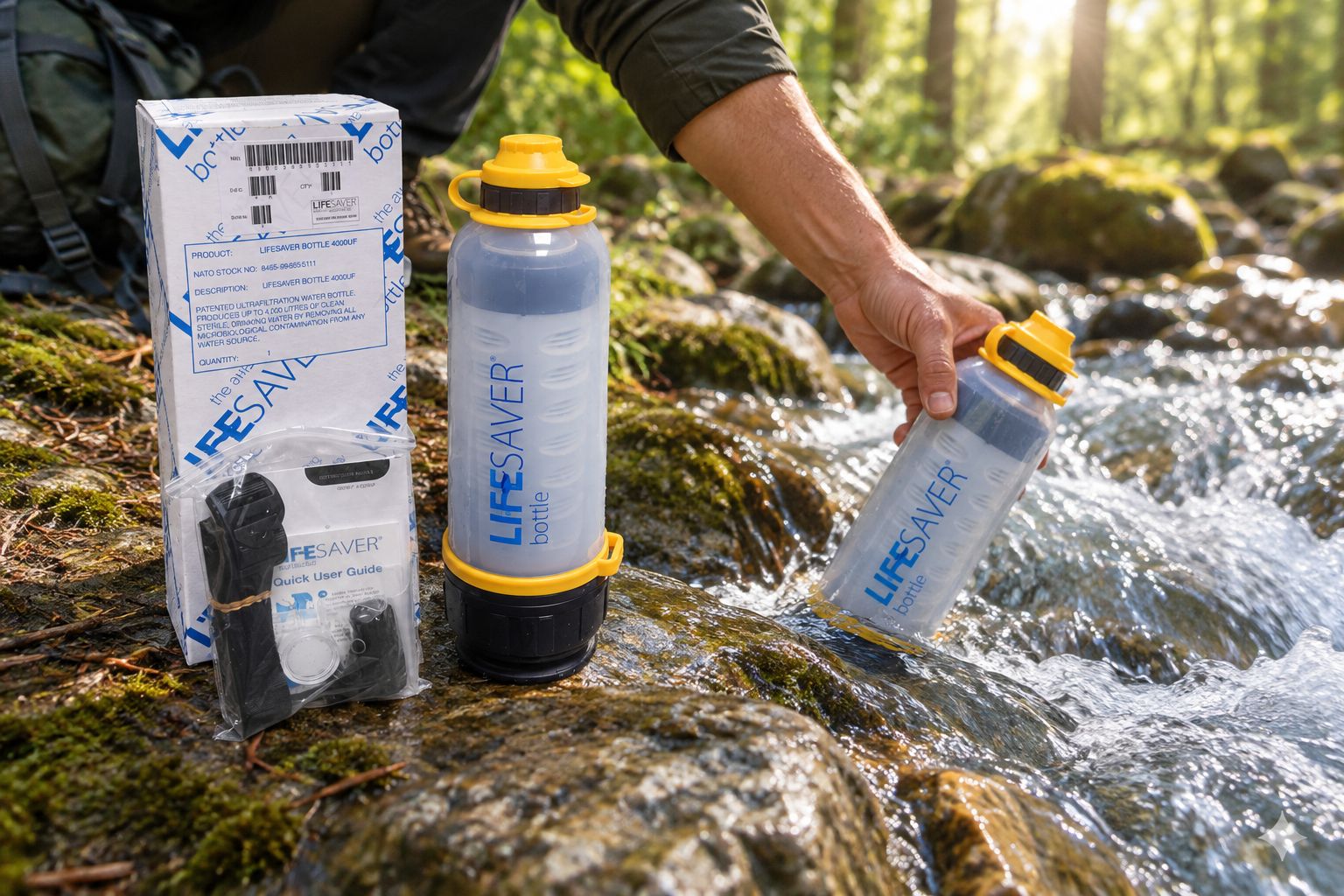
3. Lifesaver 4000uf portable water filter: best for group camps and repeat trips
The Lifesaver 4000uf is a mechanical filter, not a chemical treatment, so there's no waiting and no aftertaste. It's ex-MOD surplus stock at MilitaryMart, new and unused in the box, built to strip bacteria and particulates from a water source without adding anything to it. It suits a group camp where several people are refilling bottles through the day rather than dosing individual strips one at a time.
Lifesaver 4000uf pros:
- No chemical taste and no contact-time wait
- Reusable across a whole trip rather than one strip per fill
- Genuine ex-MOD surplus construction built for field use
Lifesaver 4000uf cons:
- Heavier and bulkier than a strip of tablets
- Needs a manual pumping or squeeze action rather than a passive dose
- Cartridge life eventually runs out and needs replacing
Best for: group camps, cadet detachments, and anyone who'd rather filter than dose chemicals. Verdict: Buy.
4. Millbank type sediment filter bag: best pre-filter for murky rivers and streams
A Millbank bag doesn't purify anything on its own — it's a canvas pre-filter that pulls visible sediment, silt and plant matter out of murky water before you treat it with tablets or a filter. Run river water through one before dosing it with chlorine dioxide and you'll use fewer tablets and get a clearer result. MilitaryMart stocks the new-made version of this water purification pre-filter alongside the surplus water bottles it's traditionally paired with.
Millbank bag pros:
- Extends tablet life by removing sediment that soaks up chemical dose
- Simple canvas construction with no moving parts to break
- Genuinely traditional bushcraft kit still in daily use
Millbank bag cons:
- Does nothing to kill bacteria, viruses or cysts on its own
- Slow to filter a full water bottle through canvas weave
- Needs somewhere to hang it over a container
Best for: treating water from peaty Highland streams or silty lowland rivers before dosing with tablets. Verdict: Buy — as a companion to tablets, not a replacement for them.
“A Millbank bag doesn't purify a drop of water, it just makes what's left easier to treat.”
5. Gravity-fed filter systems: best for static basecamps
Gravity filters use two reservoirs connected by a filter cartridge: fill the top bag, hang it, and let gravity push water through into a clean bottom bag over several minutes. They handle several litres in one go with no pumping, which suits a static camp feeding a group rather than a moving hiker. See military hydration systems for hiking and bushcraft for how these pair with a bladder or bottle setup.
Gravity filter pros:
- Filters multiple litres unattended while you set up camp
- No batteries and minimal physical effort
- Good throughput for a group compared with dosing tablets one bottle at a time
Gravity filter cons:
- Slow flow rate compared with a pump filter
- Bulky to carry, needs a branch or pole to hang from
- Awkward on an exposed or treeless site
Best for: a fixed base camp over several nights rather than a moving trail. Verdict: Hold — worth it for a static group camp, overkill for a solo overnighter.
6. Boiling: best budget and backup method
A rolling boil for one minute, three minutes above 2,000 metres, kills bacteria, viruses and parasites without needing a single tablet or filter. It costs nothing beyond the fuel you're already carrying for cooking, which makes it the obvious fallback when a filter clogs or a tablet strip runs out. A Swedish Army Trangia stove or any camp stove does the job.
Boiling pros:
- No purchase cost beyond fuel already carried for cooking
- Kills everything, including pathogens tablets and filters can miss
- No expiry date to track
Boiling cons:
- Needs fuel, time and a stable place to cook
- Impractical while actually walking rather than camped
- Boiled water still needs cooling before it's drinkable
Best for: the backup plan when your primary method fails, or when you're already cooking anyway. Verdict: Buy — as a backup, not a primary method for a moving trip.
How these were ranked
Every method above was judged against the criteria that actually change a camping trip: pathogen coverage against bacteria, viruses and protozoan cysts; how long you wait before drinking; whether it tastes of anything; how much it weighs in a rucksack; and whether it needs batteries or a pump to work. Chlorine dioxide tablets top the list because they cover the widest pathogen range at the lowest weight — the trade-off is patience. Nothing here was picked for brand name alone.
Kit worth pairing with your purification method
A purification method is only half the job — you still need something to carry, store and pre-filter the water in. MilitaryMart carries the filter, sediment bag and bladder that round out any water purification kit for 2026.


Which water purification tablets or filter should you choose?
Pick chlorine dioxide tablets if you're planning ahead on a multi-day wild camp or DofE trip in 2026 — dose the water the night before and it's ready by morning. Pick the Lifesaver 4000uf filter if you're running a group camp and don't want six people each carrying six strips of tablets. Keep iodine tablets and a Millbank bag as backups, and treat boiling as the fallback when everything else runs dry. For most solo and small-group wild camps in 2026, chlorine dioxide tablets remain the default: light, effective, and no kit to carry beyond the strip itself.
FAQ
What's the best water purification tablets for camping in 2026?
Chlorine dioxide tablets are the best water purification tablets for camping in 2026 because they cover bacteria, viruses and protozoan cysts like Giardia and Cryptosporidium in one strip. Iodine tablets work faster but cover a narrower range of pathogens and leave a metallic taste.
How long do water purification tablets take to work?
Most chlorine dioxide tablets need around 30 minutes for bacteria and viruses, extending to up to 4 hours for full protection against Cryptosporidium in cold water. Iodine tablets work faster, often within 30 minutes, but against a narrower range of pathogens.
Do water purification tablets kill cryptosporidium?
Chlorine dioxide tablets kill Cryptosporidium given enough contact time, up to 4 hours in cold or cloudy water. Iodine tablets are markedly weaker against this parasite at normal camping doses.
Is a portable water filter better than tablets?
A portable filter like the Lifesaver 4000uf removes pathogens mechanically with no waiting and no chemical taste, which suits a group camp. Tablets are lighter and cheaper for a solo or small-group trip.
Can I drink stream water in the UK without treating it?
No. UK streams and rivers can carry Giardia and Cryptosporidium even when the water looks clear, so treat it with tablets, a filter, or a rolling boil first. This applies to Highland burns and lowland rivers alike.
Do I need to pre-filter dirty water before using tablets?
Yes, for visibly murky or silty water a Millbank-type sediment bag removes particulates first, which stops the tablet dose being used up on debris. Clear water from a fast-moving stream usually doesn't need this step.
Is boiling water enough to make it safe to drink?
A rolling boil for one minute, or three minutes above 2,000 metres, kills bacteria, viruses and parasites without any tablets or filter. It's the standard backup when your primary purification method runs out or fails.
How much water purification kit should I carry for a weekend camp?
A strip of chlorine dioxide tablets covers a weekend for one person; a group of four or more is usually better served by a portable filter or gravity system plus a spare tablet strip as backup.
One last thing
Iodine tablets, the tablet most people default to because they've heard of them, are the weakest option here against Cryptosporidium — the parasite most likely to ruin a UK wild camp. If you only carry one thing in 2026, carry chlorine dioxide, not iodine, and keep a Millbank bag in the same pocket for the days the water runs cloudy.


Leave a comment